 SUNSET:

 2
2The Moon crosses the Pleiades this week, then heads east for the year’s most dramatic Spica occultation.
Rich in cyclic phenomena, astronomy has always been fertile ground for metaphors. Lunar occultations are a good example. When the Moon temporarily hides and then reveals a star, death and resurrection might come to mind. Or something less profound like a game of peekaboo. Both fit. It's one of my favorite facets of the hobby — how we imbue mundane celestial mechanics with meaning. While the raw facts and perceptible beauty of celestial objects more than suffices to inspire wonder and awe, the added human dimension maintains and nurtures our connection to nature essential for a happy life.

Bob King
Two bright occultations highlight the month. The first occurs on the night of November 15-16 when the full Moon will hide anywhere from a few to all of the brightest members of the Pleiades cluster for observers across the U.S. (including Hawaii and excepting Alaska), Central America, and the Caribbean. In the eastern half of the country successive occultations occur in the wee hours, while in the mountain states and West the show begins before midnight.
The Moon lies close enough to Earth to have a parallax of about 1° or two full-Moon diameters as viewed from opposite sides of the planet. This causes its path across the cluster to vary by location, making disappearance and reappearance times for cluster members unique to every city or region.

Bob King
Now for the bad news. With the Moon less than 12 hours past full, the Pleiades will be swamped in glare and invisible without optical aid. Its brightest member, Alcyone at magnitude 2.9, might show in 10x50 binoculars, but a telescope with a moderate magnification of 50-150x will be the best tool for picking out the stars as they disappear at the bright lunar limb and reappear at the (very narrow) dark limb.
For single, bright occultations, the International Occultation Timing Association (IOTA) will post a map with immersion and emersion times for a host of cities. This event involves lots of stars, so no maps or times are given. Fortunately, we can simulate any occultation with star-gazing apps and desktop planetarium software. I use Stellarium on the home computer and the Stellarium Mobile app (iOS and Android) on my phone along with SkySafari for iOS and Android. These are just a few of the many options out there.
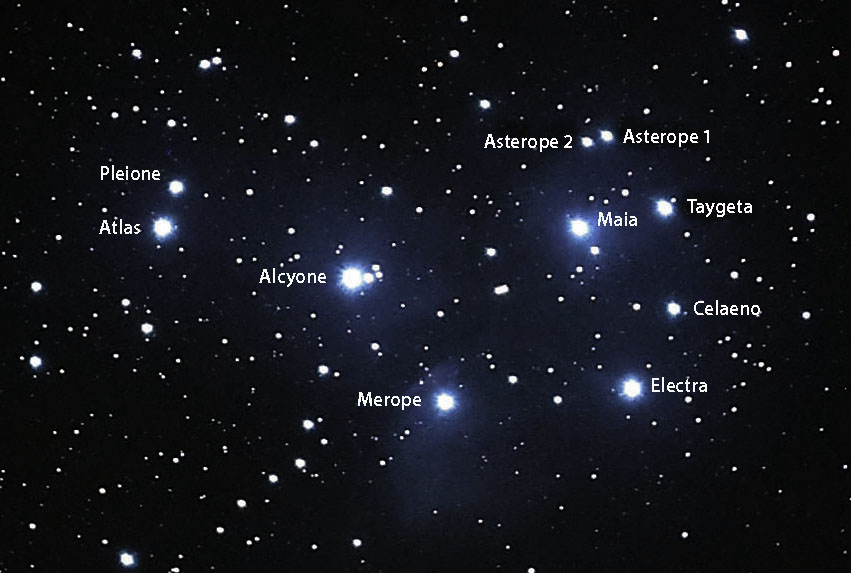
Whichever you choose, set the time for your location around midnight Nov. 15-16, then step forward or backward and watch which stars disappear and reappear along the lunar limb and when. Mark down the times or save them in your phone, then plan your observing session accordingly.
Given their location approximately 4.5° north of the ecliptic plane Pleiades occultations only occur around the time of a major lunar standstill, when the Moon's declination reaches its northern and southern extremes. The current 6-year-long Pleiades occultation season started in September 2023 and will end in July 2029. During each lunar cycle the Moon overtops the ecliptic by enough to cover at least a part of the cluster from somewhere on Earth.

Stellarium Mobile
Up for a dry run? Let's pick Kansas City, Missouri and see how the occultation plays out. Times are for Nov. 16 CST and approximate:
- 12:53 a.m. — Electra (magnitude 3.7) occulted
- 1:07 a.m. — Merope (4.2) occulted
- 1:25 a.m. — Electra reappears
- 1:50 a.m. — Alcyone (2.9) occulted
- 2:24 a.m. — Merope reappears
- 2:40 a.m. — Atlas (3.6) occulted
- 2:41 a.m. — Pleione (5.1) occulted
- 3:03 a.m. — Alcyone reappears
- 3:48 a.m. — Atlas reappears
- 3:53 a.m. — Pleione reappears
That makes five bright Pleiades stars removed and safely returned in the span of 3 hours.
Spica's dramatic reappearance

Occult 4
Circumstances are much more favorable for the Nov. 27th Spica occultation, when the Moon will be a 12.5%-illuminated crescent four days before new. Happily, IOTA has posted a coverage map with Universal times of Spica's disappearance and reappearance for many cities along the path. Remember to subtract 5 hours for EST, 6 for CST and so on.
Observers in the eastern half of the U.S. will see both immersion and emersion, although the Moon will hover only about 5° high in the east for Midwesterners at the time of Spica's disappearance. The good news is that the best part — its spectacular reappearance at the dark limb — will be more broadly visible, as far west as Arizona and New Mexico. At least this time around, the event will be over by the time the Moon rises for skywatchers living farther west in Nevada, California and Washington State. Frowny face.

Stellarium
Along much of the East Coast, Spica pops back into view during morning twilight up through sunrise. In Boston, for instance, the star reappears at 6:53 a.m. EST, three minutes after sunup. Observers there will need a small telescope to see it reemerge in a blue sky at the Moon's now-invisible western limb. From the Midwest, Spica will flash back into view in a dark sky at the softly-illuminated, earth-lit limb. The first magnitude star's return will be both dramatic and visible without optical aid. Views in binoculars and telescopes should be equally rewarding. Hmm — which instrument to pick? Never an easy choice because occultations — like life — are too brief.
About Bob King
I love the sky (day and night) and have been a skywatcher and amateur astronomer since childhood. I'm also a long-time member of the American Association of Variable Star Observers (AAVSO) and Astronomical League. I pen the Astro Bob blog and have written four books: Night Sky with the Naked Eye (2016); Wonders of the Night Sky You Must See Before You Die (2018) and Urban Legends from Space (2019) and Magnificent Aurora, published in 2024. The universe invites us on an adventure every single night. To accept the invitation, we only need look up.




Comments
John Schnupp
November 18, 2024 at 4:04 pm
I too really like Stellarium for creating simulated views. There is one thing that should be mentioned. To create accurate views, especially when determining timing of lunar events, the Moon scale needs to be set to 1. On the PC version of the program this is done in Sky & Viewing Options (F2), SSO (solar system objects) tab. For the Scale (right side of window) the Moon needs to be either unchecked or set to 1.00. The same is also true for the Sun, Planets and Minor Bodies settings.
You must be logged in to post a comment.
Bob KingPost Author
November 19, 2024 at 11:56 pm
Hi John,
I'm glad you mentioned this. Thank you. I notice that Stellarium defaults to "1.00" with the box unchecked so I thought we were "safe." But it's always possible someone might enlarge the Moon and forget about it. So it's always good to check.
You must be logged in to post a comment.
You must be logged in to post a comment.