 SUNSET:

 0
0In February, Sky & Telescope Contributing Editor Govert Schilling visited three new astronomical observatories in northern Chile. This chronicle of the Simons Observatory is the first of a three-part blog series.
Govert Schilling
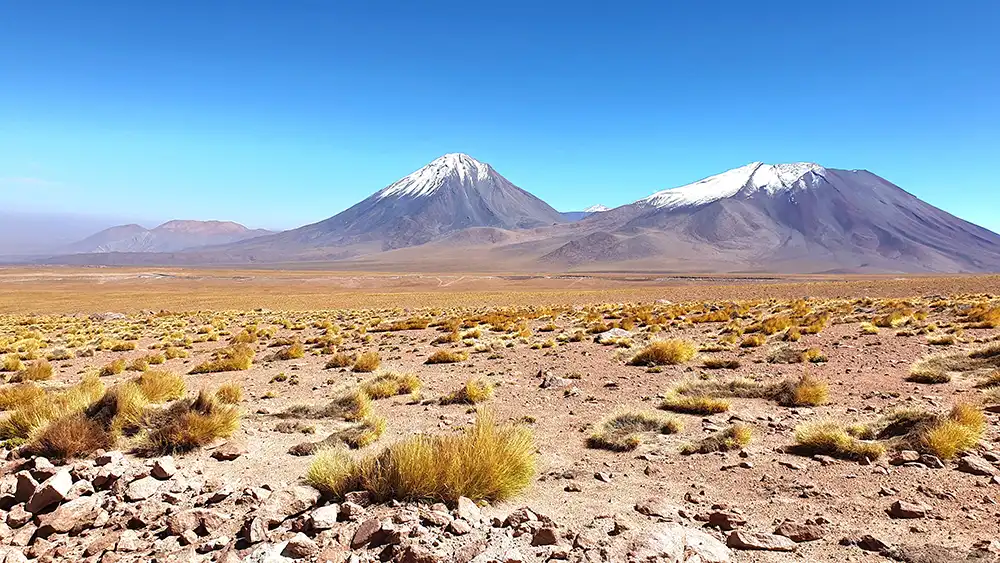
David Boettger takes a sharp right from Ruta 27 in northern Chile, up an unmarked gravel road. He stops his four-wheel-drive pick-up truck and hands me a small backpack with an oxygen bottle and a plastic tube that goes into my nose. We’re at an altitude of some 4,200 meters (14,000 feet) in the Andes mountain range, and we’ve got another 1,000-meter climb ahead of us. “From here, everyone is obliged to take extra oxygen,” Boettger says, before he continues along the rocky, winding road, with a grand view of nearby Volcán Licancabur.
Boettger is the soft-spoken scientific systems engineer of Simons Observatory — a new facility that will study the cosmic microwave background (CMB), the afterglow of the Big Bang. Since water vapor in Earth’s atmosphere absorbs microwaves from space, the observatory has been constructed at an extremely high and dry location, at an altitude of 5,200 meters on the Chajnantor plain, close to where the borders of Chile, Argentina, and Bolivia meet. Chajnantor is also home to the Atacama Large Millimeter/submillimeter Array (ALMA), which has its own broad access road from the south, but Simons Observatory staff members usually take the steep, bumpy track from the north. “We only use the ALMA road for heavy transports,” says Boettger.
From the passenger seat, I can see the 66 ALMA antennas in the distance, kilometers away. Even higher, at the 5,600-meter summit of Cerro Chajnantor, sits the huge building of the Tokyo Atacama Observatory (TAO), which houses an infrared telescope, and represents the highest permanent astronomical observatory in the world. This area is really the next best thing to being in space. The sky is deep blue, and the Sun is blindingly bright. It’s freezing cold, and the wind is so strong that I hardly manage to open the door of the truck when we arrive at the Simons Observatory site, at the foot of the Cerro Toco volcano. In a makeshift office — basically a converted freight container — Boettger provides me with a hard hat and a pair of Sun goggles before taking me on a tour.
The Simons Observatory, named after its main benefactor, the late hedge fund manager Jim Simons, consists of one large and three small telescopes. Each instrument is outfitted with tens of thousands of small, ultra-sensitive bolometers that precisely measure the microwave radiation from the Big Bang.
The small telescopes have 42-centimeter lenses with a very large field of view. Their goal: to discover the curl-like polarization patterns in the CMB that would shed light on the inflationary epoch, the hypothesized period of exponential expansion in the first split second after the birth of the universe.
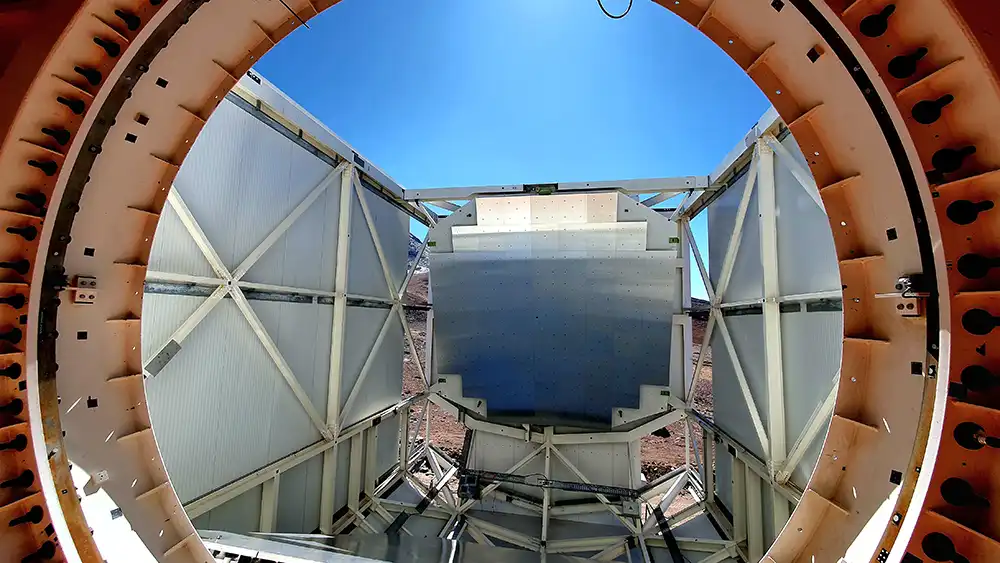
Each Small-Aperture Telescope (SAT) sits in the open air, encircled by a large metal “collar” that shields the instrument from microwaves reflected by the surrounding landscape. As I am walking around taking pictures, one telescope suddenly starts to move. “They are operated remotely from Princeton University,” explains Boettger.

Govert Schilling
“We plan to build more SATs in the future,” Boettger adds. “The more bolometers we have, the higher our signal-to-noise ratio will be.”
While the SATs are already operational, the Large-Aperture Telescope (LAT) is still in the final construction phase. A huge crane has just installed two giant 6-meter mirrors, each one consisting of dozens of rectangular aluminum panels; workmen are removing the large wooden crates in which the mirrors arrived from Germany. As I am climbing the four flights of metal stairs at the outside of the rectangular, multi-story building, I am happy I have my oxygen bottle — at this altitude, atmospheric pressure is just 60% of its sea-level value, and without extra oxygen, every physical activity is truly exhausting.
“For me, this is also the first time I see the mirrors in place,” says Boettger, as he shows me the large cylinder-shaped enclosure of the LAT’s cryogenically cooled camera, which is already installed. “It won’t be long before first light.” (In fact, the team obtained first light on February 22nd, just one day after my visit.)
Because of its much higher resolution, the large telescope will be able to measure the gravitational lensing effect that cosmic matter — both visible and dark — has on the CMB. These observations yield information on cosmic structure, and they are also necessary to correctly interpret the measurements of the three small telescopes.
Govert Schilling
Scientists from more than 30 universities and institutions around the world will participate in the Simons Observatory’s five-year survey, a collaboration founded by Brian Keating and Kam Arnold at the University of California, San Diego. According to cosmologist Jo Dunkley (Princeton University), it will probably take a few years before the first results are published. Meanwhile, competing teams, both at the Chajnantor plain and at the South Pole, also hope to find the tell-tale polarization patterns in the CMB.
Indeed, not far from where we are I can spot the POLARBEAR experiment, which an international collaboration led by the University of California, Berkeley, has operated here since 2012. As for the South Pole, scientists from the BICEP array in Antarctica already announced the discovery of the inflationary signal back in 2013, but they had to retract their claim later that year. “For certain types of observations, Antarctica is an even better location than Chajnantor,” says Boettger. “But in terms of logistics, it’s even more challenging, and from the South Pole you can only see half of the sky. Right now, ours is the most sensitive and promising CMB observatory.”
As we drive back — and down — to Ruta 27 and to the small oasis town of San Pedro de Atacama, I try to visualize how the low-energy CMB photons from the Big Bang are constantly raining down on the surreal landscape, as they have been doing for billions of years. I feel fortunate to live at a time when scientists are starting to study them in minute detail, hopefully elucidating the very beginning of the universe.
About Govert Schilling
Sky & Telescope Contributing Editor Govert Schilling lives in The Netherlands but loves to explore his home planet. In May 2022, Harvard University Press published The Elephant in the Universe: Our Hundred-Year Search for Dark Matter. His latest book is Target Earth - Meteorites, Asteroids, Comets, and Other Cosmic Intruders That Threaten Our Planet.



Comments
You must be logged in to post a comment.