 SUNSET:

 0
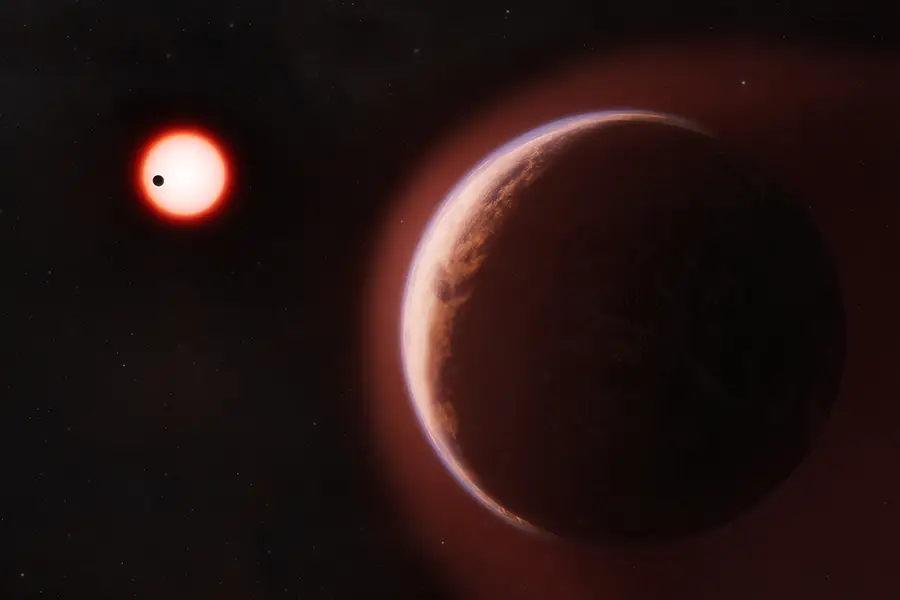
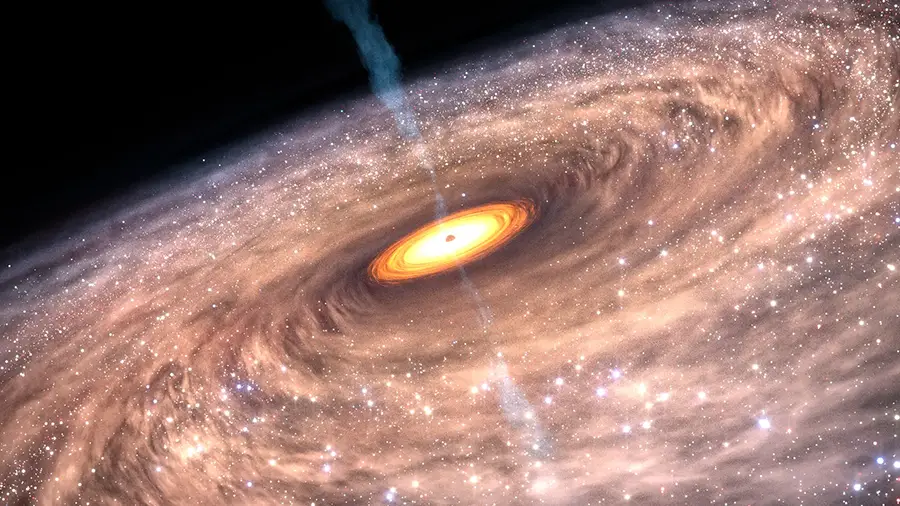
0Extra amounts of an uncommon element — neon-22 — could re-energize some white dwarfs, and potentially make the systems habitable.

Mark A. Garlick / markgarlick.com / CC BY 4.0
Most Sun-like stars undergo a gradual death, exhausting their nuclear fuel and shedding their outer layers before cooling to form dense cores known as white dwarfs. The surrounding conditions are far from hospitable, with steadily dropping temperatures that likely offer nearby planets too little stability for life to survive.
But a small percentage of white dwarfs seems to get a last gasp of energy — one that might enable habitability on the worlds around them, according to new research published to astronomy preprint arXiv and presented at the 245th meeting of the American Astronomical Society.
The extra energy appears in so-called Q-branch stars, which astronomers discovered in 2018 using the European Space Agency’s Gaia telescope. These white dwarfs are slightly more massive than our Sun and, remarkably, appear to have paused their cooling for at least 8 billion years. Without any fuel left to burn, they must have an alternative heat source.
Astronomers have proposed that the heat comes from neon-22, a heavy element produced in the stellar core. At high enough temperatures, buoyant crystals form in a white dwarf’s interior that rise toward the surface; meanwhile, heavier neon-22 atoms, if present, are forced out of the crystals and sink toward the core. The process reshuffles the core and releases gravitational energy as heat. The process only occurs in about 6% of higher-mass white dwarfs and requires at least 2.5% of neon-22 by mass.
Understanding the delay that Q-branch white dwarfs appear to be experiencing was “kind of the triumph of the last few years in the white dwarf community,” says team lead Andrew Vanderburg (MIT).
The discovery has important implications. Vanderburg had been interested in the habitability of planets around white dwarfs, which looked bleak because the so-called habitable zone shrinks as the stellar remnant cools. “When I saw that there was this pause [in cooling], I thought ‘Oh, problem solved.’”
So, Vanderburg and his colleagues modeled the habitable zone — the area where planets can hypothetically host liquid water on their surfaces — around white dwarfs with and without neon-22 reshuffling. They found that neon-rich white dwarfs foster a habitable zone for two to three times longer than regular white dwarfs. Some planets may remain habitable for 10 billion years — longer than it took life to evolve on Earth.
Interestingly, the habitable zone didn’t just last longer, it was also farther away from the star, out to 3% of the Earth’s distance from the Sun, or even more for more massive white dwarfs. Farther-out habitable zones put planets farther away from the white dwarf’s intense gravitational pull, which can heat a planet from the inside, boiling off surface water, or even tear it apart altogether.
Understanding the origin of these neon-rich white dwarfs can help astronomers search for more of them as well as any habitable worlds they support. Some may have been born in areas already enriched with heavy elements from billions of years of cosmic evolution. If not, the researchers propose that explosive mergers of two stars into a single white dwarf could induce nuclear burning that produces heavy elements like neon. While such mergers would surely blast away any existing planets, new ones could form from the remnants.
“I think that’s possible, probably just very hard,” says Jay Farihi (University College London) who studies white dwarfs but wasn’t involved with the current study. But “if it inspires astronomers to go out and now look for that . . . that’s the real payoff.”
Vanderburg agrees that the work is largely a thought experiment with the potential to narrow our search for habitable worlds. “The dream is that we find one of these Earth-like planets around a white dwarf,” he says. And if it’s heated by neon-22, “we’ll be ready.”
About Hannah Richter
Hannah Richter is a freelance Earth, space, and science policy journalist based in Washington, D.C. In addition to Sky&Telescope, her work has appeared in Science, Nature, Scientific American, Popular Mechanics, Smithsonian, WIRED, Science News, Ars Technica, and Sierra, among others. She has also written an e-book for NASA's Fermi Gamma-ray Space Telescope and is an alumna of MIT's Graduate Program in Science Writing.



Comments
You must be logged in to post a comment.