 SUNSET:

 0
0A promising comet could reach naked-eye brightness next month. Here’s how to track it.
Dan Bartlett
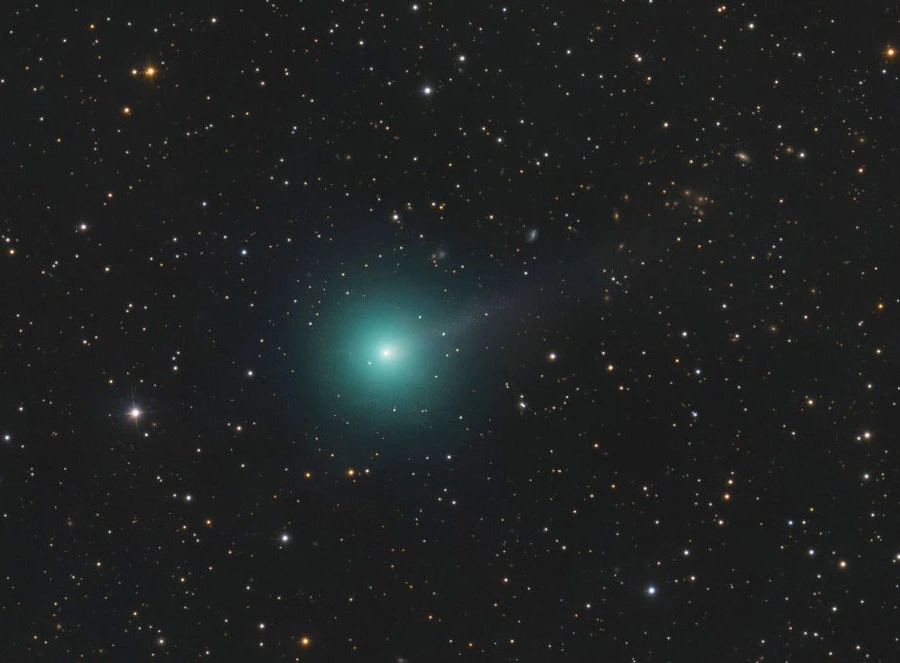
Observable comets have been scarce this year. Happily, that picture is changing as summer gives way to fall. Some of you have been tracking 11.5-magnitude Comet ATLAS (C/2025 K1) the past couple of months. As September opens, it's still visible for a short spell at twilight's end very low in the western sky in Virgo. After its October 8th perihelion, when the comet cruises a toasty 31 million miles (0.33 a.u.) from the Sun, it will return to the morning sky reborn as a 7th-magnitude object within easy reach of binoculars. Or so we hope. I'll post more on its progress later this month.
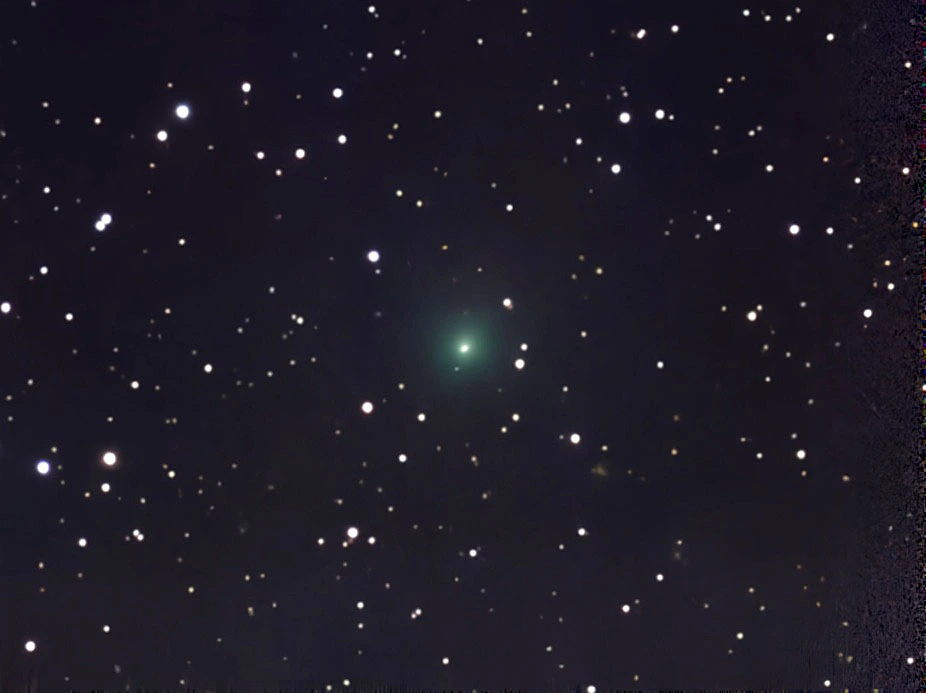
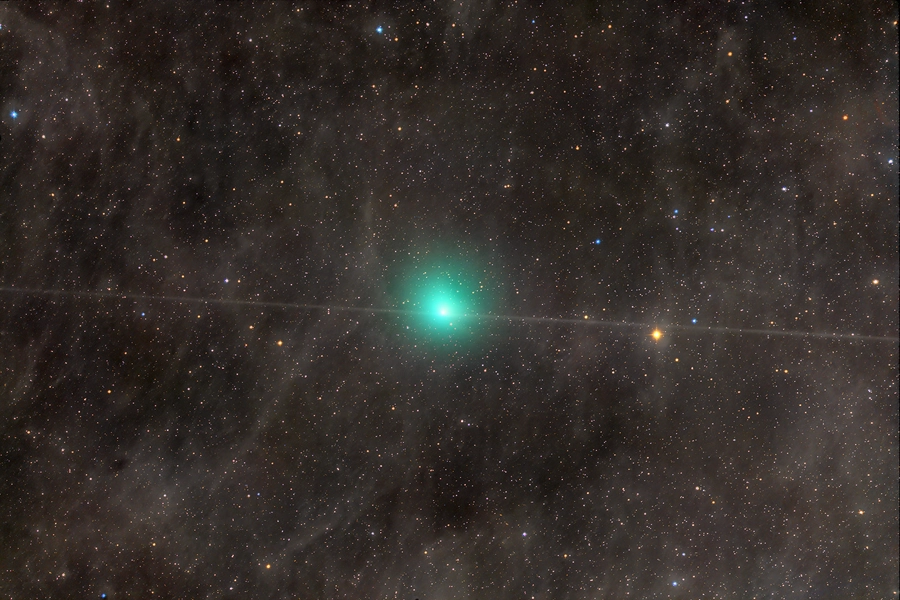
In the meantime, let me lure you outside before dawn to meet Comet Lemmon (C/2025 A6). It's been brightening rapidly since early August and now glows at around magnitude 10.5. When discovered during the Mount Lemmon Survey (part of the Catalina Sky Survey near Tucson, Arizona) this past January, it was initially thought to be a faint asteroid. Later, precovery images revealed a tiny coma, tagging it as a comet. In early August, after Lemmon emerged from the solar glow at dawn, it was a dim, 14th-magnitude mote. But it quickly brightened to 11 by month's end.
Bob King
I observed C/2025 A6 with my 15-inch Dobsonian on August 26th in northern Gemini shortly before the start of morning twilight. At magnitude 10.8, it wasn't exactly an eye-grabber, but I had no trouble seeing the comet's diffuse, lightly condensed coma at 64×. With averted vision, I estimated its diameter to be 4′. Photos revealed a vivid green hue due to diatomic carbon (C2) emission, indicating a gas-rich object. I then applied a Swan band filter, which isolated the two brightest C2 emission lines at 511 and 514 nanometers, and observed a modest increase in contrast against the background sky. The filter also helped better define the coma's apparent size.
An early forecast put the comet's peak brightness at around magnitude 10 in late October. But more recent estimates, based on observations in August, are much more optimistic, with the object possibly becoming as bright as magnitude 4.5 in the same time frame. That would make Comet Lemmon a naked-eye object when viewed from a dark, moonless sky and a snap to spot in binoculars.
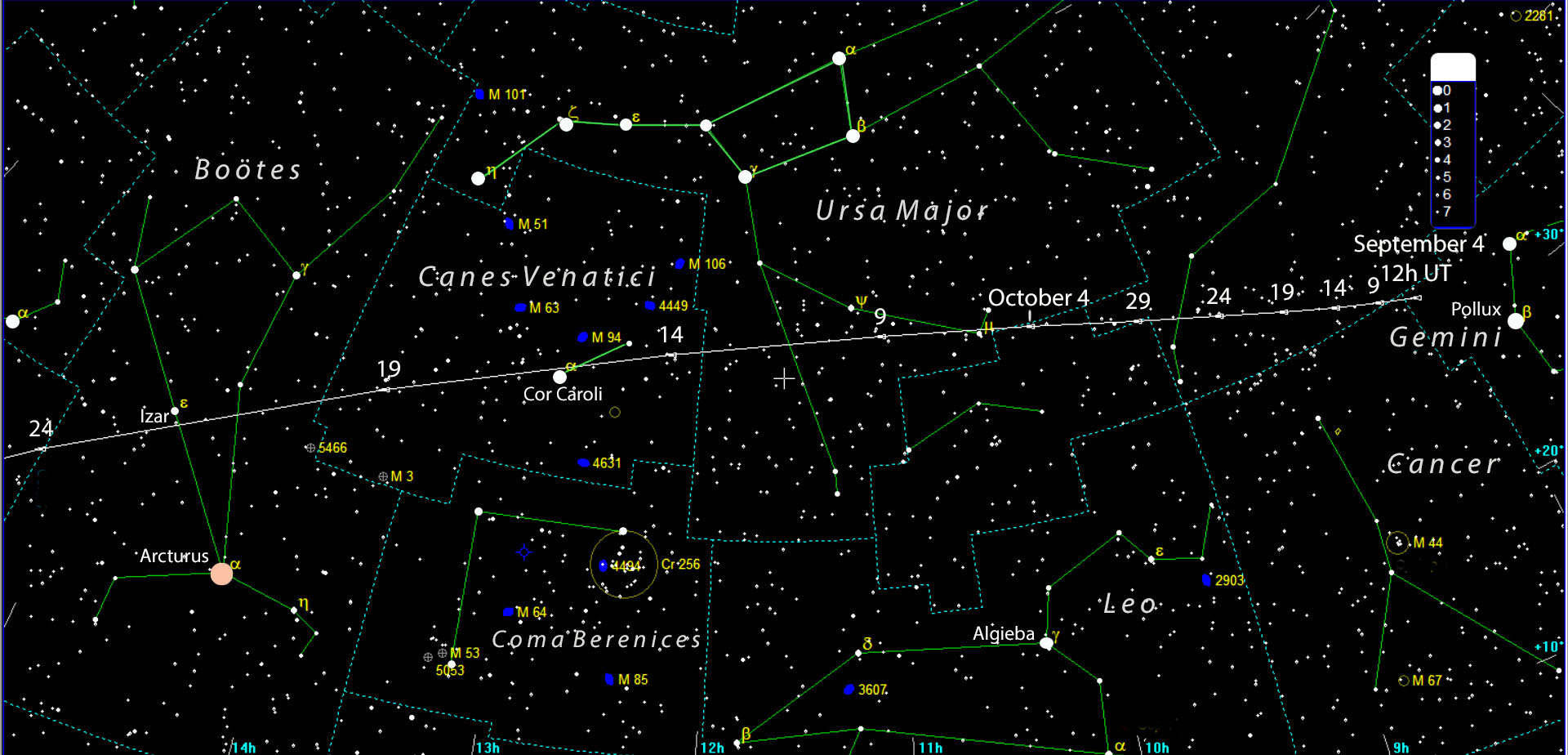
MegaStar, courtesy of Emil Bonanno, with annotations by Bob King
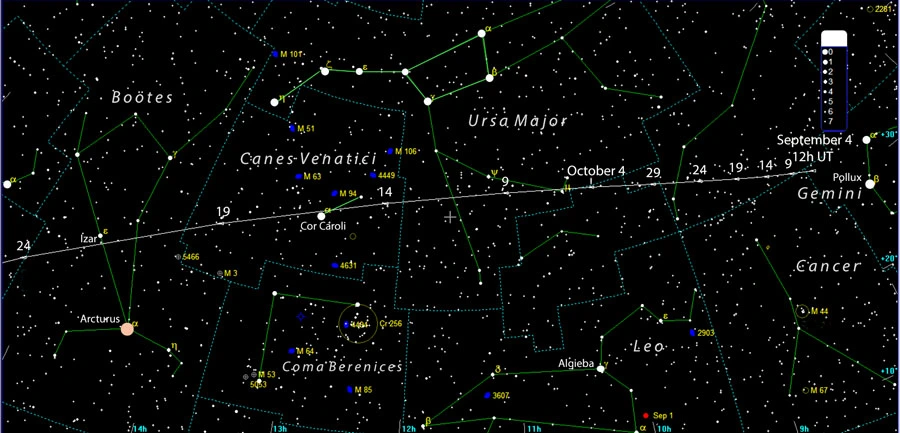
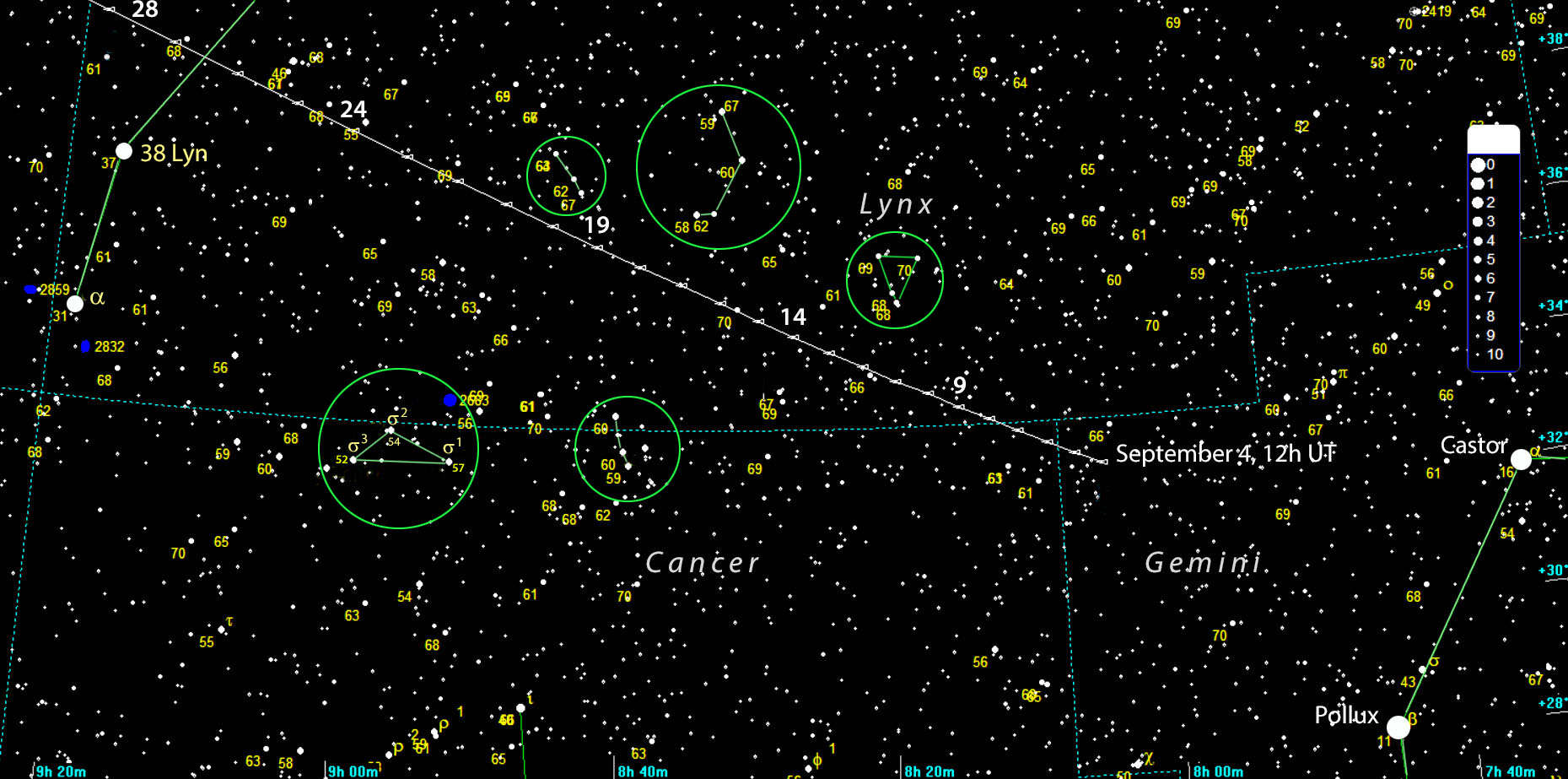
At the moment, it's in northern Gemini and slowly moving northwest. It clips Cancer on September 6–7 and then crosses into Lynx. After a brief stint in Leo Minor in early October, the fuzzy speedster tickles the toes of Ursa Major and briefly becomes a circumpolar object for observers in central Canada and northern Europe. Speeding ever faster as it approaches the Sun, Comet Lemmon passes less than a degree from the double star Cor Caroli in Canes Venatici on October 16. At that time, it could be as bright as 5th magnitude and tearing southeast at 4° per night! By good fortune, the Moon will be a waning crescent and not spoil our view at this time. To follow its progress, visit the Comet Observation Database (COBS).
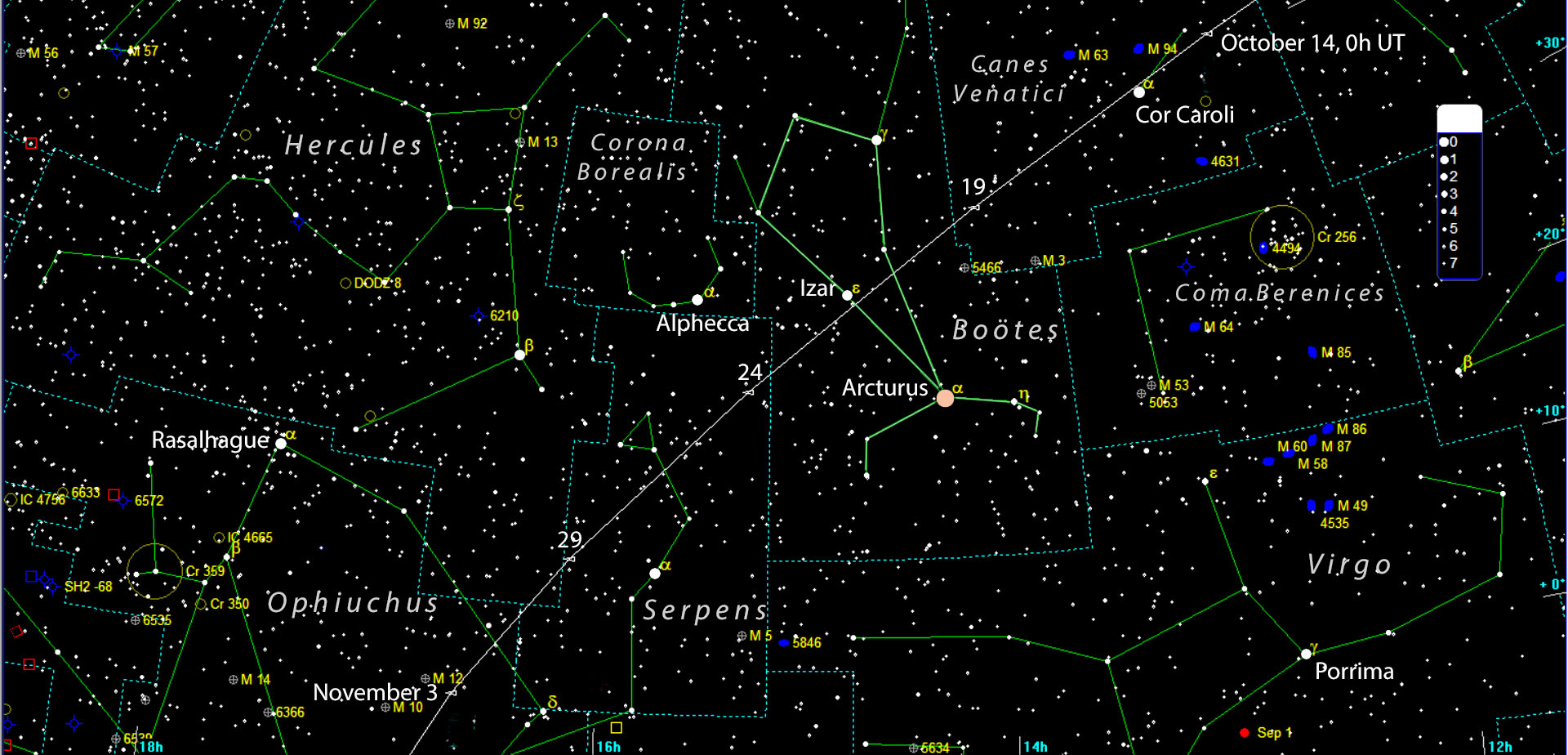
MegaStar, courtesy of Emil Bonanno, with annotations by Bob King
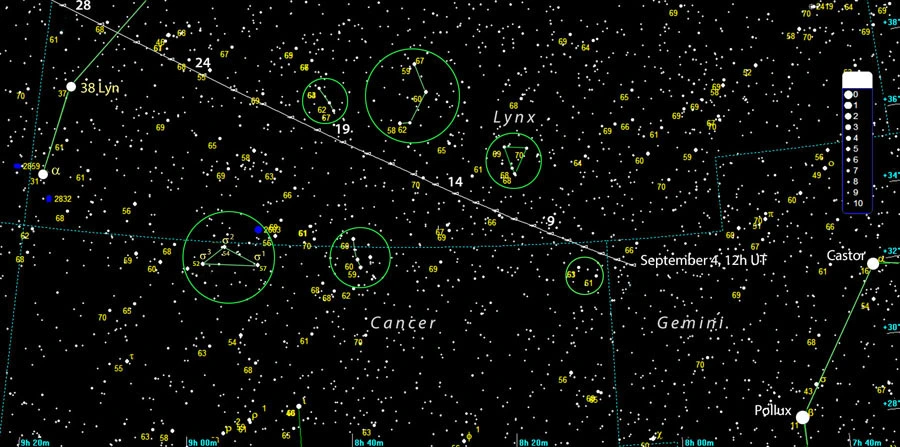
MegaStar, courtesy of Emil Bonanno, with annotations by Bob King
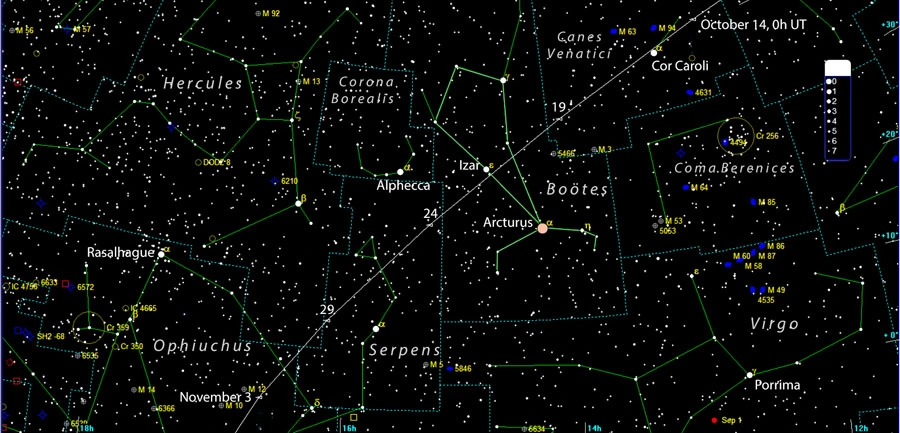
Continuing to brighten, Comet Lemmon should crest at around magnitude 4.5 during the third week of October, just about the time it buries itself in dawn's rosy glow. Have no fear, the end is not near. Even as it departs the morning sky, the object's high, northerly declination allows it to simultaneously hold court at dusk from about mid-October into the second week in November. Observers can track it in the west at nightfall as the comet hastens across Boötes, Serpens, and Ophiuchus without lunar interference until month's end. Viewing circumstances are fortuitous. C/2025 A6's closest approach to Earth (56 million miles) occurs on October 21st, less than 3 weeks before the comet's November 8th perihelion.
Now that our expectations are neatly laid out, let's see what the comet has in store!
About Bob King
I love the sky (day and night) and have been a skywatcher and amateur astronomer since childhood. I'm also a long-time member of the American Association of Variable Star Observers (AAVSO) and Astronomical League. I pen the Astro Bob blog and have written four books: Night Sky with the Naked Eye (2016); Wonders of the Night Sky You Must See Before You Die (2018) and Urban Legends from Space (2019) and Magnificent Aurora, published in 2024. The universe invites us on an adventure every single night. To accept the invitation, we only need look up.



Comments
You must be logged in to post a comment.