 SUNSET:

 1
1Astronomers have used 40 years’ worth of data to peer inside the Sun, revealing that the solar cycle can leave a distinct fingerprint beneath the visible surface.
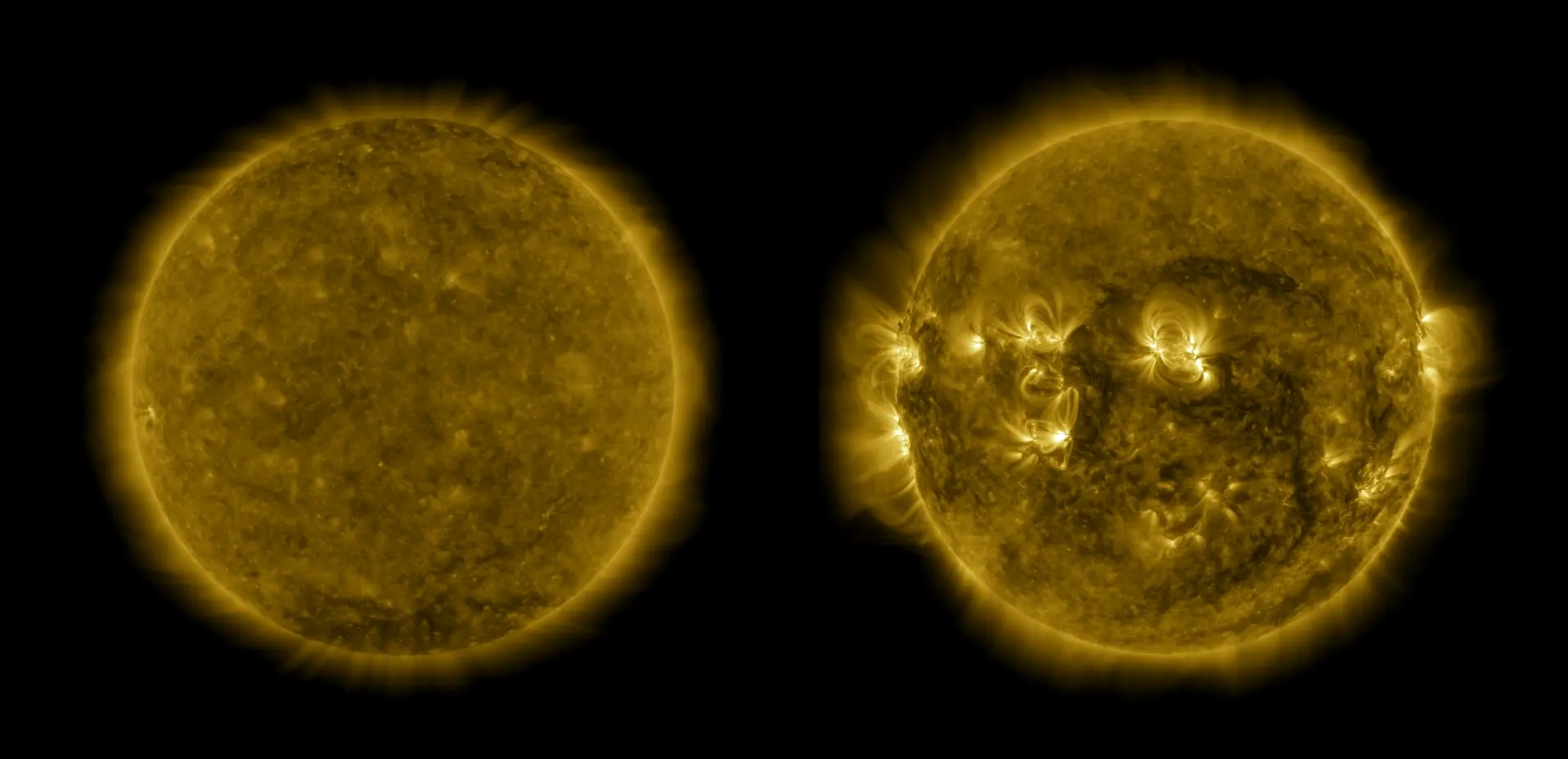
NASA / SDO / Joy Ng
The Sun’s activity rises and falls in a repeating pattern that peaks roughly every 11 years, driven by changes in the Sun’s magnetic field as the magnetic poles swap places. A team of solar astronomers, led by Sarbani Basu (Yale University), combined data from the six telescopes of the global Birmingham Solar-Oscillations Network (BISON) to explore the Sun during its quietest periods.
Their observations rest on a technique called helioseismology. Just as seismologists use earthquakes’ vibrations to analyze Earth’s interior, helioseismologists use pressure waves (aka, sound waves) careening around inside the Sun to paint a picture of the solar interior.
Different types of sound waves travel to different depths inside the Sun. By measuring tiny shifts in their frequencies — changes of just a few parts in a million — astronomers can reconstruct how temperature, density, and pressure vary beneath the surface. This makes helioseismology one of the most powerful tools for studying the Sun’s inner workings.
Basu and the BISON team are the first to study helioseismic data across four successive solar minima, the quietest phases of the solar cycle, publishing their results in the Monthly Notices of the Royal Astronomical Society.
“Revealing how the Sun behaves beneath its surface during these quiet periods is significant, because this behavior has a strong bearing on how the activity levels build up in the cycles that follow,” Basu says.
Basu’s team looked for a distinctive sound wave “glitch,” created when helium in the Sun’s outer layers loses both its electrons. This doubly ionized helium changes the compressibility of the plasma 20,000 to 40,000 kilometers (13,000 to 25,000 miles) below the visible surface, which shows up as a small oscillation in the sound waves. The strength of this signal reveals how conditions in those outer layers change over time.
Using BISON data, the astronomers discovered that the minimum between Solar Cycles 23 and 24, which occurred between 2008 and 2009, showed measurably different internal conditions compared to the other three minima. That minimum was one of the quietest and longest on record, with sunspot numbers dropping to their lowest levels in nearly a century.
During that minimum, the helium-ionization “glitch” was stronger and the inferred sound speed slightly higher just below the visible solar surface. Those increases likely reflect subtle structural changes; for example, there might have been slightly higher gas pressure and temperature in that region, linked to the unusually weak magnetic activity.
“For the first time, we’ve been able to clearly quantify how the Sun’s internal structure shifts from one cycle minimum to the next,” says team member William Chaplin (University of Birmingham, UK). “We found that deep quiet minima can leave a measurable internal fingerprint.”
Probing the Sun in this way is vital work. “With upcoming missions such as the European Space Agency’s PLATO, the techniques used in this study could be applied to other Sun-like stars,” says Chaplin.
PLATO, due for launch early next year, will study stars with terrestrial exoplanets to help us to understand how stellar activity changes, and how that influences the solar system around it in turn. The results will have important consequences for debates around exoplanet habitability.
Understanding our own star remains the key to understanding stars everywhere.
About Colin Stuart
Colin Stuart (@colinstuartspace) is an astronomy author and tutor. He also runs a free online astronomy club.



Comments
Anthony Barreiro
March 12, 2026 at 1:22 am
Wikipedia says the radius of the Sun is 695,700 km, so 20,000 to 40,000 km would be a depth of about 3% to 6% below the surface. Earth's radius is 6,371 km, so a proportionate depth would be 183 to 366 km, in the upper mantle. These proportions give me some perspective on this research, and it was fun to do a little research and arithmetic.
You must be logged in to post a comment.
You must be logged in to post a comment.