 SUNSET:

 9
9After a dearth of bright comets earlier this year, we look forward to an exciting month ahead.
Dan Bartlett
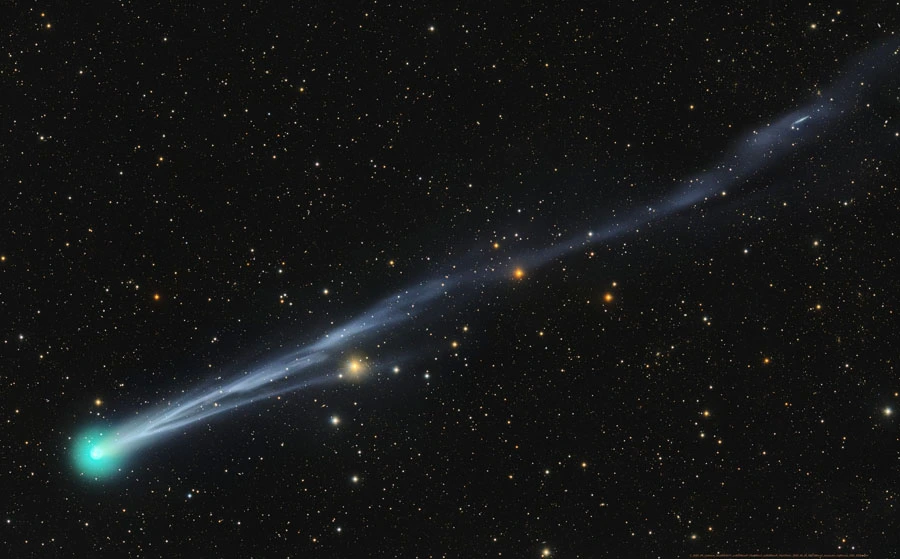
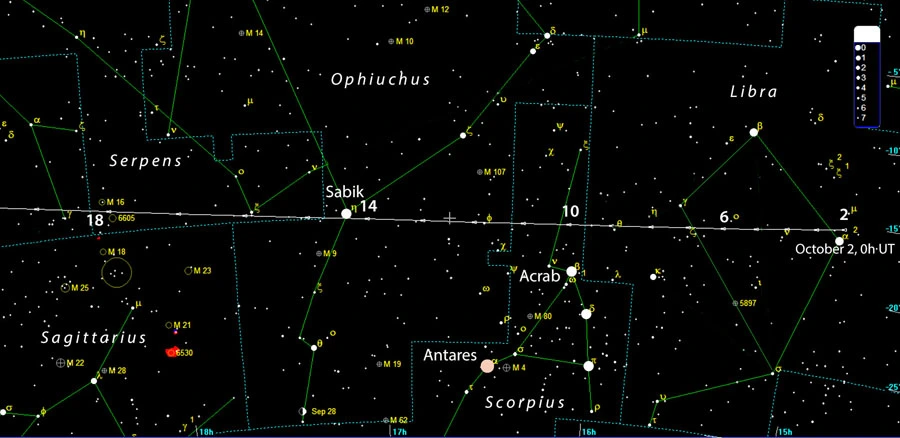
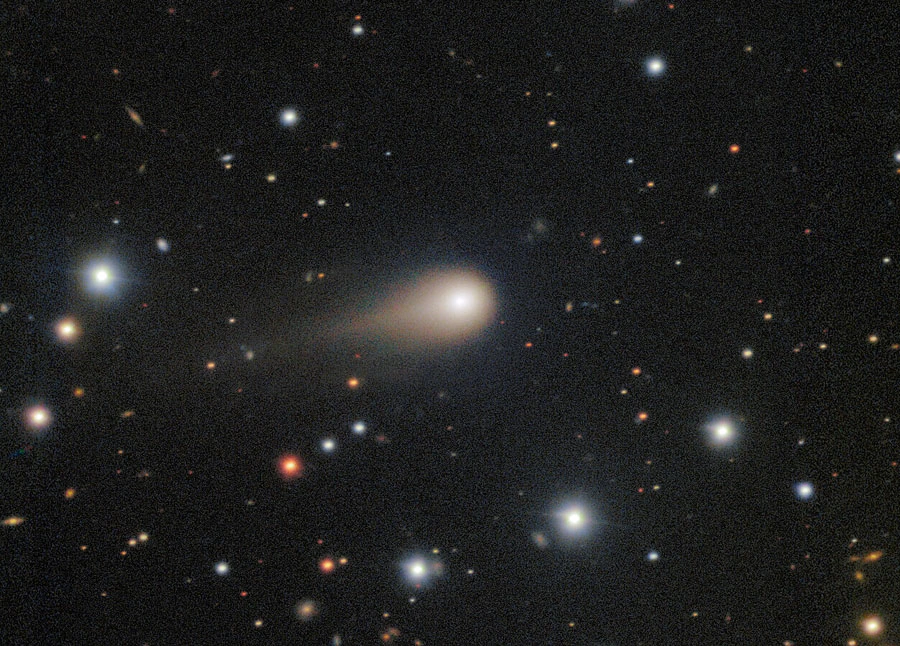
An exaltation of larks. A dazzle of zebras. A murmuration of starlings. These are a few of the more poetic and evocative collective nouns used to describe natural phenomena. How about a convergence of comets? By early October, both Comet SWAN (C/2025 R2) and Comet Lemmon (C/2025 A6) will be wagging their diaphanous tails across the sky for observers in mid-northern latitudes. While the former has been observed and photographed primarily by Southern Hemisphere observers, it will become widely visible to those of us at mid-northern latitudes starting the second week of October. Watch for it to make an entrance low in the southwestern sky in Libra at dusk, then track northeastward through Scorpius and into Ophiuchus.
David Órdenes
Luc Perrot
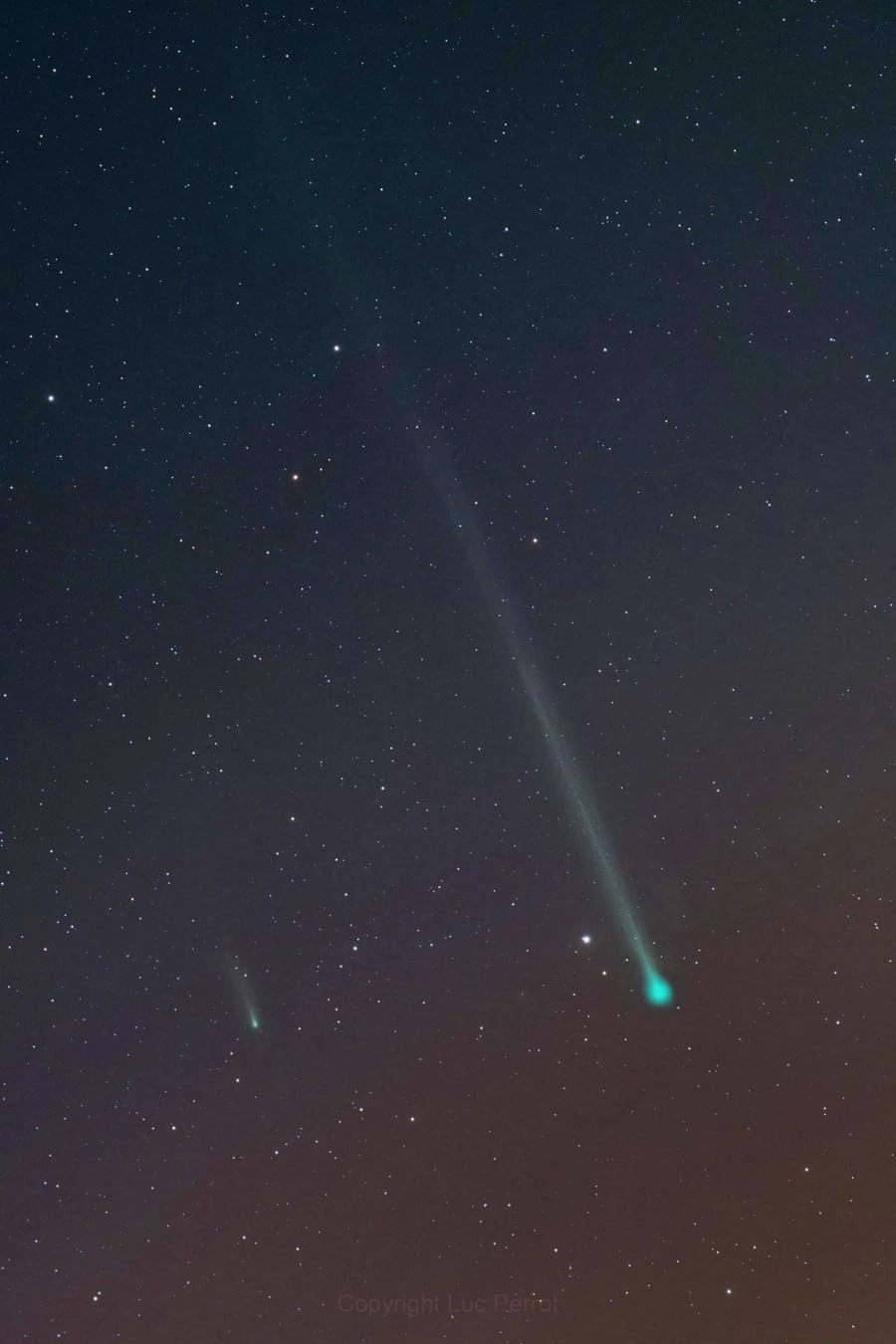
A recent outburst on September 26th kicked up Comet SWAN's brightness about a half magnitude, to 5.9. It currently displays a strongly condensed 5′ coma and an approximately 1° tail pointing southeast. We expect the blue-green fuzzball to remain around 6th magnitude through mid-October before fading. Glare from the full Harvest Moon on and around October 6th will compromise views of the tail, but the compact head of the comet should still punch through even in binoculars.
MegaStar chart, courtesy of Emil Bonanno, with additional annotations by Bob King
From latitude 40° north, SWAN stands about 5° high in late twilight (an hour after sunset) on October 2nd. But as it vectors toward its closest approach to Earth on October 19th, the comet's elongation from the Sun increases, and it gains altitude. By October 6th the Oort Cloud visitor stands 5° high at the end of astronomical twilight. Three nights later, with the return of a moonless sky, it's in line with the trio of bright stars that outline the head of Scorpius. As Comet SWAN continues to wing eastward and ascend, don't miss an easy observing opportunity on October 13th, when it will pass 1.2° southwest of 2nd-magnitude Sabik, Eta (η) Ophiuchi.
Bob King
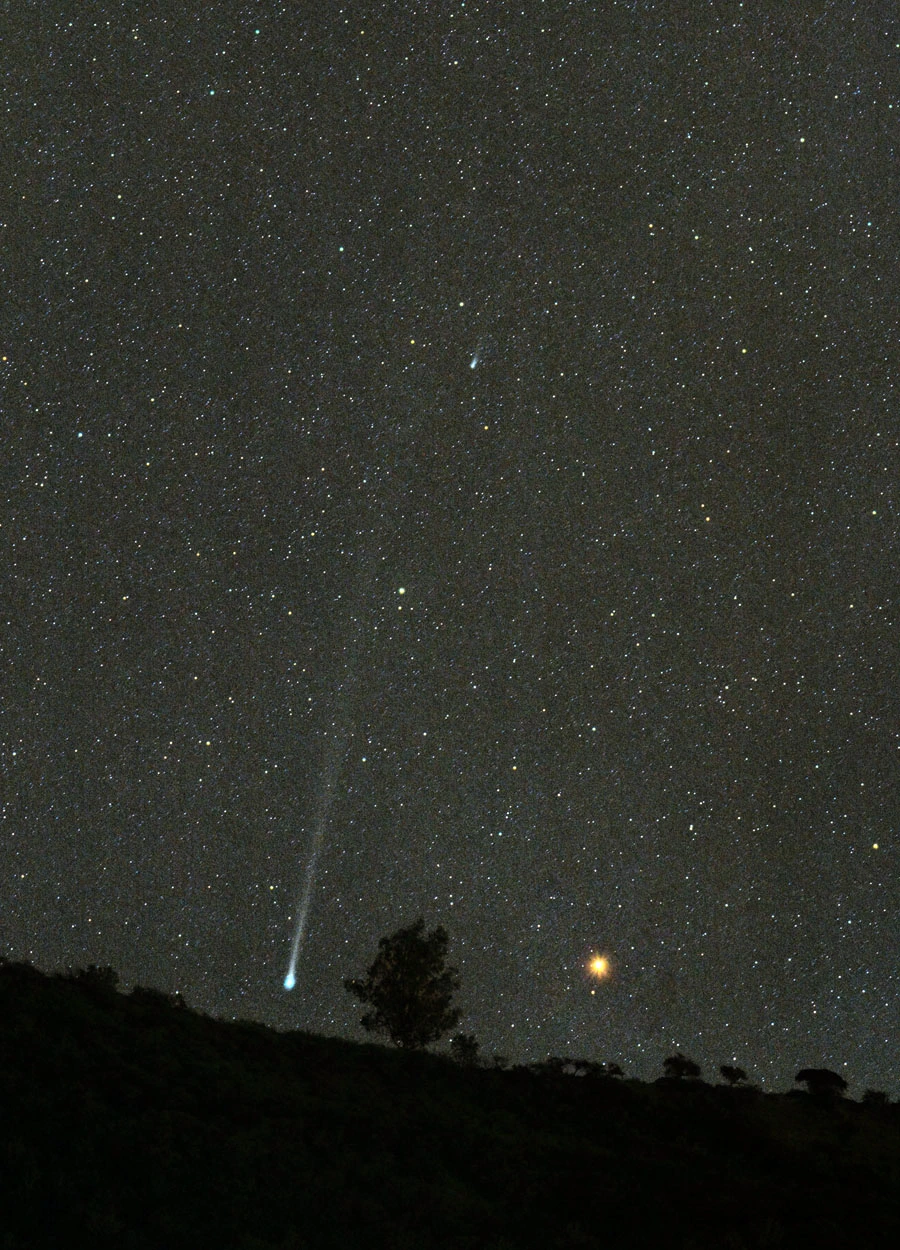
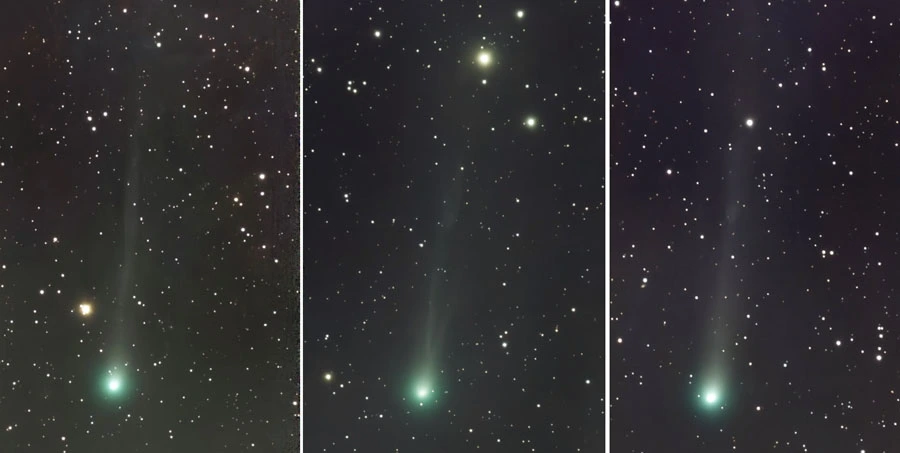
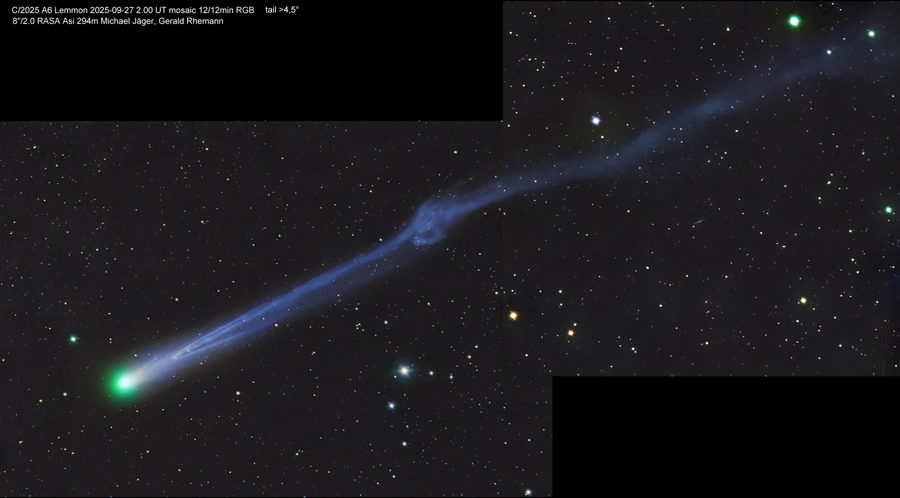
In the meantime, SWAN's counterpart has been luring Northern Hemisphere observers into the morning sky for their first look at a binocular-bright comet since Comet Tsuchinshan-ATLAS paid a visit last fall. Thanks to a recent spate of clear nights, I've seen lots of Lemmon. From a rural sky, it's immediately obvious in 10×50 binoculars as a small, round ball of fuzz with a denser, brighter core and a hint of a tail aimed northwest. On September 26th, through my 15-inch telescope at 64×, the 5′-wide, moderately condensed coma glowed a subtle but tantalizing blue-green hue, with about 1° of tail visible. This is a nice comet. I estimated its brightness that night at magnitude 7.5. Two mornings later, its inner coma was noticeably more condensed, and the comet's overall brightness had inched up closer to magnitude 7.
Michael Jäger, Gerald Rhemann
Recent brightness predictions have been revised for Comet Lemmon, further whetting excitement for what's to come. It's possible it could vault to around 3rd magnitude around the time it makes its closest approach to Earth on October 21st. With no Moon to interfere at that time, this rare planet-trotter should be obvious without optical aid from the countryside from mid-October through month's end. Of course, that's a prediction. As always, comets are under no obligation to perform as anticipated!
As a side note, I have to share how much fun I've been having in photographing Comet Lemmon with my smart telescope. While I'm taking in views of the comet (or Jupiter) with binoculars or my 15-inch, the tiny, automated Seestar S50 camera-scope is busy stacking images, like volunteers piling pancakes on plates at a Lion's Club fundraiser. I typically expose between 5 and 8 minutes, long enough to capture details in the tail and distinct color in the coma. If you own one, go for it. Modest comets like SWAN and Lemmon make perfect targets.
MegaStar chart, courtesy of Emil Bonanno, with additional annotations by Bob King
MegaStar chart, courtesy of Emil Bonanno, with additional annotations by Bob King
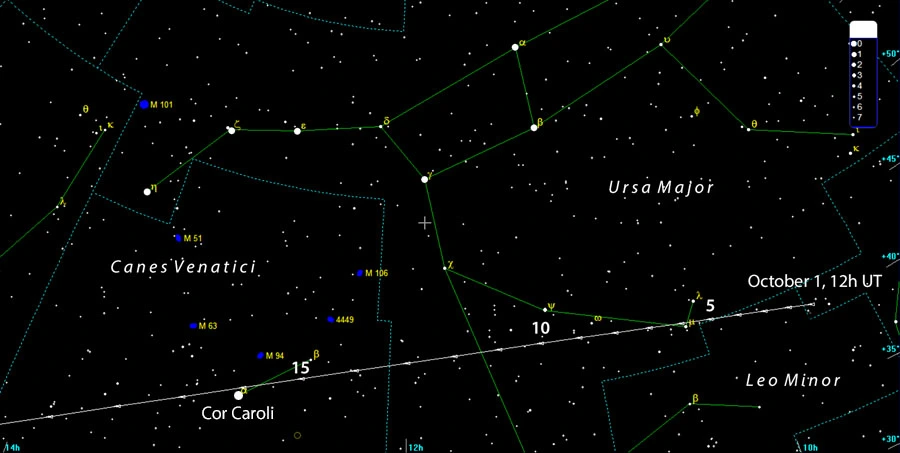
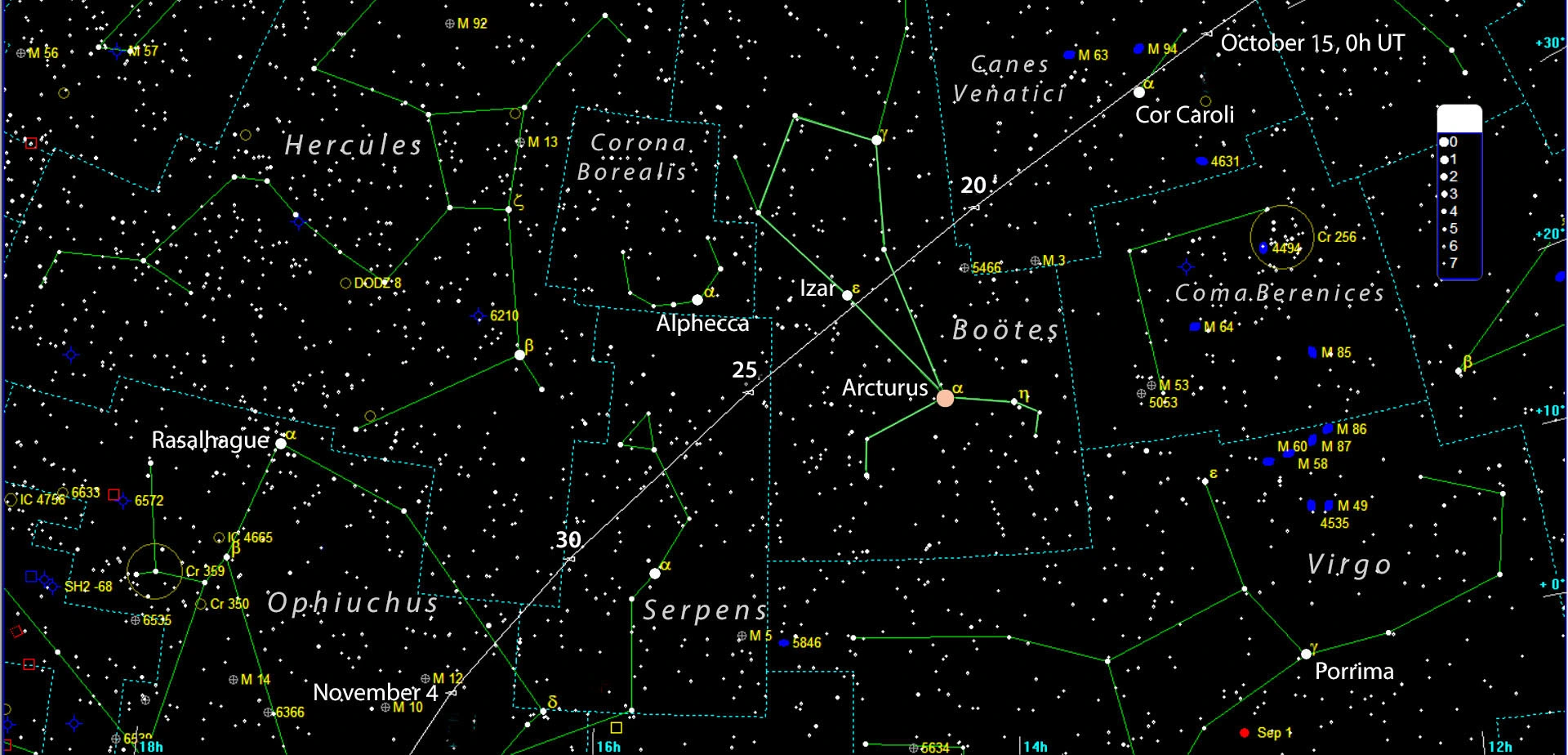
Like Comet SWAN, Lemmon is "picking up speed" and covering more distance in the sky as it approaches Earth. It begins October in eastern Lynx and spends three nights in Leo Minor before crawling across the claws of the Great Bear, Ursa Major. Around October 13th, when the comet crosses into Canes Venatici, it will have transitioned into the evening sky, visible low in the northwest starting in late twilight. The timing is perfect because it escapes the Moon just as the comet's brightness is approaching its peak. The object's relatively low altitude in a dark sky will provide excellent opportunities to frame it with a pretty foreground scene — possibly even with a smartphone.
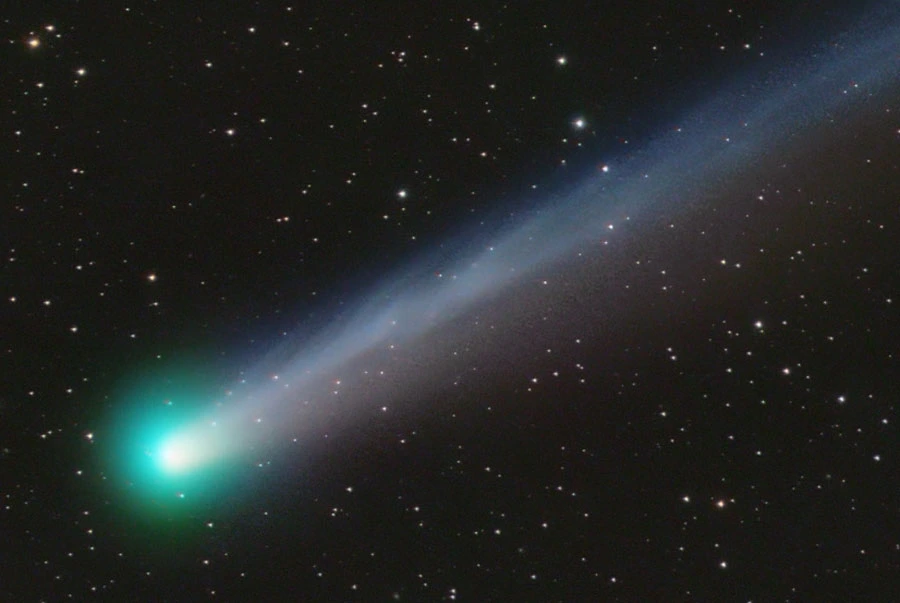
Michael Jäger Gerald Rhemann
Maximum brightness occurs during early evening hours toward the end of the second week and during the third week of October, when the Moon will be mostly absent and Lemmon trucks across Boötes some 10° north of Arcturus. What a wonderful time for comet-watchers this will be, with Lemmon highlighting the northern sky and SWAN showing off in the southern. Speaking of which, Southern Hemisphere observers, no doubt chomping at the bit, will finally see Comet Lemmon at the end of October/early November as it heads south across Serpens into Ophiuchus.
About Bob King
I love the sky (day and night) and have been a skywatcher and amateur astronomer since childhood. I'm also a long-time member of the American Association of Variable Star Observers (AAVSO) and Astronomical League. I pen the Astro Bob blog and have written four books: Night Sky with the Naked Eye (2016); Wonders of the Night Sky You Must See Before You Die (2018) and Urban Legends from Space (2019) and Magnificent Aurora, published in 2024. The universe invites us on an adventure every single night. To accept the invitation, we only need look up.



Comments
Will Rothfuss
October 3, 2025 at 8:59 pm
Hi Bob,
I see you photographed Comet Lemmon with the Seestar. I assume it is not in the data base? How did you find it? And regular sidereal tracking was good enough? Thanks!
You must be logged in to post a comment.
Bob KingPost Author
October 4, 2025 at 3:32 pm
Hi Will,
Indeed it was in the Seestar database. Regular tracking worked out just fine because the exposure was limited to about 8 minutes, and the comet was still moving a moderate to slow rate against the stars.
You must be logged in to post a comment.
Anthony Barreiro
October 4, 2025 at 10:47 am
Under clear skies in San Francisco around 5:20 am PDT this morning I saw Comet Lemmon through 10x42 image-stabilized binoculars. A distinct little fuzzball, easy to find in the same binocular field as lambda and mu Ursa Majoris, looked about 7th magnitude.
You must be logged in to post a comment.
Bob KingPost Author
October 4, 2025 at 3:33 pm
Anthony,
Good to know it's still easy to see. I've been under clouds since the article posted.
You must be logged in to post a comment.
Joe Stieber
October 4, 2025 at 5:35 pm
From the New Jersey Pines this morning, Oct 4, 2025, C/2025 A6 (Lemmon) was easy to find and see with 12x50 binoculars. With 18x70 binoculars, it was quite nice with a vague hint of a tail about a degree long. In a 115 mm spotting scope at 35x, it was splendid. The bright coma had a distinct central condensation and a faint 1° tail was unequivocally seen.
All of this morning's observations used direct vision. Back on August 31 when I first spotted A6 with the 115 mm scope, it was just a very faint patch of haze requiring averted vision for me to see it.
You must be logged in to post a comment.
OwlEye
October 8, 2025 at 12:33 pm
Hi Bob,
Great article!
We had a cold front move through yesterday, which left us with rather clear skies at sunset, although the moon - already on the rise - had a bit of a glow around it.
Went to a spot 1.5 miles east of my home - nice flat horizon! - with the 6 and 4.25-inch reflectors, and was star-hopping from Gamma Librae eastward with the 6-inch at 31 X toward Comet SWAN at about 7:55 pm, CDT. I found the scalene triangle between Gamma and Theta Librae, short-hopped from their to the comet's position, and there it was! Not particularly bright, considering it's low altitude, bright moonlight, and nautical twilight having just ended.
It appeared quite condensed, and the central condensation scintillated (twinkled) a few times. Using a couple nearby stars, I made the brightness at ~ 6.5 magnitude. It got a bit easier to see until about 8:10 pm, then began to fade away in the haze and atmospheric extinction. It was gone at 8:23.
Tried to see the comet with the 4.25-inch at 15 ad 35 X, but to no avail. However, I did this after it had started to fade, so I'm not sure if it would have been visible or not.
Regards,
DZ
You must be logged in to post a comment.
Joe Stieber
October 10, 2025 at 10:29 pm
On the evening of 08-Oct-2025, I was able to see C/2025 R2 (SWAN) with my 35x115 spotting scope as a dim patch of haze about 7:30 pm from suburban Mt Laurel, NJ. It was about one hour after sunset and 20 minutes after moonrise. I was not able to see R2 with 18x70 binoculars.
On the evening of 09-Oct-2024, I went to Thompson’ Beach, NJ, on the north shore of the Delaware Bay. It’s considerably darker there. Again, I spotted R2 with the 35x115 scope at 7:30 pm, about 20 minutes before moonrise, and it was easy to see. Then I looked with my 18x70s, and it was still easy to see. Finally, I looked with 12x50 binoculars, and it wasn’t difficult to see. Nice!
You must be logged in to post a comment.
CBoynton
October 28, 2025 at 1:39 pm
We live in coastal SoCal, and marine layer clouds are a near constant menace for observing the night sky. Yesterday evening ~19:30 Monday 27 October there was no marine layer since we were in the beginning phase of a Santa Ana wind event (offshore winds). Despite lacking dark skies (due to suburban light pollution) I was able to find Lemmon C/2025 A6 with 7x50 binoculars sweeping south from Alpha Coronae Borealis through Beta and Gamma Serpentis. Altitude was ~15deg. I could see the faint and fuzzy ball of the coma, and may have seen some elongation. Visually I could not make out any color.
You must be logged in to post a comment.
Bob KingPost Author
October 28, 2025 at 1:42 pm
Dear GC,
Thanks for sharing your report and glad you saw Comet Lemmon! It will help others reading this from light-polluted suburban areas to know it's still possible to see this beautiful comet. I've been watching the last two nights from rural skies, and it was dim but easily visible with the naked eye at magnitude 3.9.
You must be logged in to post a comment.
You must be logged in to post a comment.