 SUNSET:

 1
1Powerful X-rays from the nearby naked-eye star Gamma Cas mystified astronomers for decades. Now, a new observatory reveals that they come from its white dwarf companion.

Daniel Johnson
Some 550 light-years away, a bright star called Gamma Cassiopeiae is belching out bursts of X-rays. Now, astronomers have discovered that the radiation is actually coming from the star’s invisible companion, which lights up in X-rays as it gobbles up material from the star.
Gamma Cassiopeiae (Gamma Cas for short) is visible to the naked eye at 2nd magnitude, making up the center of the Cassiopeia constellation’s distinctive “W” in northern skies. It’s a variable star that’s exhausting its supply of hydrogen, but it hasn’t run out just yet. Unlike other stars like it, it emits X-rays.
The star is surrounded by a gaseous disk, and for years, astronomers theorized that the emission was being produced either from the star’s magnetic fields interacting with the disk, or perhaps from disk material falling onto an unseen companion star.
Now, in a study published in Astronomy & Astrophysics, a team led by Yaël Nazé (University of Liège, Belgium) has observed the system with the X-Ray Imaging and Spectroscopy Mission (XRISM) space telescope. The researchers conclude that the white dwarf companion is the one emitting the X-rays as it consumes material from Gamma Cas. These revelations help astronomers learn more about how these exotic massive stars evolve and interact with each other.
Solving an X-Ray Mystery
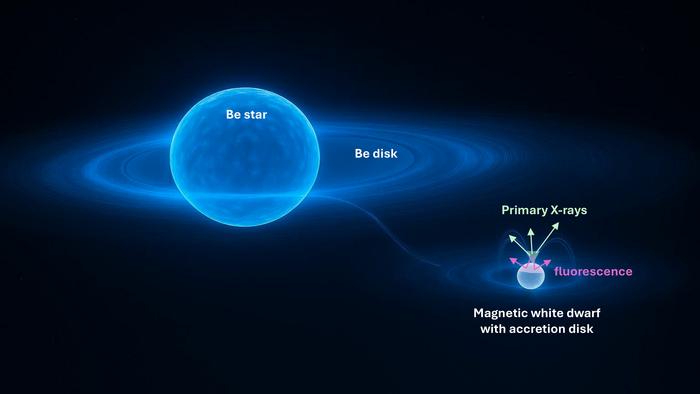
University of Liège / Y.Nazé
Gamma Cas’s peculiarities were first observed in 1866, when Italian astronomer Angelo Secchi noticed that the star had bright emission lines of hydrogen, rather than absorption lines like other stars. Gamma Cas became the first of the new class dubbed “Be stars” — massive B-type stars with hydrogen emission (e) lines.
But it took time to understand what Be stars were. Astronomers eventually figured out that the hydrogen emission comes from gaseous disks around these stars. It turns out that the stars themselves spin so fast, they expel material near the stellar equator. The resulting disks can build up and dissipate over time, leading to variations in brightness.
But that’s not all. In 1975, astronomers discovered that Gamma Cas is emitting intense X-rays. Gamma Cas’s high-energy emission indicates the presence of a searing 150-million-degree plasma, making it 40 times brighter in X-rays than a typical Be stars. For the last 50 years, the source of these X-rays — now discovered around two-dozen other Be stars, dubbed “Gamma Cas analogs” — was a mystery.
To pinpoint the source of the X-rays once and for all, the team used the Resolve spectrometer on XRISM to measure the spectrum, or intensity of light across different X-ray energies. XRISM was launched in 2023 by the Japan Aerospace Exploration Agency (JAXA), in partnership with the European Space Agency (ESA) and NASA.
The team observed the system on three separate occasions, looking at emission lines from heated iron atoms. Those observations revealed that the X-rays are coming from a source whose motion aligns exactly with Gamma Cas’s white dwarf companion — confirming that it’s the white dwarf that’s spewing X-rays.
With the new discovery, the picture becomes clear: Gamma Cas is expelling gases from its surface, which the white dwarf then captures. As the material falls onto the white dwarf’s surface, it heats up, “producing a high-temperature plasma that emits X-rays,” says Masahiro Tsujimoto (JAXA, Japan), who coauthored the study.
Detecting White Dwarfs
“It has been suspected for a while that the companion in gamma Cas was a white dwarf,” says team member Sean Gunderson (MIT). That was the only object dim enough to be outshined by a massive star like Gamma Cas and escape detection. Its gravity tugs on Gamma Cas as it completes an orbit every 203 days.
In fact, some astronomers theorize that most Be stars originate as a binary pair of massive stars. Gas transfer between the two stars spins up the receiving star, while the star that’s losing mass evolves into something else — a white dwarf, a helium star that’s been stripped of its hydrogen envelope, or an even denser neutron star that emits its own distinct high-energy flares. In some cases, like Gamma Cas, interactions light up the companion in X-rays.
"This paper provides the best evidence yet for the Be plus white dwarf case," according to Douglas Gies (Georgia State University), who was not involved in the study.
While more observations are needed to confirm the binary nature of Gamma Cas analogs, XRISM offers a new technique to understand these anomalous systems. “Gamma Cas is just one example, and we need additional cases to firmly establish Be and white dwarf binaries as a class of systems,” Tsujimoto says.
As astronomers revisit these ideas, they’ll also need to consider such systems’ rarity. Astronomers initially thought that Be star and white dwarf binaries would make up a large percentage of all Be systems, but Gamma Cas analogs only make up 10% of all Be stars. The primary stars in these systems, like Gamma Cas, are also more massive than expected — Gamma Cas itself is over a dozen times heavier than our Sun.
This discovery represents years of work aiming to understand Gamma Cas and its analogs. “We have been working on that for more than a decade now,” says Nazé. “It was really a kind of adventure.”
Editorial note (March 31, 2026): Commentary from Douglas Gies added to the piece.
About Arielle Frommer
Arielle Frommer has been writing for Sky & Telescope since April 2024. She covers news stories ranging from newly-discovered exoplanets to local astronomy events. She is a recent graduate of Harvard University, where she obtained her bachelor's degree in Astrophysics and Physics and researched massive star formation and exoplanets. Arielle is currently studying extrasolar atmospheres at Leiden Observatory in the Netherlands. In her free time, she enjoys hiking, crocheting, drinking coffee, and reading and writing fiction.











Comments
James Ryan
April 1, 2026 at 1:35 am
Wowser, XRISM's microcalorimeter is a discovery machine!
You must be logged in to post a comment.
You must be logged in to post a comment.