 SUNSET:

 0
0Here’s how to reveal the reflected light of stellar explosions photographically.
Rolf Olsen
The night sky often seems like a stable, unchanging tapestry of stars, nebulae, and distant galaxies. Occasionally some transient phenomenon like an eclipse or a bright comet graces our skies, reminding us that our vista is not entirely static. But some transient events play out over decades or even centuries, and, despite their ethereal nature, have an extraordinarily violent origin. These are light echoes, the glow of bygone novae or supernovae reflecting off interstellar dust and reaching us from afar long after the cataclysm was first visible.
On February 23, 1987, a star approximately 163,000 light-years away in the Large Magellanic Cloud (LMC) reached the end of its life and quickly became the brightest supernova visible in nearly 400 years, peaking at an apparent magnitude of 2.9 (S&T: Feb. 2017, p. 36). As the first supernova discovered that year, it was designated SN 1987A. This was the closest one observed since Kepler’s Supernova in 1604. The progenitor star of the LMC explosion turned out to be the unassuming, 12th-magnitude star Sanduleak –69 202, a blue supergiant that astronomers determined ended its existence as a Type II, core-collapse supernova that produced a neutron star. It was the first time modern astronomers were able to study one in detail, and their observations have provided significant insight into the deaths of such stars.
Late Reflections
In 1987, I was just an 11-year-old boy with a keen interest in astronomy growing up in Denmark, where SN 1987A was permanently below the horizon. I’ve always wished that I could have seen this remarkable event with my own eyes.
But two things occurred that enabled me to “see” the light of this event. In 2003 I relocated to New Zealand and its excellent view of the Southern Hemisphere skies. There I ventured into the world of astrophotography and concentrated on taking extremely deep images of this night sky (S&T: Feb. 2022, p. 60). Using the incredible sensitivity of my CCD detector, I found that recording the light from this historical supernova is now entirely possible! Thanks to a phenomenon known as light echoes, we are still able to witness the light from a supernova even long after it has passed.
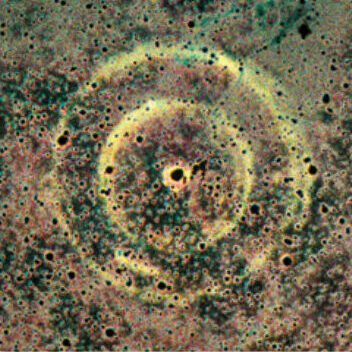
Light echoes are analogous to audio echoes produced when sound waves reflect off of solid objects. With a large enough distance between the origin of the sound and the observer, the sound from the event arrives noticeably later. In 1940 the prolific Swiss astronomer Fritz Zwicky proposed the existence of supernovae light echoes when he suggested that light from historical supernovae could still be seen as faint echoes long after the initial explosion. Light echoes are produced when the initial flash from a bright source, such as a supernova, expands outward in all directions. Some of this light is reflected off of dust clouds in interstellar space. A small part of that reflected light is directed towards Earth and can be seen years or even decades later as faint arcs of light surrounding the site of the original explosion.
Rolf Olsen
A Long Gap between Observations
While photographing the Tarantula Nebula (NGC 2070) in the LMC a few years ago, I recalled having some image data of the same target recorded eight years earlier. This rekindled my fascination with SN 1987A, and I decided to test to see if light echoes from the supernova might be visible with my modest amateur equipment.
Astronomers had detected echoes of this famous explosion previously at large observatories. The first to do so was Michael Rosa on February 13, 1988, with the European Southern Observatory’s 3.6-meter telescope. Later, astrophotography pioneer David Malin produced a spectacular color image of these faint, luminous shells in 1989 while working at the Anglo-Australian Observatory (now the Australian Astronomical Observatory). But to my knowledge, no amateur detection had ever been noted. I considered the possibility that, more than three decades later, the echoes may no longer be visible, but I decided to compare my 2020 observations with the data taken eight years earlier anyway.
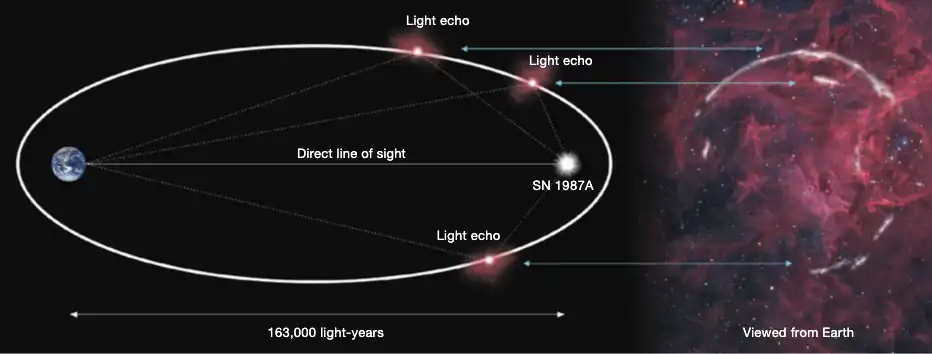
Diagram: Beatriz Inglessis / Sky & Telescope; SN 1987A image: A-AO / DAVID MALIN
A Surprising Result
Inspiration for this project came in part from a technique I had applied in 2011 to make the first amateur detection of the circumstellar disk around the relatively nearby star Beta Pictoris (S&T: Aug. 2013, p. 72). In that case, the challenge was to eliminate the overwhelming glare from the star itself in order to reveal its faint, edge-on debris disk. To do so, I photographed both Beta and a similar reference star under the same conditions. The two images were then aligned, and the reference star image was subtracted from the target image to eliminate the glare of Beta Pictoris, revealing the star’s dusty disk.
I achieved the detection of light echoes from SN 1987A in a similar way, this time by using two images of the same target recorded eight years apart.
Although the instruments used to record the two data sets were slightly different (I used a 10-inch f/5 Newtonian telescope in 2012 and a 12.5-inch f/4 Newtonian reflector in 2020), the difference in resolution was minor. I was still using same QSI683 CCD camera and Astrodon LRGB filters. Exposure times in both cases were just over one hour through the luminance filter, which blocks near-infrared light.
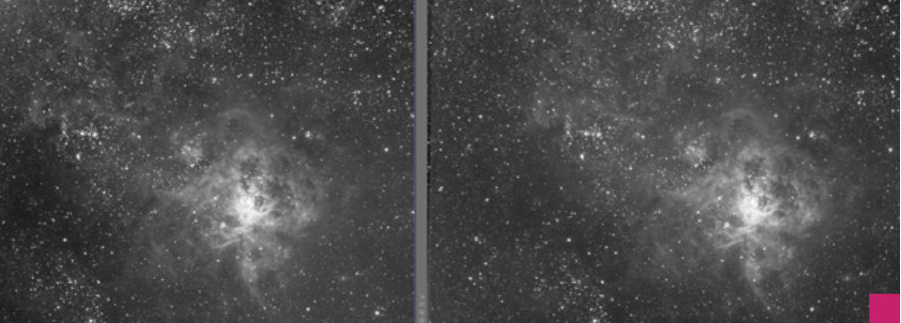
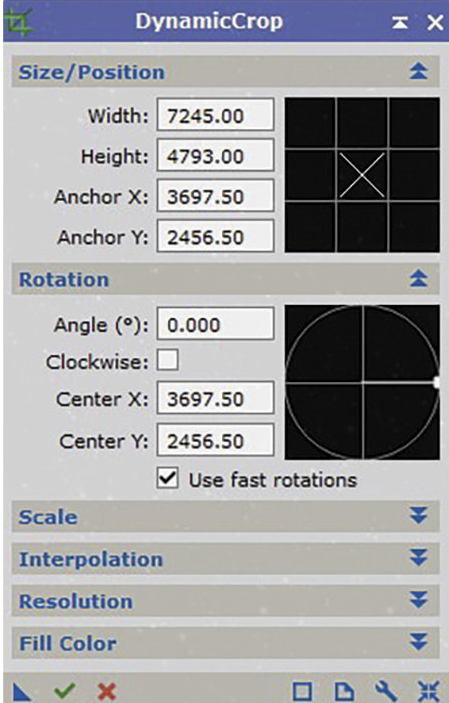
To create this image, I first aligned the 2012 image exactly to the 2020 image, using star alignment in PixInsight, though any astronomical image-processing software that can align star-field images will work. Afterwards, the two images were background subtracted (consecutively recorded images are subtracted from each other) to ensure the best possible comparison and to (hopefully) allow the detection of any differences between the two images, such as faint arcs from the light echoes. This didn’t reveal anything of note.
Rolf Olsen
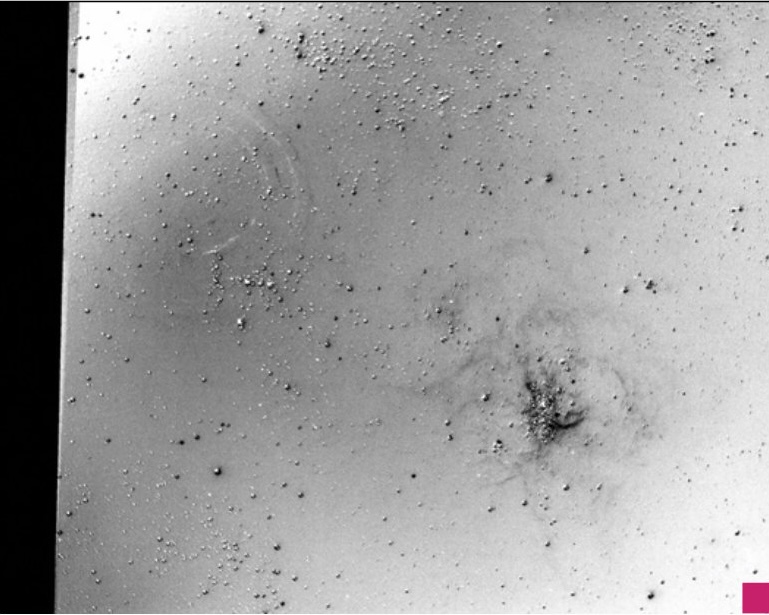
I then subtracted the 2020 image from the 2012 image using the PixelMath process in PixInsight, in order to reveal any brightness difference that might have occurred over the eight years. At first, all I was presented with was a bland, gray image, but when I stretched the result, I was surprised to see very large and prominent arcs — the light echoes I sought!
Rolf Olsen
These features appear as concentric light and dark arcs centered on the precise location of SN 1987A. The light and dark tones are simply an artifact of the order in which the images are subtracted. However, the spaces between the light-and-dark arcs clearly reveal how much the echoes have expanded during the intervening eight years between the two sets of images. The result shows what is possibly the first amateur detection of light echoes from SN 1987A — fully 33 years after the event.
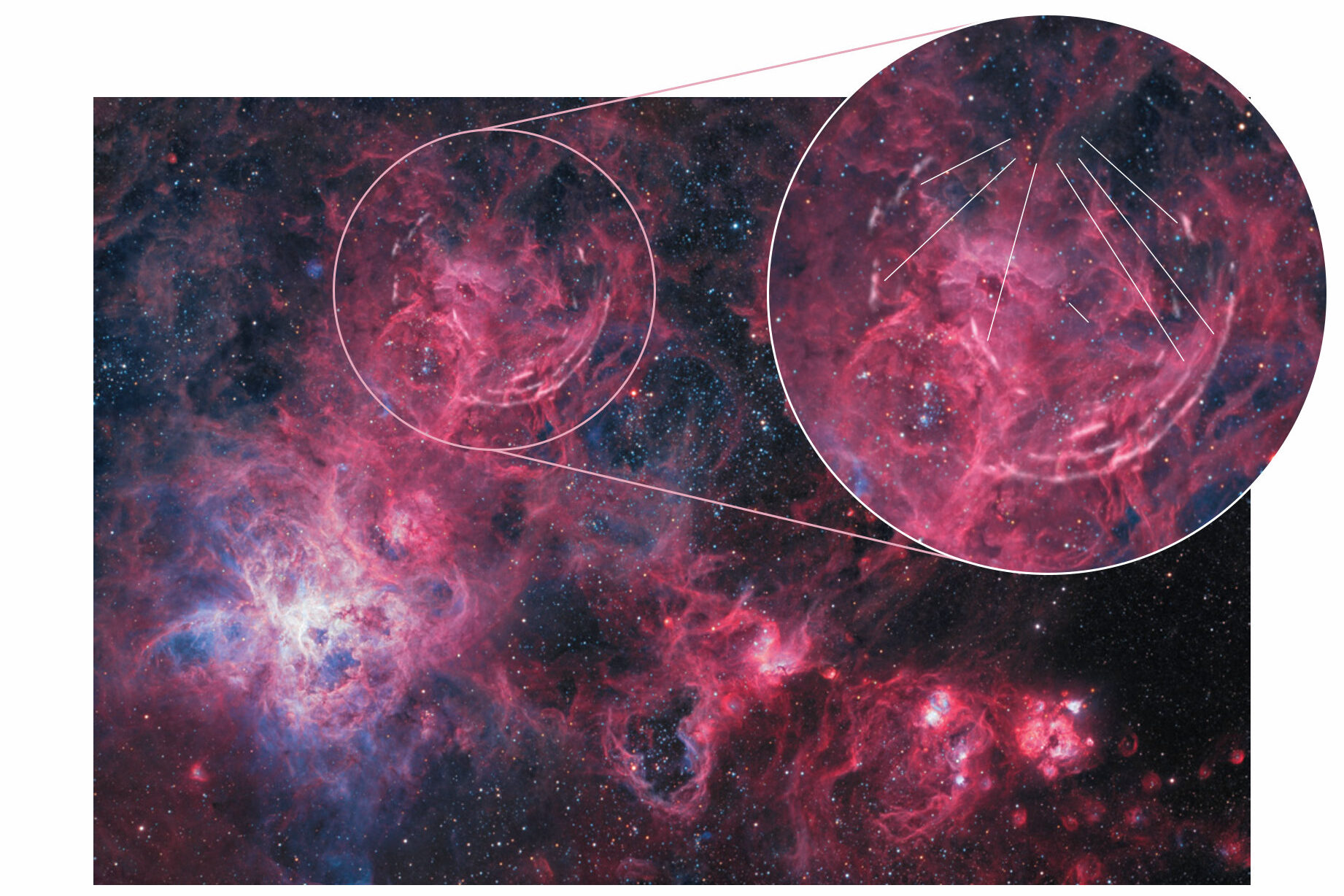
To present the light echoes in the beautiful context of the sprawling clouds of the LMC, I then acquired a substantial amount of narrowband image data in 2021 and used that to create a deep, colorful picture of the region’s complex gas clouds. The broadband light echoes were then composited onto this to achieve the result seen on page 60.
The full-size image is a mosaic of two deep fields centered near the bright Tarantula Nebula in the LMC. The field is filled with numerous bright, colorful nebulae and star clusters. At the LMC’s distance of 163,000 light-years, the field of view seen here spans a massive 2,917 by 2,000 light-years. At this large scale, the nebulosity seems to feature many bubble shaped voids of different sizes. These are formed by the radiation pressure from young star-forming regions and shock waves from ancient supernovae. The small but comparatively recent remnant of SN 1987A is also visible as a tiny pink dot at the focal point of the light-echo arcs.
I acquired all the image data from my observatory in outer suburban Auckland, New Zealand. I used my 121⁄2-inch telescope to acquire the wider, narrowband context photo of the Tarantula Nebula and surrounding area in early 2021. This is a deep, bi-color image comprising 7 hours and 15 minutes worth of exposures through hydrogen-alpha and oxygen III filters, totaling 14.5 hours.
Superluminal Illusion
The light echoes from the supernova appear to be moving outwards faster than the speed of light, something that is physically impossible but often observed in phenomena that move close to our line of sight. This effect is most often associated with relativistic jets of matter ejected from active galactic nuclei — for example, the jet emitted by the supermassive black hole in the center of elliptical galaxy Messier 87 in Virgo.
Using the formula s = d × v, we can calculate the angular speed of motion of the light echoes across the sky, as apparent speed (s) equals distance to object (d) times angular velocity (v).
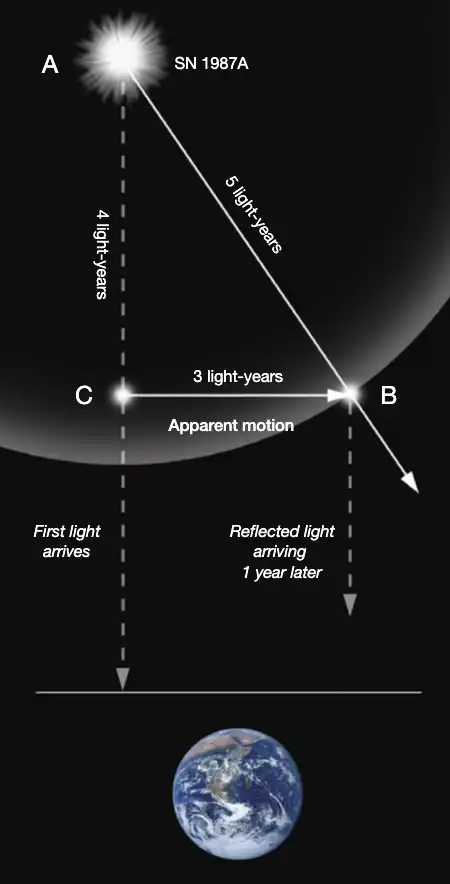
Between 2012 and 2020, the brightest arc had expanded outwards by approximately 47 pixels. With an image resolution of 0.764 arcseconds per pixel, this corresponds to a movement of 4.49 arcseconds per year (47 × 0.764 ÷ 8). At the distance of the LMC, this equates to around 28 light-years in 8 years — 31⁄2 times the speed of light! So how is that possible?
Beatriz Inglessis / Sky & Telescope
This apparent superluminal speed is in fact an optical illusion and doesn’t represent the actual speed of the outward-travelling sphere of light, which is, of course, moving at 299,792 kilometers per second. This interpretation fails to consider that when measuring the apparent motion of distant objects across the sky, they aren’t often moving perpendicular to our line of sight. The light bouncing off dust clouds at various distances has travelled farther than the light coming directly from the supernova itself, but the dust clouds aren’t located at the same distance as the explosion — a simple trick of perspective that produces the faster-than-light illusion. A similar phenomenon is seen in the expanding light echo surrounding V838 Monoceros, which underwent a nova outburst in 2002.
Other Applications
Astronomers have used this same imaging technique to discover several light echoes in the LMC from previously unknown ancient supernovae. It’s even possible to acquire spectra of these light echoes to study the type of supernova, centuries after the direct light would have first reached Earth. These discoveries were a byproduct of the SuperMACHO Microlensing Survey, which looks for evidence of dark matter using the same image-subtraction technique to detect transient distortions in the light of individual stars.
Such light echoes are also helpful for measuring the structure of the interstellar medium, because the dust and gas in space are cold and dark. When a supernova explodes, its expanding flash illuminates the surrounding clouds, providing astronomers with a three-dimensional “scan” of otherwise invisible structures between us and the dying star.
This subtraction technique can also be used in search of light echoes from novae and supernovae in Northern Hemisphere skies. While most are extremely faint and require large instruments to record, photographing them may be an interesting project for imagers with fast astrographs, sensitive cameras, and datasets spread over multiple years. Who knows what might turn up?
This article originally appeared in the December 2022 issue of Sky & Telescope.
About Rolf Wahl Olsen
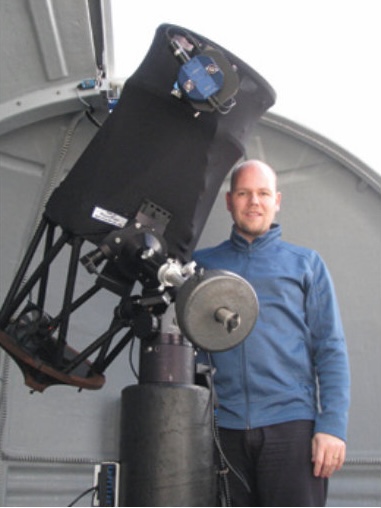
ROLF WAHL OLSEN photographs the night sky from his observatory in the foothills of the Waitakere Ranges west of Auckland, New Zealand.


Comments
You must be logged in to post a comment.