 SUNSET:


What is the age of the universe?
Determining the age of the universe requires a knowledge of the universe's expansion rate, as well as its density and composition. Cosmologists currently set the age of the universe at about 13.77 billion years.

The End of the Universe: What is our ultimate fate?
During the latter half of the 20th century, cosmologists narrowed the universe’s fate to three possibilities, and they all depend on its density.

What are constellations?
In 1930, the International Astronomical Union (IAU) divided the sky into 88 constellations. Each constellation is defined by an imaginary boundary on the sky and named after a classical star pattern within those boundaries. So when we say a star is “in” a particular constellation, we mean it lies within the IAU-defined boundaries of that constellation.

How Many Stars are There in the Universe?
By measuring the number and luminosity of observable galaxies, astronomers put current estimates of the total stellar population of the observable universe at roughly 70 billion trillion.

What is the brightest star in the sky?
The brightest star in the sky is Sirius, also known as the “Dog Star” or, more officially, Alpha Canis Majoris, for its position in the constellation Canis Major.

How Do Stars Die and How Long Do Stars Live?
Both the life and death of a star depend on its mass. Generally speaking, the more massive a star, the faster it burns its fuel and the shorter its life. The most massive stars meet their end in a supernova explosion after only a few million years of fusion, while the tiniest stars continue to feebly burn for upwards of a trillion years.

What Is a Star?
A star is a luminous ball of gas held together by its own gravity. Nuclear fusion in its core supports the star against gravity and produces photons and heat. The Sun is the closest star to Earth.

Why Do Stars Twinkle?
Though it wouldn’t work so well in the nursery rhyme, a star’s twinkling actually has a technical term, astronomical scintillation: the effect of our planet’s atmosphere on starlight.

Asteroids: What Are They and Where Do They Come From?
Asteroids are rocky objects leftover from the solar system's formation, found primarily in the asteroid belt, a region of the solar system in between the orbits of Mars and Jupiter.

Comets: What Are They? Where Do They Come From?
Comets are suspected to be remnants of planet formation in the solar system about 4.6 billion years ago and primarily originate in the Kuiper Belt and the Oort Cloud.

Why do comets have tails?
Comets develop tails as they approach perihelion—the place in their orbits when they are closest to the sun. The sun’s heat causes some of the material in a comet to vaporize, which in turn releases dust particles that were trapped in the ice.

How big is the Sun?
The Sun is more than 330,000 times as massive than the Earth. It has a diameter of nearly 1.4 million kilometers (865,000 miles), and its volume could enclose about 1.3 million Earths.

What is the solar wind?
The Sun’s outer atmosphere, the corona, is the source of the solar wind, a steady outflow of charged particles from the Sun.

What Is the Smallest Planet and Largest Planet in our Solar System?
When it comes to both mass and volume, Jupiter is the largest planet in the solar system, while Mercury is the smallest.

What is a meteor shower?
Meteor showers occur when Earth passes through a stream of meteoric material. The brief streaks of luminescence we call meteors are caused by meteoroids burning up as they pass through the atmosphere.

Astrology vs Astronomy: What's the Difference?
The practices of astrology and astronomy have common roots, but they have evolved into two separate fields. Astronomy studies positions, motions, and properties of celestial objects. Astrology attempts to study how those positions, motions, and properties affect people and events on Earth.

What is radio astronomy?
Radio astronomy is the study of the universe through analysis of very long-wavelength emission from celestial objects.
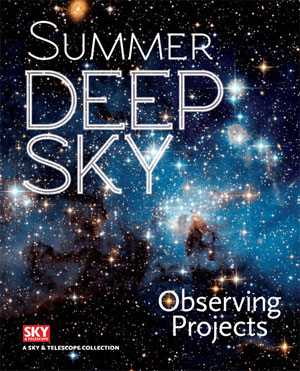
New E-Book: Summer Deep-Sky Observing
Look a little deeper into the summer sky with our new e-book, Summer Deep-Sky Observing. We'll have you happily busy at your telescope all season long!

Astrophotography: Tips & Techniques
How to Photograph a Meteor Shower
When a meteor shower is coming up, have you thought of trying your hand at meteor photography? Here are some techniques to help you on your way.

First Mercury Globe Now Available
Sky & Telescope announces the first-ever globe of Mercury, pieced together from the latest images taken by the Messenger spacecraft. It's now available on our online store!
