 SUNSET:


This Week’s Sky at a Glance, March 29 – April 6
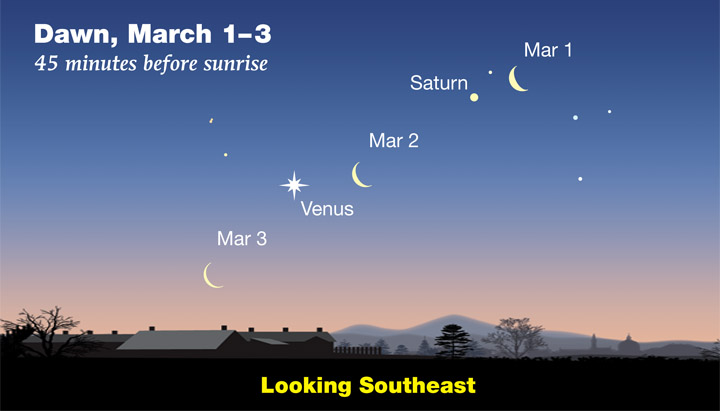
Mars pairs with the Pleiades this week, and a sunrise challenge on Monday morning: find the thin crescent Moon to the right of Venus.

Pop in on Pallas and Iris Tonight
Break out your binoculars or telescope the next clear night for a peek at the bright asteroids Pallas and Iris, both at opposition this spring.
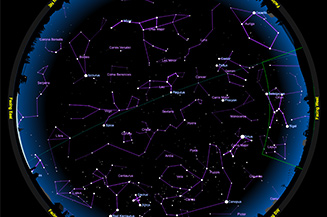
Interactive Sky Chart
Find out what's in your sky tonight — create a custom map of the night sky for your location!
This Week’s Sky at a Glance, March 22 – 30
Immediately after dark, before moonrise for most of North America, Sirius shines brilliantly in the south-southwest.
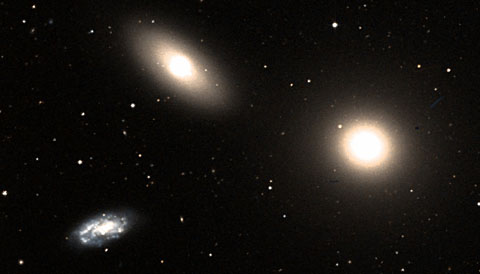
It's Spring! Time to Visit the Bright Galaxies of Leo I
Springtime is galaxy time. Only 30 million light years away, the Leo I Group and nearby Leo Triplet entice the eye with an assortment of bright spiral and elliptical galaxies. Welcome to spring! The new season begins (or began depending on when you read this) at 5:58 p.m. EDT on…
This Week’s Sky at a Glance, March 15 – 23
Immediately after dark, before moonrise for most of North America, Sirius shines brilliantly in the south-southwest.

Deep-sky Hunting in Cancer, the Crab
As winter melts into spring, we sample both familiar and overlooked deep-sky treasures in the "empty space" between Gemini and Leo, home of the Crab.
This Week’s Sky at a Glance, March 8 – 16
Mars (magnitude +1.2, in Aries) glows high in the west at nightfall and sets by 11 p.m. In a telescope it's a tiny blob 5 arcseconds wide.

How to See Sirius in the Daytime
Spotting Sirius in broad daylight may be easier than you think! Here's how to do it.
March 2019: Spot the Winter Hexagon
The Sky Tour astronomy podcast for March 2019 takes you on a guided tour of the predawn sky and then helps you find the dazzling stars that make the huge Winter Hexagon — including Sirius, the Dog Star.
This Week’s Sky at a Glance, March 1 – 9
Venus, Jupiter, and Saturn all rise before dawn. As dawn gets under way, Jupiter and Venus, the brightest, dominate the low southeast. Saturn is between them.

A Zodiac Ramble . . . with a Few Fun Detours
Take a trip along the ecliptic from dusk till dawn to check out the sights along this well-traveled highway — the zodiacal light, Mercury, and the gegenschein, plus scenic detours to a comet and asteroid.
This Week’s Sky at a Glance, February 22 – March 2
Venus, Jupiter, and Saturn all rise before dawn. As dawn gets under way, Jupiter and Venus, the brightest, dominate the low southeast.

Deep-Sky Observing Without Equipment, Part II — The Winter Sky
Really want to see what your eyes can do? Leave the telescope at home and join me for a naked-eye tour of the late winter sky.
This Week’s Sky at a Glance, February 15 – 23
The Moon is in the feet of Gemini this evening. Castor and Pollux are to its left, Procyon is to its lower left, and Orion is to its lower right.

Will Sirius Disappear on February 18th?
On Monday night, February 18th, observers in the western U.S. and Mexico may see the occultation of a lifetime when a tiny asteroid momentarily blots out the night sky's brightest star.
This Week’s Sky at a Glance, February 8 – 16
Comet Iwamoto is 7th magnitude this week as it crosses Leo and Cancer high in the late-night sky. See Bob King's Comet Iwamoto Ascends and Brightens, with finder chart. Friday, February 8 • The waxing crescent Moon shines in the west-southwest at nightfall. Above it by about two fists…

Comet Iwamoto Ascends and Brightens
Comet Iwamoto is visible as a binocular target from a dark sky. Follow it this week as it passes from Virgo into Leo.

February 2019: Dawn & Dusk Planets
February's Sky Tour podcast urges you to get outside early to gaze on three bright planets — then return in the evening to spot two more.
This Week’s Sky at a Glance, February 1 – 9
Daily astronomical sights for the naked eye, binoculars, and telescopes, from Sky & Telescope magazine, the essential guide to astronomy.
