 SUNSET:


This Week’s Sky at a Glance, May 17 – 25
The Moon, nearly full, shines in dim Libra. Find Arcturus very high above the Moon. Less far to the Moon's right or upper right is Spica, one magnitude fainter.

Watch International Space Station Flybys All Night Long
The annual International Space Station marathon viewing season begins later this week, when skywatchers in the Northern Hemisphere can watch up to five successive ISS passes in one night.
This Week’s Sky at a Glance, May 10 – 18
The Moon shines to the right of Regulus. Above Regulus is Algieba (Gamma Leonis). They're the two brightest stars of the Sickle of Leo.
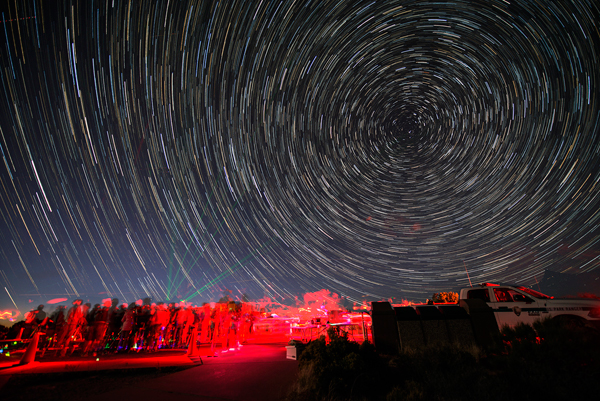
Astronomy Day is Coming Up! How You Can Participate
It’s that time of year again! It’s Astronomy Day! Join fellow enthusiasts on Saturday May 11th for a plethora of fun and exciting events in celebration of all things astronomical.

The Moon Bumbles Into the Beehive Friday
The thick crescent Moon occults oodles of stars in the Beehive star cluster Friday evening for much of the Americas.

Meet Spica, the Ear of Grain
Meet Spica, the "ear of grain" in the constellation Virgo. This bright star is actually part of a binary orbiting so closely, they tug each other out of spherical shapes and whirl around each other every four days.
This Week’s Sky at a Glance, May 3 – 11
Three zero-magnitude stars shine after dark in May: Arcturus high in the southeast, Vega much lower in the northeast, and Capella in the northwest.
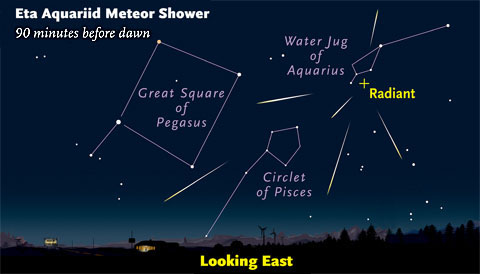
An Excellent Year for the Eta Aquariid Meteor Shower
With no Moon to muss, take a crack at seeing the Eta Aquariids, which could be one of the better meteor showers of the year.
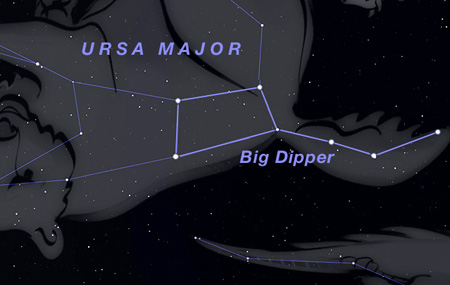
May 2019: The Stars of Spring
Our Sky Tour podcast for May 2019 starts with meteors created by Halley's Comet and then helps you find the best stars and constellations in the evening skies of late spring.
This Week’s Sky at a Glance, April 26 – May 4
The dim Little Dipper extends to the right from Polaris. High above the Little Dipper's bowl you'll find the bowl of the Big Dipper.

Astronomy and Stargazing Projects
Hunting Bright Variable Stars in M5 and M13
Globular clusters are packed with variable stars, some of which are easy to see and follow in amateur telescopes. We explore M5 and M13, two of the season's finest.
This Week’s Sky at a Glance, April 19 – 27
The Pointer stars forming the end of the Big Dipper's bowl point straight down toward Polaris. Face north and look way up.

Astronomy and Stargazing Projects
Double-Star Date with a Dragon
For your enjoyment, a diverse selection of double stars in Draco for small and medium telescopes.

Stargazer's Corner: Adventures Under the Night Sky
Las Brisas Observatory: 37 Years and Counting
Can a $400 observatory built from old shipping crates and a dome riding on golf balls withstand the harsh environments of the Rocky Mountains for 37 years?
This Week’s Sky at a Glance, April 12 – 20
The Moon shines high in the southwest with Pollux and Castor to its upper right and brighter Procyon farther below it.

Yanking Markarian's Chain
Markarian's Chain, a remarkable arc of bright galaxies, is your ticket to the Virgo Cluster. Hop aboard!
This Week’s Sky at a Glance, April 5 – 13
The Moon, stars, planets, constellations -- sky sights every night for the unaided eye, binoculars and telescopes, from Sky & Telescope magazine.

Stargazer's Corner: Adventures Under the Night Sky
The Story Behind the Shot: "Super Blood Wolf Moon" Eclipse of 2019
Reader Michael Rossacci shares the story behind his capture of the January 20, 2019, total lunar eclipse.

Twinkle, Twinkle Quasi-Star — 12 Quasars for Spring Evenings
Quasars are among the brightest and most distant objects in the universe. Many are visible in amateur scopes if you know just where to look. We'll help you track them down.
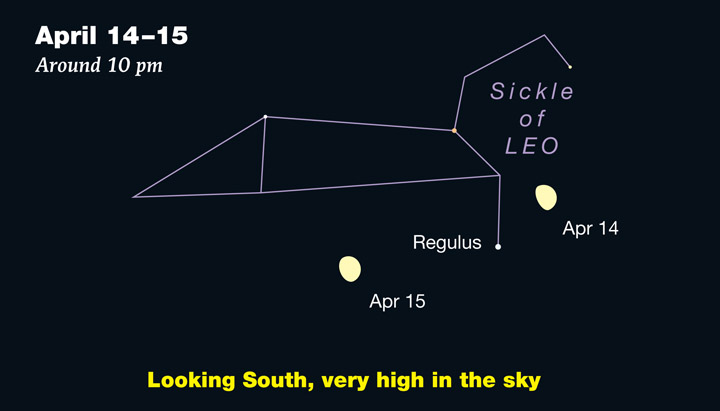
April 2019: Critters on the March
The Sky Tour astronomy podcast for April 2019 takes you on a guided tour of the predawn sky and then helps you find a Hunter, a Lion, and a Bear in the evening sky.
