SUNSET:

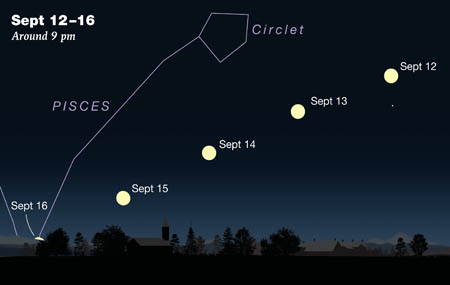
September 2019: Triangle Time
Download September's Sky Tour astronomy podcast for tips on observing Jupiter, Saturn, and the easy-to-spot Summer Triangle.

This Week’s Sky at a Glance, August 30 – September 7
Altair is the brightest star on the southern side of the sky after dark this week. (We're not counting the planets Jupiter and Saturn, far to its lower right.)

Be a Warrior — Tackle a Trojan Asteroid
You've seen Jupiter and its four brightest moons. Now meet the rest of the family — the Trojan asteroids.
This Week’s Sky at a Glance, August 23 – 31
Jupiter is that white dot in the south as twilight fades. After dark it moves lower toward the southwest. Orange Antares, much fainter, twinkles 7° to Jupiter's lower right.

Get to Know the Ghostly Galaxies of Sagittarius
We often think of Sagittarius as home to one galaxy only — the Milky Way. But two members of the Local Group and a smattering of fainter galaxies reside here, too.

Stargazer's Corner: Adventures Under the Night Sky
Where is the Tropic of Capricorn?
A well-traveled geophysicist recounts his curious findings at a prominent geographic benchmark in the Southern Hemisphere.

The RAC Summer Star Party
It's high summer and time to party — star party, that is. The RAC Summer Star Party offered fun, friends, and some good, clear nights this year. As is typical for New England, the spring season was wet and cloudy with few opportunities for extended observing sessions. But at least…
This Week’s Sky at a Glance, August 16 – 24
As nights turn chilly, the Great Square of Pegasus lifts up in the east, balancing on one corner. From its left corner extends the main stars of the Andromeda constellation.

Good Morning, Orion!
An August jaunt at dawn reacquaints us with the constellation Orion, the harbinger of winter.
This Week’s Sky at a Glance, August 9 – 17
As nights turn chilly, the Great Square of Pegasus lifts up in the east, balancing on one corner. From its left corner extends the main stars of the constellation Andromeda.

Perseid Prospects, Mornings with Mercury and the Lunar X
With the Perseid shower, a great morning apparition of Mercury, and a chance to see craters scratch out an X on the moon, skywatchers have a busy week ahead!
This Week’s Sky at a Glance, August 2 – 10
The Big Dipper hangs diagonally in the northwest after dark. From its midpoint, look to the right to find Polaris (not very bright) glimmering due north as always.

August 2019: Stars of Summer
Download August's Sky Tour astronomy podcast for tips on observing the Perseid meteor shower and the key planets, stars, and constellations in the evening skies of summer.

Astronomy and Stargazing Projects
Wallow a While in the Lagoon Nebula
We take a dip in one of summer's finest nebulae and explore everything from spooky Bok globules to the tornadic Hourglass Nebula. Don't forget your snorkel, er, telescope! Sometimes a single deep-sky object becomes your whole universe. So it was for me when I took several deep wades in the…

August Will Have Two New Moons! What’s the Big Deal?
First there were "blue Moons;" now there are "black Moons." What do these terms mean . . . and do they matter?
This Week’s Sky at a Glance, July 26 – August 3
Jupiter and Saturn stand out in the southern sky these evenings.
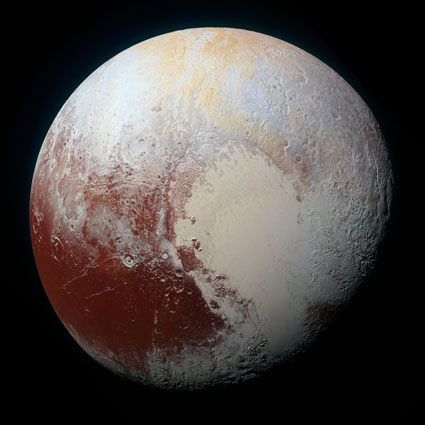
Lonely Pluto Is More than a Speck
With Saturn pointing the way, it's easy to venture into the Kuiper Belt this summer and pay a visit to Pluto.
This Week’s Sky at a Glance, July 19 – 27
The white "star" glaring in the south during and after dusk is Jupiter. Fainter, orange Antares fainter twinkles to its lower right. Saturn glows far to Jupiter's left.

Celebrate Apollo 11 with a Visit to Armstrong, Aldrin and Collins Craters
Find the craters named for the three astronauts who flew the first manned mission to land on the Moon.
This Week’s Sky at a Glance, July 12 – 20
Jupiter is that white point glaring in the south during and after dusk. Orange Antares, fainter, twinkles to its lower right.