 SUNSET:

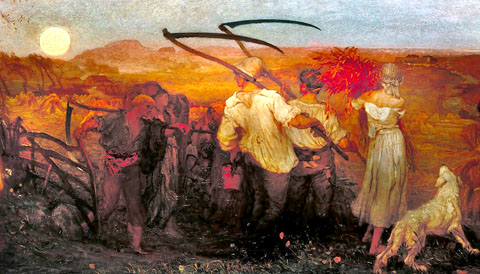
Here Comes the Harvest Moon!
This month's Harvest Moon will be up early to light the night as well as act as a beacon for watching the annual fall bird migration through a small telescope.

This Week’s Sky at a Glance, September 14 – 22
The Moon hangs over Antares at nightfall on September 15th, as shown above. Far left of the Moon are Saturn, then Mars. To the Moon's lower right shines Jupiter.

Equuleus, the Constellation Nobody Knows
Often passed over, the constellation of the Little Horse has charms of its own, including double stars, galaxies, and asterisms. Let's saddle up and go for a ride.
This Week’s Sky at a Glance, September 7 – 15
Scorpius lies down in the south-southwest as night arrives. Its brightest star, Antares, appears about midway between Jupiter in Libra and Saturn in Sagittarius.
Stargazer's Corner: Adventures Under the Night Sky
Mars 2018: An Old Friend Returns
The author shares his encounters with Mars at perihelic opposition over the course of his years as an amateur astronomer.

Explore the Veil Nebula
The Veil Nebula, the tattered remains of an ancient supernova explosion, is one of the most spectacular objects in the night sky. Did you know it has two dozen parts visible in amateur telescopes?

Meet Pollux, the Red Giant with a Planet
Meet the stars: Pollux, one of the Twins in the sky, is a star that has swelled into its red giant phase while holding onto its Jupiter-like exoplanet, dubbed Thestias.

Tour September's Sky: Goodbye, Venus!
As told in this month's astronomy podcast, Venus is disappearing in the west after sunset. So September offers you a final chance to see four bright planets at once.
This Week’s Sky at a Glance, August 31 – September 8
As twilight fades, spot Venus very low in the west-southwest. Upper right of it on September 1st, by just 1.3° is Spica, a 1st-magnitude star but less than 1% as bright as Venus. Can you see Spica naked-eye through the twilight?

Stargazer's Corner: Adventures Under the Night Sky
When Dusk Descends at Stellafane
A dazzling day greeted S&T Observing Editor Diana Hannikainen when she attended the Stellafane Convention this past August, but it was the dome of night sky that truly sparkled.

Comet 21P/Giacobini-Zinner Shines in September
Watch a binocular-bright comet leapfrog across Auriga in the next few weeks before a remarkable conjunction with the bright star cluster, M35.
This Week’s Sky at a Glance, August 24 – September 1
Friday, August 24 • For yet another week, four bright planets await your view at once as twilight fades. From right to left, they are Venus very low in the west-southwest, Jupiter in the southwest (upper left of Venus), Saturn in the south a little higher than Jupiter, and…

See All Eight Planets in One Night
Four planets are great, but how about eight? You can see them all in a single night in the next couple weeks — if you play your cards right.
This Week’s Sky at a Glance, August 17 – 25
Lined up nearly vertically below the Moon August 18th are the stars marking the head of Scorpius. Lower left of the Moon is brighter Antares, an orange-red supergiant star. Farther left of the Moon are Saturn, then bright Mars.

Astronomy and Stargazing Projects
Shadow Play — Summertime Dark Nebulae for Binoculars
Using only binoculars, we explore a host of inky dust clouds, the dark nebulae that smudge the Milky Way on late summer nights.
This Week’s Sky at a Glance, August 10 – 18
Tonight's Moon, stars and planets -- Sky & Telescope magazine's daily sky sights for the naked eye, binoculars and telescopes.

R Coronae Borealis Awakes and Pluto Blocks a Star
Sometimes, it's just as exciting to watch a celestial object fade or disappear as it is to see it explode. We celebrate the "return" of a mysterious variable star and prepare for Pluto to occult a star.
This Week’s Sky at a Glance, August 3 – 11
Friday, August 3 • This week four bright planets shine at once during twilight, if you have low horizons in the right places. From right to left, they're Venus low in the west, Jupiter higher in the southwest, Saturn at about the same height in the south-southeast, and brilliant…
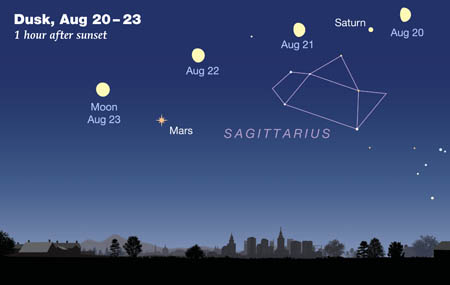
Tour August's Sky: Perseid Time!
As told in this month's astronomy podcast, August offers excellent viewing conditions for the always-flashy Perseid meteor shower — and a chance to see four bright planets at once.

The Fun Begins at M22
Add a dash of random to your night sky viewing plans and you're guaranteed an adventure. We'll start ours with the famous globular M22 and see where it takes us.
