 SUNSET:


This Week’s Sky at a Glance, November 9 – 17
The "star" glowing upper left of the crescent Moon during and after dusk tonight (November 10) is Saturn, currently 4,075 times farther away. Far to its upper left, Mars shines brighter.

Three Upcoming Sky Events We Can All Share
Comets, meteors, and Moon: Share the night sights that are coming our way!
This Week’s Sky at a Glance, November 2 – 10
Friday, November 2 • Look for Capella sparkling low in the northeast these evenings. About three fists at arm's length to Capella's right, look for the fingertip-sided Pleiades cluster. They're early markers of the cold months to come. Above the space between them are the stars of Perseus, astride the…

Tour November's Sky: Cassiopeia's Clan
This month's astronomy podcast takes you on a tour of a dysfunctional "royal family" in the northern sky — along with tips for viewing two meteor showers.

Trick-or-Treat with the Seven White Dwarfs
In the Halloween spirit, we pay a visit to the cosmic dead, those tiny stars that should just fade away but always seem to be causing trouble instead.
This Week’s Sky at a Glance, October 26 – November 3
Mars shines in the southern sky these evenings. Saturn glows lower in the southwest.

Double Your Deep-Sky Pleasure with "Two-in-the-View"
Once you've seen two, a single won't do. Enjoy this selection of multiple deep-sky objects visible in the same field of view of your telescope.
This Week’s Sky at a Glance, October 19 – 27
Lots of sky sights this week: Jupiter, Saturn, Mars, Orionid meteors, stars in balance, telescopic occultation by the asteroid Kleopatra, more.

Get Ready for International Observe the Moon Night
Fascinated by our Moon? Want to know more about it? Join fellow lunar enthusiasts on Saturday, October 20th, for International Observe the Moon Night!

Meet Deneb, the Bright but Distant Star
Deneb, in the constellation Cygnus, is a star that shines brilliantly despite being one of the farthest you can see with the unaided eye.

Fall Astronomy Day 2018
Curious about astronomy? No plans for Saturday? Well, you’re in luck! Saturday October 13 is Fall Astronomy Day and your local amateur astronomical community has all sorts of fun things in store for you.
This Week’s Sky at a Glance, October 12 – 20
Mars and Saturn are the two planets of the evening sky this week, the brightest points of light in the south. The Moon passes them both.

How Dark Is Your Night Sky?
Traditional and digital tools can help you learn the naked-eye magnitude limit of your sky and find out if the darkness has changed at your observing site.
This Week’s Sky at a Glance, October 5 – 13
Vega is the brightest star very high in the west after nightfall in early autumn. Arcturus, equally bright, is getting low in the west-northwest.

The Outer Planets Move In, plus an "Old Moon" Observing Challenge
As the bright planets march westward, Uranus and Neptune become the fresh new faces of fall. And if you've never seen an ultra-thin lunar crescent, here's your chance.
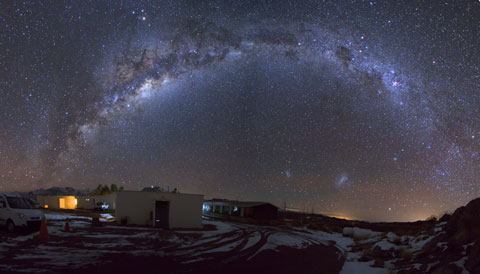
Stargazer's Corner: Adventures Under the Night Sky
Chile: The Destination for Observing Clear Skies
The authors had the chance of a lifetime to see true dark skies when they joined the June 2018 cohort of the Astronomy in Chile Educator Ambassadors Program (ACEAP).
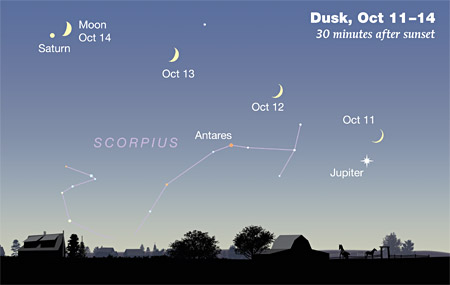
Tour October's Sky: Jupiter, Saturn & Mars
Download this month's astronomy podcast to get "when and where" guidance on finding bright planets, evening constellations, and meteors shed by Halley's Comet.
This Week’s Sky at a Glance, September 28 – October 6
Friday, September 28 • Late this evening, spot the little Pleiades cluster to the upper left of the Moon, as shown at right. When we see the Pleiades climb the eastern sky in autumn, their tiny dipper pattern stands on its handle. Saturday, September 29 • There's roughly a…
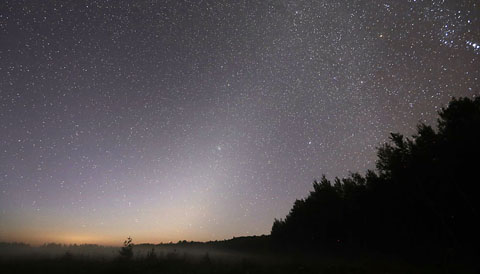
The Sacred Hour Before Dawn and an Evening Comet Surprise
Silence can sometimes be in short supply, but one sure place to find it is under a starry sky before the first blush of dawn. Comet 29P/Schwassmann-Wachmann erupts again!
This Week’s Sky at a Glance, September 21 – 29
Mars, in southern Capricornus, fades from magnitude –1.5 to –1.3 this last week of September, still as bright as Sirius. It shines highest in the south soon after dark and sets around 2 a.m.
