 SUNSET:


Meet Polaris, the North Star
Meet Polaris, the North Star. It's not the brightest star in the sky, but it's within a degree of the north celestial pole.

The Lyrid Shower Kicks Off Year of Great Meteor Watching
The annual Lyrid meteor shower will shoot off silent fireworks on Earth Day this Sunday. We explore the shower's origin and how best to view and photograph it.

Spring Astronomy Day 2018
Looking for something to do on Saturday? Make plans to celebrate Astronomy Day on April 21st!

This Week's Sky at a Glance, April 13 – 21
After dark, Leo walks horizontally across the meridian high in the south. His brightest star is Regulus, the bottom star of Leo's Sickle.

Asteroid 113 Amalthea to Occult Star
Here's an opportunity for amateur astronomers to reveal more about asteroid Amalthea's satellite.

Dusty Vistas: Best Gritty Galaxies of the Season
Stare up at the Milky Way band on a dark night and you'll see missing pieces from clouds of foreground dust that absorb the light of distant stars. There are other mottled "milky ways" just like ours, millions of light-years away.

Big Scope Breakout: New Supernovae, Novae, Bright Spot on Saturn
The sky's been bursting with exploding stars this season. Plus there's a new storm on Saturn. What's a skywatcher to do? Haul out the scope!
This Week's Sky at a Glance, April 6 – 14
The two Dog Stars stand vertically aligned around the end of twilight. Look southwest. Brilliant Sirius in Canis Major is below; Procyon in Canis Minor is high above.

Put a Little Bit of Leo in Your Life
We lift the Lion's paw to find a bright, red variable star, a germinating planetary nebula, galaxies rarely visited, and a diversity of doubles.
This Week's Sky at a Glance, March 30 – April 7
After nightfall, Orion is still well up in the southwest in his spring orientation: striding down to the right, with his belt horizontal. Shining above the belt is bright orange Betelgeuse. Down below the belt is bright white Rigel.
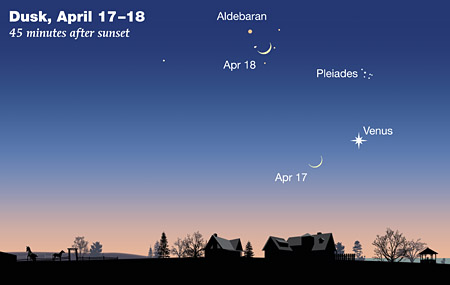
Tour April's Sky: Venus Ascending
This month's astronomy podcast guides you around the nighttime sky during April, giving you easy-to-follow help for finding bright planets and key stars after the Sun goes down.

Astronomy and Stargazing Projects
What Southern Stargazers Long to See in Northern Skies
Southern Hemisphere objects like Omega Centauri and the Magellanic Clouds make Northern Hemisphere observers envious. Today, we turn the tables and find out what those living in negative latitudes would love to see up north.

Meet Sirius, the Brightest Star
Meet the stars near Earth, starting with the brightest: Sirius, the "Dog Star."

Last Chance to See Doomed Chinese Space Station
China's premier space station, Tiangong 1, has a one-way ticket into the Earth's atmosphere later this month. See it before it's no more.
This Week's Sky at a Glance, March 23 – 31
The first-quarter Moon shines high above Orion on the evening of March 24, 2018, in the feet of Gemini below Castor and Pollux.

Walking with Arcturus
Stars are time machines that can transport us into the past or future. They can also illuminate our own personal journeys, as Arcturus did for me one night.
This Week's Sky at a Glance, March 16 – 24
Watch the low in the east-northeast for the rise of the "Spring Star," Arcturus. Find the Big Dipper high in the northeast and follow the curve of its handle far around and down to see where Arcturus will be.

Budding and Ancient Star Clusters of the March Sky
Open clusters present a mystery. Some fall apart in a few hundred million years, others hang around for billions. Join me as we visit both the youngest and oldest star clusters in the Milky Way.
This Week's Sky at a Glance, March 9 – 17
Friday, March 9 • Just after twilight fades away this week, bright Sirius stands due south on the meridian. Sirius is the bottom star of the equilateral Winter Triangle. The Triangle's other two stars are orange Betelgeuse (Orion's shoulder) to Sirius's upper right, and Procyon to Sirius's upper left.…

A Beginner's Guide to the Southern Hemisphere Sky
How and when to see Alpha Centauri, the Southern Cross, Omega Centauri, and many other celestial sights on a trip south of the equator.
