 SUNSET:


Catch these Comets in 2018
We look ahead to see what fuzzy visitors, new and returning, will brighten the nights ahead. One and possibly two naked-eye comets are on the way.

This Week's Sky at a Glance, January 5 – 13
Orion strides up the southeastern sky after nightfall in January. Above it glitters Aldebaran. Above Aldebaran are the Pleiades. Far left of them shines Capella.

Mars Flies By Jupiter in a Close Dawn Conjunction
The new year opens with the magnificent pairing of the solar system's largest planet with one of its smallest.

Poor Year for the Quadrantid Meteor Shower
The Quadrantid meteor shower is usually one of the year's best. But this year's event will be spoiled by strong light from an intruding Moon.
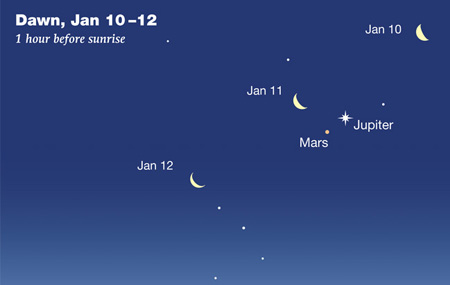
Tour January's Sky: Planet Pairings at Dawn
January's astronomy podcast describes how to spot Mercury, Mars, Jupiter, and Saturn in the predawn sky during January — plus you'll learn about a "trifecta" full Moon at month's end.
This Week's Sky at a Glance, December 29 – January 6
In the evening sky tonight, look lower left of the waxing gibbous Moon for Aldebaran, and upper left of the Moon for the Pleiades.

Solar and Lunar Eclipses in 2018
Two total lunar eclipses occur this year, the first since late 2015, in January and July. Meanwhile, three solar eclipses take place in 2018 — all of them only partial cover-ups.

The Best Meteor Showers in 2018
More than a dozen times each year, we experience a pulse of "shooting stars" from an annual meteor shower. Sky & Telescope predicts that the two best meteor showers in 2018 will be the Perseids in mid-August and the Geminids in mid-December.
This Week's Sky at a Glance, December 22 – 30
Sirius, the Dog Star, sparkles low in the east-southeast after dinnertime. Procyon, the Little Dog Star, shines in the east to Sirius's left.

Meet the Shy Side of the Local Group
The Local Group galaxies and their kin are the building blocks of the most magnificent galaxies in the universe. Let them inspire your winter nights.
This Week's Sky at a Glance, December 15 – 23
As the Summer Triangle sinks in the west, Altair is the first of its stars to go. Start by spotting bright Vega in the northwest at nightfall. The brightest star above it is Deneb. Altair is farther to Vega's lower left.

What's the Thinnest Crescent Moon You Can See?
A slender Moon is an beautiful and inspiring sight. December and January offer several opportunities to see these exceptional crescents.

Fantastic Year for Geminid Meteor Shower
Mark the date: December 13th. That's the night the Geminid meteor shower peaks. Highlighted by the return of its parent asteroid 3200 Phaethon, this year's show promises to be one of the best ever.
This Week's Sky at a Glance, December 8 – 16
Astronomy is an outdoor nature hobby. For an easy constellation guide to the evening sky, use the map in the center of Sky & Telescope magazine.
This Week's Sky at a Glance, December 1 – 9
Now that the Pleiades and Aldebaran are up in due east, can Orion be far behind? Orion's entire iconic figure, formed by its brightest seven stars, takes about an hour and a quarter to cross the horizon below them.
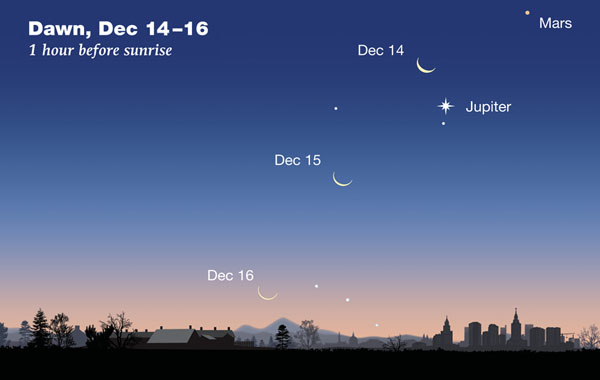
Tour December's Sky: See 3 Planets at Dawn
As you'll hear in December's astronomy podcast, early risers are treated with views of Jupiter (obvious), Mars (not as easy), and Mercury (timing is everything!).

Asteroid 3200 Phaethon: Geminid Parent at Its Closest and Brightest!
The parent asteroid of next month's Geminid meteor shower, 3200 Phaethon, is about to make a historically close flyby. Get ready to watch it race across the sky.
This Week's Sky at a Glance, November 24 – December 2
When Fomalhaut is due south, you'll always find the first stars of Orion beginning to rise in the east, and the Pointers of the Big Dipper due north below Polaris.

Invite Ross 128 Over This Thanksgiving
With exoplanet Ross 128b in the news, we pay a visit to the star that sustains this potentially habitable exoplanet.

Stargazer's Corner: Adventures Under the Night Sky
Simple Formulas for the Telescope Owner
Simple telescope formulas — how to calculate what you need to know about your telescopes, oculars, and binoculars.
