 SUNSET:


This Week's Sky at a Glance, October 28 – November 5
In twilight Friday evening, Saturn, Venus, and Antares form a nearly vertical, curving line low in the southwest. Watch the configuration change this week.

Spooky Nebulae for Halloween Nights
While the kids are gathering sweet treats this Halloween, get a celestial scare with these frightful deep-sky sights.

8th-magnitude Nova in Sagittarius
A nova in Sagittarius, discovered a few nights ago by a Japanese amateur, has become bright enough to see in binoculars.
This Week's Sky at a Glance, October 21 – 29
Saturn and Antares form a compact triangle with Venus, low in the southwest at dusk on Friday. The modest Orionid meteors continue before dawn Saturday.

Halley On Fire! Orionids Peak This Week
The annual Orionid meteor shower is active all week, peaking Friday morning October 21st. If you're up before dawn, you might just see these Halley's Comet castoffs come to life.

Stargazer's Corner: Adventures Under the Night Sky
Spektrum: A Pro-Am Journal for Spectroscopy
If you're interested in how celestial objects reveal themselves simply by analyzing their light, you'll enjoy this free online international journal.

Moon to Cover Bright Star Aldebaran
This eye-catching occultation occurs late on October 18th (West Coast) and early on the 19th (East Coast). It's a grazing event as seen from Los Angeles and Denver.
This Week's Sky at a Glance, October 14 – 22
The full Moon rises around sunset on Saturday. Almost 20° to its left are the brightest stars of Aries. Like the Moon, faint Uranus is also at opposition.

Solar Forecasters Predict Chance of Auroras
The National Oceanic and Atmospheric Administration (NOAA) predicts a strong chance of geomagnetic activity tonight, October 13–14.

Plant Your Eyes In Delta Cephei's Fertile Triangle
The famous variable star Delta Cephei unlocks a box deep-sky treasures in a little-visited corner of Cepheus, the King.
This Week's Sky at a Glance, October 7 – 15
Jupiter and fainter Mercury have a close conjunction on Tuesday morning, October 11th. Look low due east about 45 minutes before your local sunrise time.

Resolving Andromeda — How to See Stars 2.5 Million Light-Years Away
At 2.5 million light-years away, you might think it's impossible to see individual stars in the Andromeda Galaxy. Let its largest star cloud, NGC 206, show you the way.

Stargazer's Corner: Adventures Under the Night Sky
Harrison Bay State Park's Star Walk
Inspired by a project featured in Sky & Telescope, Richard Clements and the Barnard Astronomical Society constructed a Star Walk in Harrison Bay State Park, Tennessee.
This Week's Sky at a Glance, September 30 – October 8
A twilight challenge: About half an hour after your local sunset time, look for Venus very low in the west-southwest through the twilight.
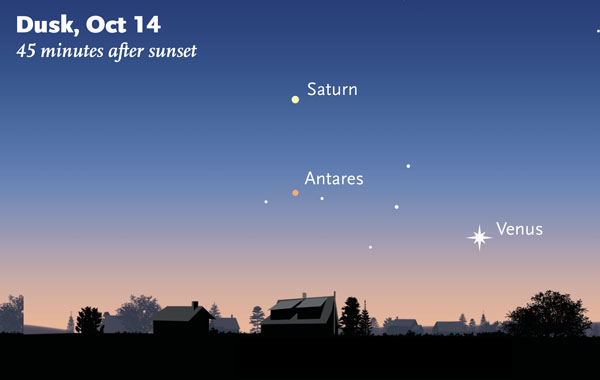
Tour October's Sky: Planets in Transition
This month is your last chance to catch Saturn in the evening sky. But Mars is still hanging around, and Venus is climbing higher each evening.

Mercury Punctuates The False Dawn
Early risers get a triple treat this week and next: a ravishing dawn Moon, an excellent apparition of Mercury, and a hint of Halloween in the ghostly zodiacal light.
This Week's Sky at a Glance, September 23 – October 1
The "W" of Cassiopeia stands high in the northeast after dark. In the southwest at dusk, Saturn and Antares continue to pull farther to the right of Mars.
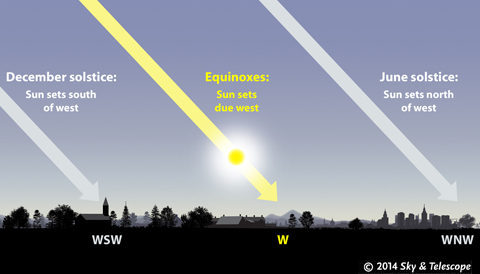
We Crossed the Equinox September 22nd
The fall equinox (spring equinox for the Southern Hemisphere) comes on September 22, 2016, at 4:02 p.m. Eastern Daylight Time (20:02 UT).

Will the Real Albireo Please Stand Up?
A stunning double star, Albireo is also a bit of an enigma. Is it a true binary or the result of a chance alignment?
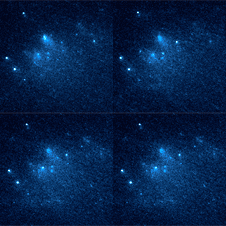
Hubble Watches as Comet 332P Breaks Apart
Back in January, a team of observers had a hunch that Comet 332P/Ikeya-Murakami was rapidly falling apart — and they were right!
