 SUNSET:

 2
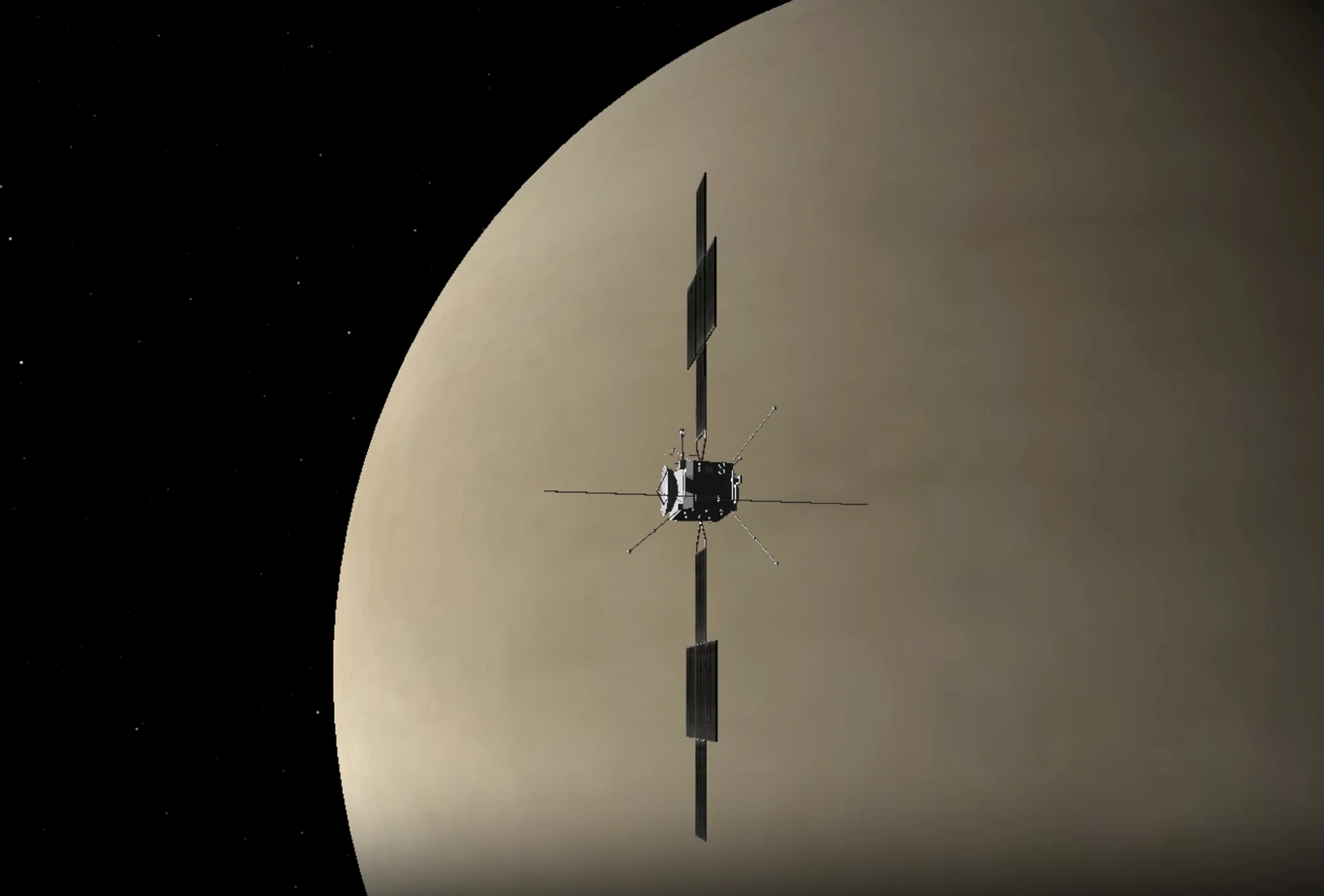
2The European spacecraft en route to Jupiter, named JUICE, completed its only flyby of the planet Venus on August 31st.
ESA
It’s a true irony of modern spaceflight: Sometimes, a spacecraft has to dive deeper into the inner solar system to find the energy to fling itself outward. That’s just what the European Space Agency’s Jupiter Icy Moons Explorer (JUICE) mission did on Sunday, as it made its only flyby past Venus.
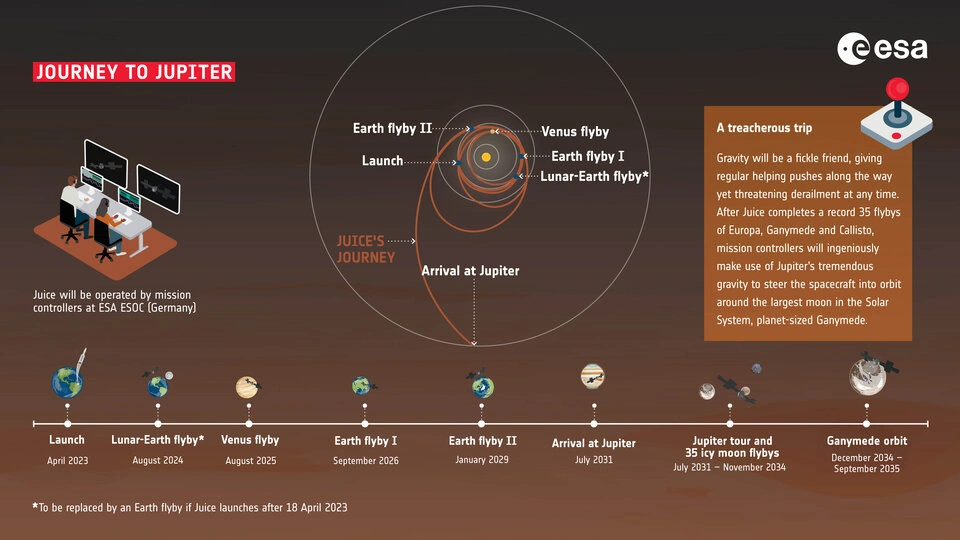
The spacecraft passed 6,923 miles (11,141 kilometers) from Venus on Sunday, August 31st. This is the second flyby of four for JUICE as it makes its way to Jupiter: one past Venus and three past Earth.
Reminder that ESA's Jupiter Icy Moons Explorer (Juice) flies past Venus this weekend. The spacecraft was designed to feel at home in the cold, dark environment of the Jupiter system, and it is too hot at Venus to turn the cameras on. Pics or it didn’t happen? You’ll have to trust us on this one.
— ESA Operations (@operations.esa.int) August 29, 2025 at 6:10 AM
Launched on an Ariane 5 rocket from the Kourou Space Center on April 14, 2023, JUICE is the heaviest spacecraft the European Space Agency (ESA) has ever placed into heliocentric orbit. At just under 6,000 kilograms (13,230 pounds), it's the fourth heaviest of all operational Sun-orbiting spacecraft. But even the massive Ariane 5 rocket only gave JUICE an escape velocity of 2.5 kilometers per second (5,600 mph). That speed is far lower than the 11 km/s velocity needed to make it to Jupiter. So four planetary flybys are needed to boost the mission on its way.
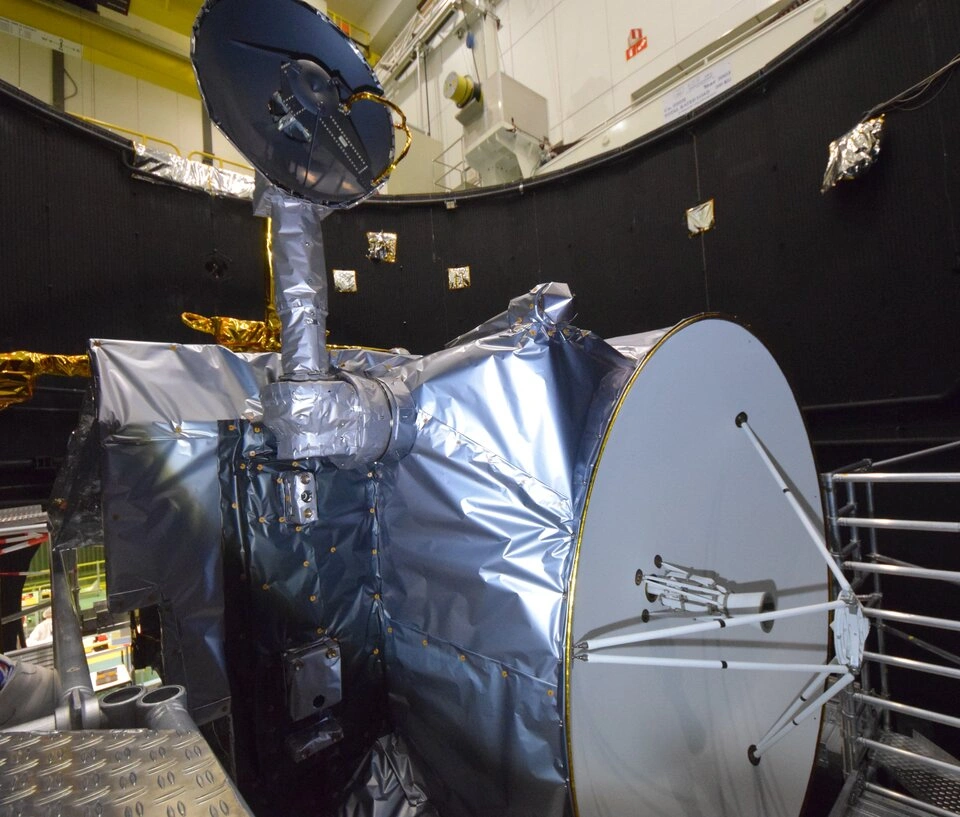
JUICE is also taking the heat on this flyby, withstanding temperatures of more than 250°C (480°F). To protect the spacecraft, JUICE’s main high-gain antenna is doing double duty as a Sun-shield, shadowing the spacecraft's remote-sensing instruments. Unfortunately, this situation also means that the spacecraft’s remote-sensing instruments must remain switched off during the pass for their protection.
“There are no science observations planned for the Venus flyby,” says Spacecraft Operations Manager Angela Dietz (ESA). “JUICE was built for a cold environment, and spacecraft operations are very constrained close to the Sun. The payload electronics are located in radiation-secure vaults that would warm up too much when operated during this mission phase. We are using the high-gain antenna as a heat shield, therefore we rely on the medium gain antenna for communications.”
With only the medium-gain antenna operating, downlink bitrates are extremely low; the spacecraft must remain in essential-systems-only mode.
ESA
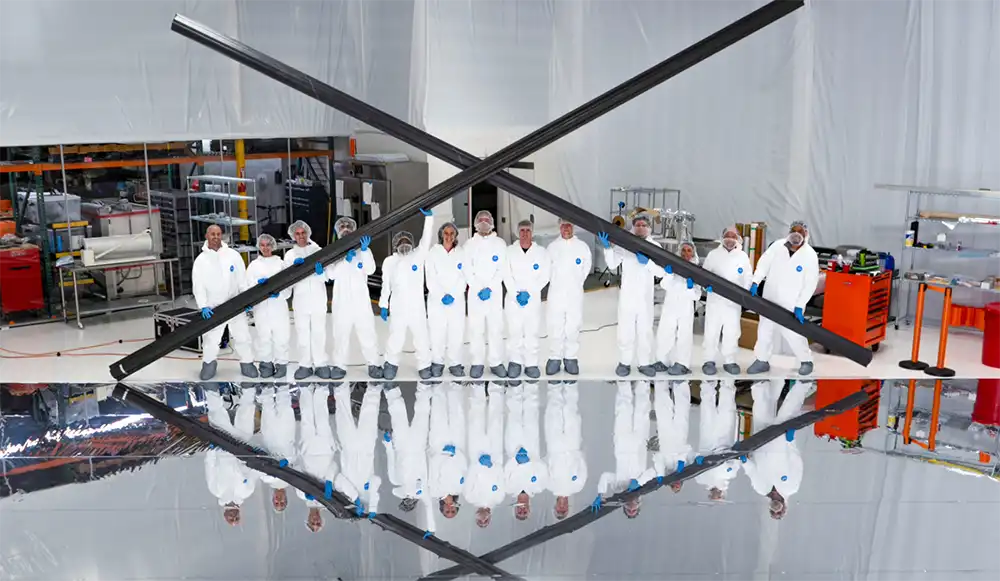
JUICE sports a pair of cruciform-shaped solar panels, needed for power at distant Jupiter.
The spacecraft is the first ESA mission to venture beyond the asteroid belt. Mission controllers had a scare this summer, when a communication anomaly occurred leading up to the Venus flyby. The problem first developed on July 16th, when ESA’s deep-space antenna located in Cebreros, Spain, failed to detect JUICE. Engineers traced the problem to a software timing bug, which caused a failure in the signal amplifier. The spacecraft was 11 light-minutes from Earth at the time, so any attempt to send commands to the spacecraft required 22 minutes to see if the commands had been received. Within a day, though, the team had implemented a software patch, which recovered communication with JUICE after realigning its main antenna with Earth.
“JUICE is performing very well,” says Dietz. “We performed two targeting maneuvers to fine-tune the trajectory — 10 weeks ahead and 4 weeks ahead of the flyby. Both were successful and we are well-aligned with the optimum targeting point.”
Timeline to Jupiter
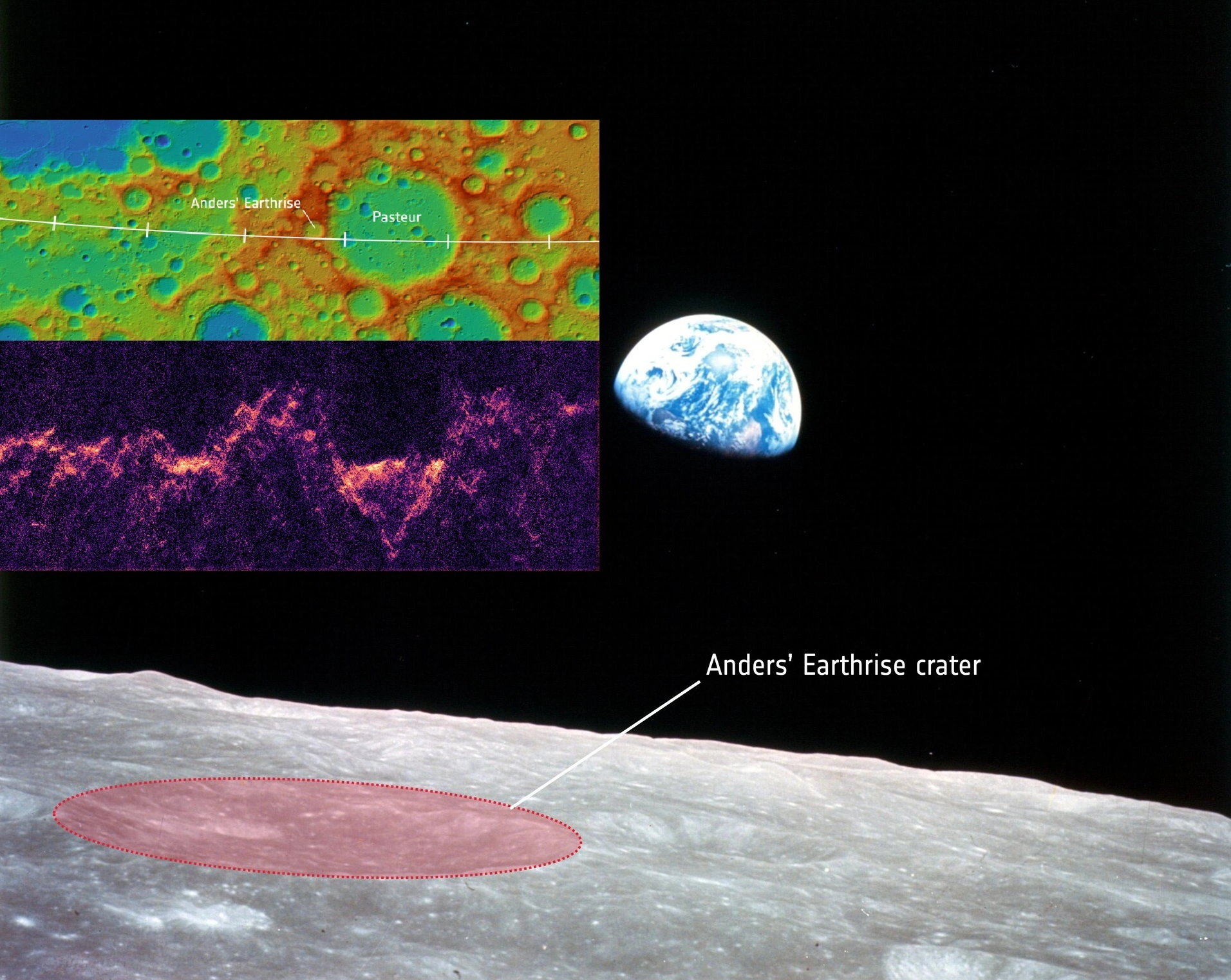
The spacecraft completed its first dual Lunar-Earth Gravitational Assist last year. For that pass, instruments were turned on and calibrated, in preparation for use at Jupiter. One crucial test was carried out for JUICE’s Radar for Icy Moon Exploration (RIME), which will make precise measurements of the surface of Jupiter’s moons. But RIME has experienced issues since launch; it's receiving electronic noise from other spacecraft sub-systems. During last year's flyby, RIME was allowed eight minutes of quiet time, with the lunar surface as a stand-in for a Jovian moon.
The instrument worked as planned, creating a unique radargram of Pasteur Crater, also known as the scene of the iconic Earthrise photo taken from Apollo 8.
ESA / JUICE / RIME / NASA / LRO / William Anders
What’s Next for JUICE
The next flyby for the mission will occur around Earth on September 29, 2026.
But first, JUICE will have the right vantage point to image interstellar Comet 3I/ATLAS, approaching within about 0.3 astronomical unit (au) of the object in early November.
“Indeed, we have decided to perform an observation campaign of the 3I/ATLAS body,” says Dietz. “JUICE is relatively close to 3I/ATLAS and can observe the comet shortly after its perihelion (when it’s 1.36 au from the Sun on October 29th). We plan to operate five remote sensing instruments in several observation slots throughout November.”
The team will continue an intensive pointing campaign to perform instrument calibrations through February of next year.
ESA
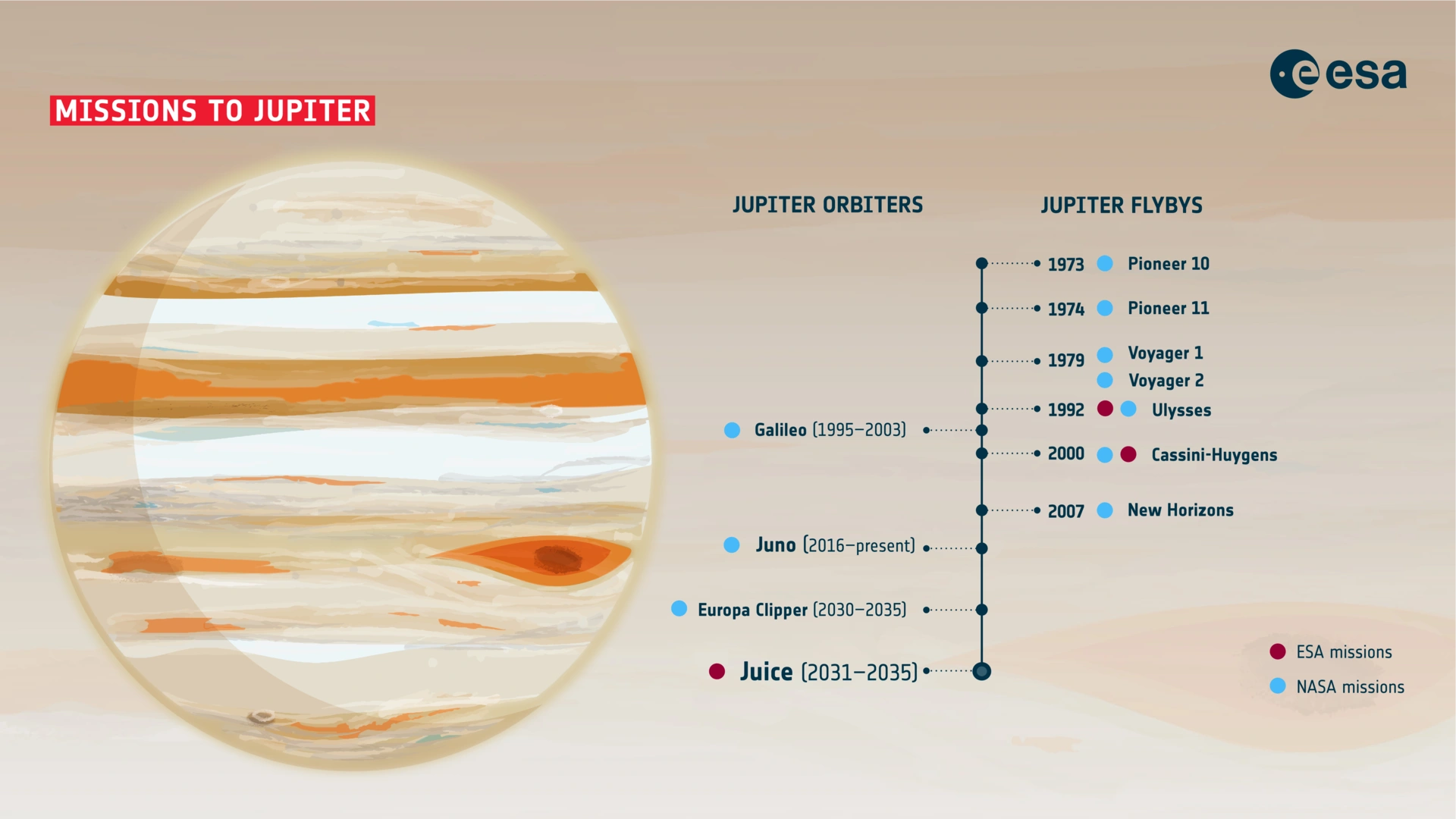
JUICE will enter orbit around Jupiter in July 2031. NASA’s Europa Clipper, also currently en route to Jove, will arrive the year prior on April 11, 2030. Then the primary mission for the spacecraft begins, as JUICE probes the surface and sub-surface layers of three icy moons. We’ll have both JUICE and Europa Clipper in action at Jupiter at the same time, as they probe the moons’ potential for subsurface oceans and life.
ESA
JUICE will complete 35 flybys past Europa, Ganymede, and Callisto, before entering into a 12-hour polar orbit around Ganymede in December 2034, for an eventual impact and disposal on the moon’s surface in 2035.
If you want to see more, check out ESA's full-length documentary on JUICE, available to watch on YouTube:
JUICE now says farewell to Venus, as we now look forward to seeing the mission fly past the Earth again next year.
About David Dickinson
David Dickinson is a freelance science writer, high school science teacher, retired enlisted U.S. Air Force veteran and avid stargazer. He currently resides with his wife Myscha in Bristol, Tennessee. David also writes science fiction in his spare time. He posts as @AstroDave on BlueSky about space news and sky-watching worldwide.



Comments
Bruce Frahm
September 5, 2025 at 6:48 pm
Why was JUICE not subject to the (as I understand it) ~ 25000 MPH velocity to escape earth orbit?
You must be logged in to post a comment.
David DickinsonPost Author
September 8, 2025 at 10:42 am
This has to do with the large mass of the probe, and using inward gravitational assists past Earth and Venus to send the mission out to Jupiter. I queried ESA on this, and they replied: "The 2.5 km/s escape velocity is what the Ariane 5 launcher provided. The rest of the speed we get from the gravity assists.
If there were a rocket powerful enough to send Juice off with an escape velocity of 11 km/s immediately after launch, it could go straight to Jupiter without doing any gravity assists at all."
You must be logged in to post a comment.
You must be logged in to post a comment.