 SUNSET:

 3
3Sometimes the obstacles in our path — such as clouds and light pollution — steer us not away from our goals but on a more meaningful path toward them.

Sometimes the obstacles in our path steer us not away from our goals but on a more meaningful path toward them. It turns out cloudy skies, blocked horizons, and some neighborhood light pollution were precisely what I needed.
After months of spending my nights dashing outside to catch a meteor shower, set up astrophotography equipment, or check for a reappearance of the aurora borealis, I’d forgotten what it’s like to look up at the sky without an agenda. When was the last time my gaze lingered over Cassiopeia to appreciate the constellation itself, instead of using the big “W” to point me toward M31 or the Double Cluster? I didn’t know.
I’d become dependent on apps and electronic devices. My routine was to check Stellarium and Sky & Telescope’s Interactive Sky Chart to make my observing plans. Throughout the day, I’d visit Clear Dark Sky and Astropheric for updates on viewing conditions. My Dwarf 2 and Dwarf 3 robotic telescopes required little effort from me. I could sit inside sipping hot tea and watching television while images of the Triangulum Galaxy built on my tablet screen. It was amazing! But after a while, I found myself feeling lazy and disconnected. I loved exploring the sky through telescopes and astrophotography, but my eyes weren’t quite as wide as they’d once been.
I decided to return to the fundamentals of stargazing. This meant no telescopes, robotic or otherwise. It would just be me, my eyes, and maybe a pair of low-power binoculars as I stretched out in my zero-gravity chair. “Eyeballs only” became my mantra. What I really wanted, though, was to recapture the awe and boundless enthusiasm I once had — to reclaim the beginner’s mind of stargazing.
The Northern Hemisphere’s circumpolar constellations were my starting point. I was dismayed to realize I could name only four of the five off the top of my head. Why is it so hard to remember Draco? The constellation is so big that I’ve had trouble tracing it across the sky, so it leaped to the top of my list — I decided to go dragon hunting.
You can guess what happened: Clouds, rain, and more clouds. Autumn descended on the Pacific Northwest around the same time I had my “beginner’s mind” brainwave. It seems inevitable that as soon as I make plans, the skies reward me with an endless parade of overcast nights.
Night after night, I ventured outside seeking stars to no avail. I set timers to remind me to stick my head outside again every hour or so. Clouds. I got up at 2 o’clock in the morning and just before dawn, hoping for an unobstructed view, but I was thwarted by cloud cover or a bright Moon. When there was a big enough cloud break, I used Vega as an anchor but found Draco’s long, twisting body obscured by our giant apple tree or washed out by the neighbor’s porch light. I could usually spot Cassiopeia easily enough between the trees, but clouds and other obstructions crept in on all sides. Discouragement was bleeding into dejection.
It was the same story the other night. A lucky gap in the clouds had me ducking outside to try again to lasso the Dragon in the northwest. And again: Clouds. Trees. Light pollution. I verged on cursing the sky.
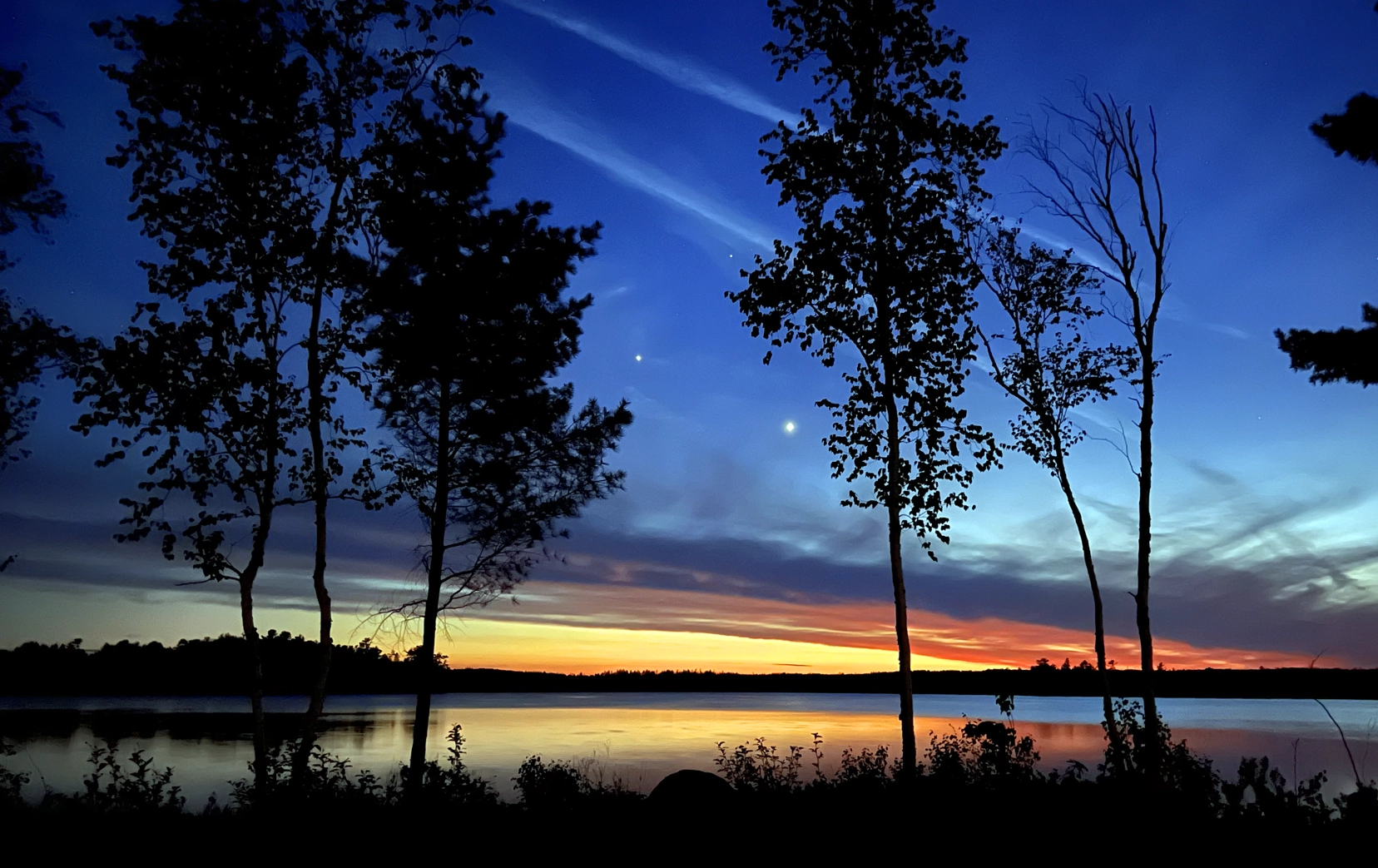
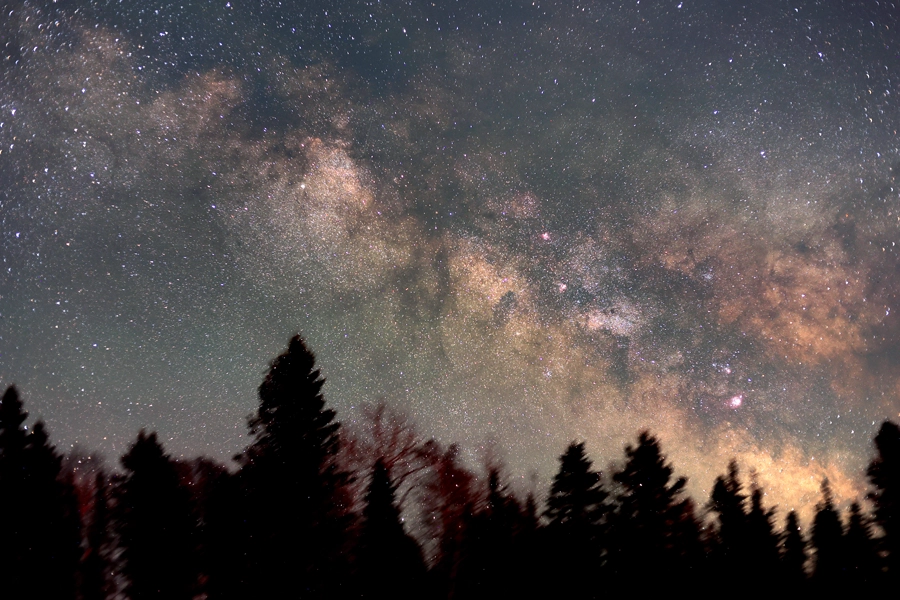
But then I paused. I stopped “looking for” and instead just looked. Above were seas of stars between wispy white masses, a cottony cobweb tapestry with starry gems peeking through. Without the larger context of the open sky, I couldn’t be certain what I was observing, but it was beautiful and mesmerizing.
Peering through my 7x35 binoculars, I spied a line of stars that resembled a stellar javelin, right next to a nearly perfect circle that formed a diamond ring. Through the tree branches, I saw a tiny fish, an anteater, and a squiggle that could have been a melted ampersand or a drunken snake — on-the-spot asterisms that fired my imagination.
Here it was: the tranquil awe that had me lying for hours beneath the stars not so long ago. This was the perspective I’d been missing, and all it required was for me to shelve my expectations.
I took a breath and remembered the nights I was eager to get outside just to see what was there. The nights when I didn’t have a plan or a target list, when I knew only a handful of star names, but remained outside as the temperature dropped and the skies grew darker. Wonder was my guide on those aimless nights when I went wandering through the stars.
I will eventually get back to beginner’s stargazing tactics. I will re-learn how to “arc to Arcturus and speed on to Spica” and will trace multiple paths to pinpoint the Andromeda Galaxy. But this effort will have to wait for more reliable clear skies, possibly next spring or summer.
In the meantime, I will remember to get out of my own way. After so much frustration, a partly cloudy autumn night helped me tap into the beginner’s mind of stargazing, and I found myself buoyed once again by the vastness and allure of the cosmos. Once I loosened my plans, the openness and eagerness returned.


Comments
OwlEye
November 6, 2024 at 1:41 pm
Thank you, Jennifer, for a great reminder.
Yesterday, from my home in De Soto, Kansas, I witnessed the most amazingly varied panoply of cloud and sky panoramas that I have seen in many years. Early in the post-sunrise morning, puffs of nimbostratus clouds moved swiftly and close to the ground, almost as if they were coming in for a landing, but only to release their burden of rain before blowing on. The rest of the morning and afternoon belonged to the ever-changing tapestry of cloud scrolling across the sky. Later in the day, patches and cracks of intense electric blue separated the overcast, speaking of clearer skies later in the day. Near sunset, the blue color of the sky on either side of the sun near the west-southwestern horizon was so clean and clear. . . like something viewed from a very high mountain top. The sun itself dropped into a generously wide rift of this clean sky and bathed the landscape in an intensely bright, orangish-yellow light. As nautical twilight came to an end, it looked as though it might be clear here at home, but by the end of astronomical twilight the sky was partly cloudy. Nevertheless, for the first time in many years, I was able to see the Andromeda Galaxy (M 31) and the Double Cluster in Perseus with my naked eyes using averted vision during gaps in said clouds. And this in Bortle 6.5 skies!! I have said it before, and I will say it again: I see what I can from where I am with what I have. Oh, and I declare today, November 6th, a day of national mourning.
DZ
You must be logged in to post a comment.
Jen Willis
November 8, 2024 at 4:47 pm
Thank you, DZ. That sounds like a wonderful experience. And for good times and bad, especially when I'm feeling overwhelmed or powerless, I like to remember the words of Arthur Ashe: "Start where you are. Use what you have. Do what you can."
You must be logged in to post a comment.
Jim White
November 18, 2024 at 11:39 am
Well said Jen!
As a part of our annual fair in August, I host a stargazing night at our local school. It is fun to show people planets, the Andromeda galaxy, double stars etc. with my 15-inch reflector. But what folks seem to enjoy the most is just looking up and marveling at the simple beauty of the night sky. They are amazed at the number of stars that are visible, or that you can see Andromeda with the naked eye.
You must be logged in to post a comment.
You must be logged in to post a comment.