 SUNSET:

 3
3A weakened geomagnetic field left Earth almost defenseless against harmful cosmic radiation 41,000 years ago, but that didn’t stop humans from thriving.
Early humans saw skies ablaze with aurora, from polar regions to the equator. But it wasn’t the Sun going wild: Earth’s magnetic shield nearly collapsed during what is known to be the last time our planet’s magnetic poles significantly shifted.
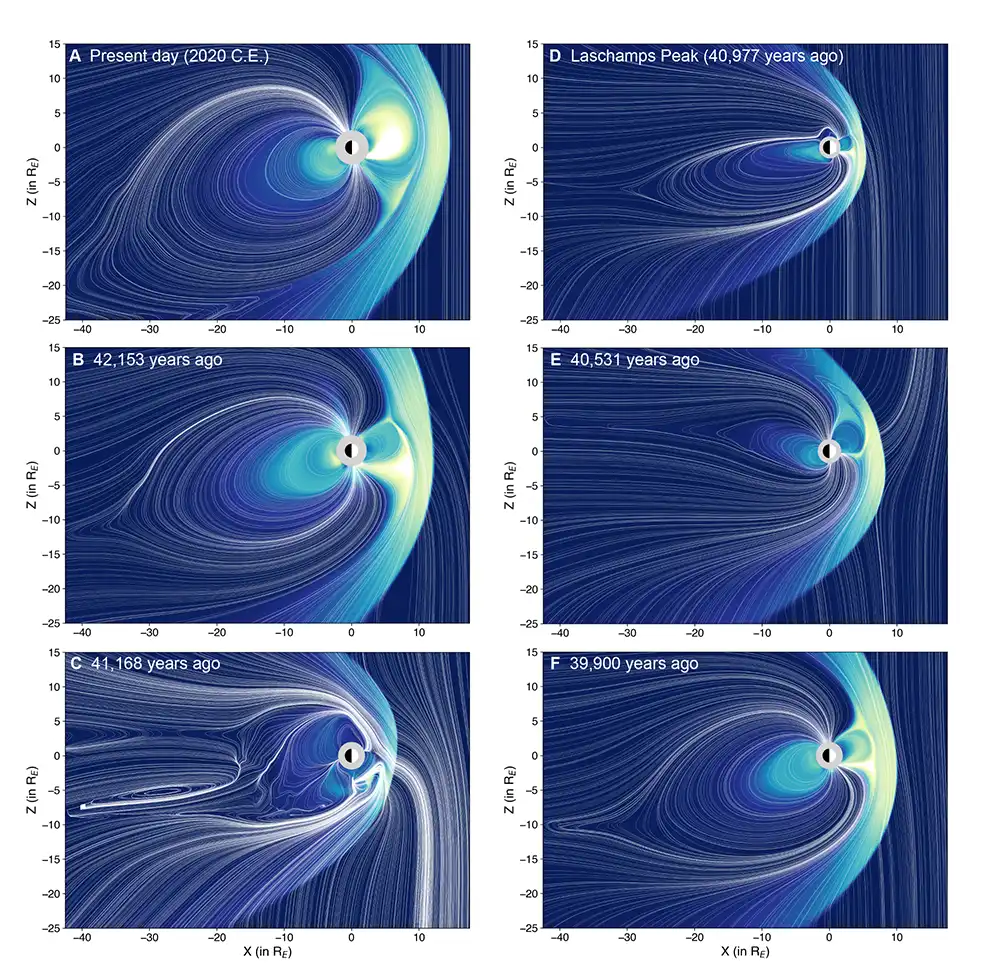
Known as a geomagnetic excursion, the phenomenon was already known to have happened. Now, scientists linked geomagnetic data with models of Earth’s space environment to visualize the event. Their images of the weakened field show which regions on our planet were most affected.
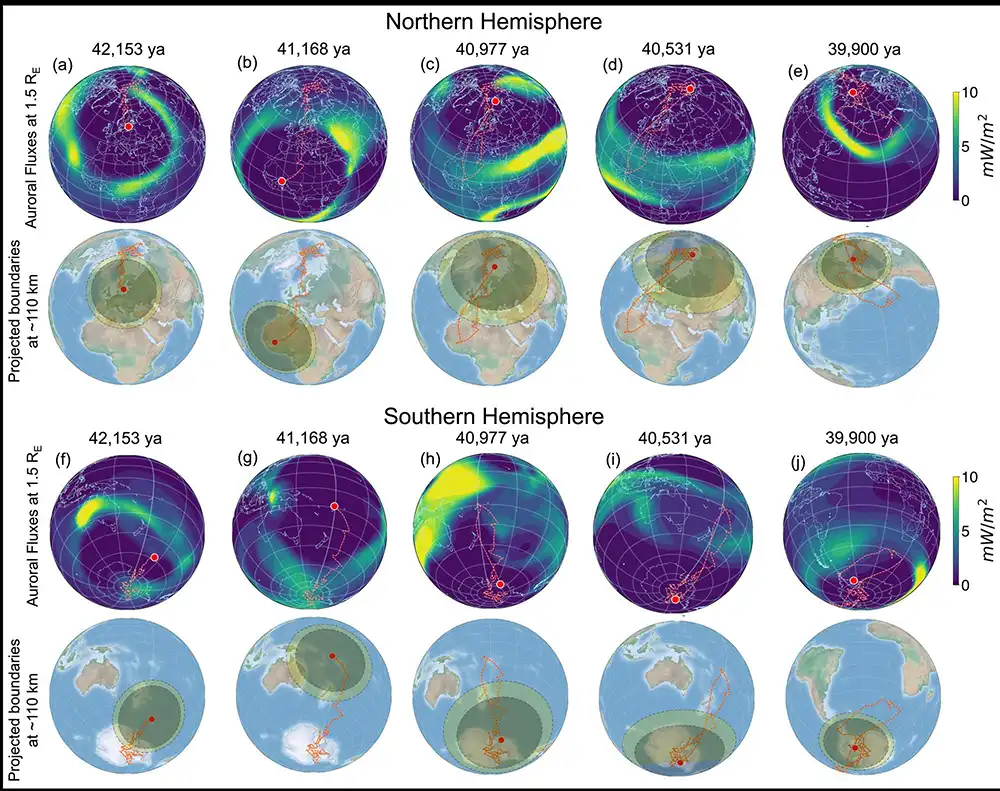
“We combined all of the regions where the magnetic field would have . . . allowed cosmic radiation or any kind of energetic particles from the Sun to seep all the way into the ground,” says Agnit Mukhopadhyay (University of Michigan), lead author of the study published in the April 18th issue of Science Advances. Coincidentally, these regions match some of the most inhabited by humans at the time. Our ancestors would have not only seen ubiquitous and stronger aurora than today, they would have also been exposed to high levels of cosmic and solar radiation.
Agnit Mukhopadhyay (University of Michigan)
Our protective shield: weakened and tilted
Earth’s magnetic field as well as our atmosphere usually protect us from the perils of ionizing radiation. Magnetic field lines running from north to south fend off charged particles — mostly protons or electrons — while stratospheric ozone absorbs harmful ultraviolet radiation. Charged particles only enter our atmosphere along “open” magnetic field lines that stretch from Earth into space. For a healthy geomagnetic field, open lines form around the magnetic poles, creating auroral ovals of some 3,000 km in diameter. Under the auroral ovals, northern and southern lights can be seen on almost any clear night.
During the Laschamps geomagnetic excursion, however, Earth’s protective shield was far from healthy. The event is named after a lava field in central France where scientists discovered the first hints of a magnetic shift in the 1960s. The lava preserved the magnetic field that prevailed as it cooled, turning solid. Using such geomagnetic “fossils” from all over the world, geologists have discovered that about 41,000 years ago, our planet’s field was much weaker than today.
In 2021, Mukhopadhyay and his team suggested that this meant that the magnetosphere, the extension of Earth’s magnetic field into outer space, must have been significantly different from its present-day configuration. “In our current study, we built upon that by refining our models and focusing on the peak of the Laschamps event,” he says. To do this, the scientists combined paleomagnetic data with two models, one that describes the environment around Earth, and another that predicts how charged particles were funneled into the atmosphere.
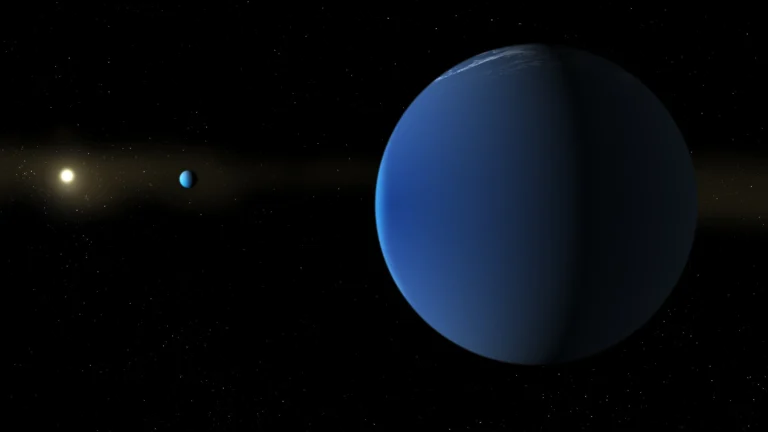
Their findings depict dramatic changes within only about 1,800 years: Between 42,100 and 39,900 years ago, Earth’s magnetic field weakened to just a tenth of its current strength and tilted relative to the spin axis by an astonishing 76° — moving the magnetic poles to Northern Africa and just northeast of Australia, respectively. For a couple of centuries, Earth’s magnetosphere resembled the tilted fields observed on other planets such Neptune, the researchers write.
Agnit Mukhopadhyay (University of Michigan)
The magnetosphere also shrank in size, as did its ability to protect our planet. At the peak of the excursion, the magnetic shield extended a meager 15,000 km on the day side, compared to 50,000 to 70,000 km today. This significantly increased the areas with open field lines. The auroral ovals, then centered close to the equator, grew almost three times their modern size, to diameters of about 8,100 km. Back then, charged particles had almost free entry into most of Earth’s atmosphere.
Crucially for everyone inhabiting Earth at the time, high-energy particles alter atmospheric chemistry and dynamics, most notably by destroying stratospheric ozone. Resulting higher ultraviolet levels could have led to sunburn and skin cancer, as well as affecting other species. The scientists suggest that this might have altered the behavior of early humans.
Prehistoric sunscreen
Archaeologists have found evidence that Homo sapiens around this time heavily used ochre, a natural pigment composed of iron oxide, clay, and silica to paint objects and cave walls, says team member Raven Garvey, an anthropology professor at Michigan University. Ochre blocks UV light, making it an effective sunscreen. It’s possible that our ancestors noticed this and used it to their advantage. They also increasingly used tailored clothing, which served as additional protection.

Agnit Mukhopadhyay (University of Michigan)
Neanderthals, who coexisted with Homo sapiens, went extinct at the same time the Laschamps excursion happened. Why they disappeared while humans thrived is an anthropological conundrum. The fact that it happened during a major geomagnetic shift might be pure coincidence, but Garvey thinks it’s worthwhile to explore a causal effect.
A geomagnetic excursion would have dramatic consequences today: “Our communication satellites would not work,” says Mukhopadhyay. “Many of our telecommunication arrays, which are on the ground, would be severely affected by the smallest of space weather events.”
“It’s an exciting study,” comments Joseph Stoner (Oregon State University) who was not part of Mukhopadhyay’s team. “It begins to fill a conceptual gap, but a lot more needs to be done to quantitatively put it together and test it."
What the study doesn’t provide, though, are new leads into what caused the excursion in the first place: “Geomagnetic excursions are believed to be associated with instabilities in the geodynamo — a process driven by the motion of liquid iron in Earth’s outer core,” Mukhopadhyay notes. “The precise mechanisms triggering such events remains an open question in geophysics.” This is also true for geomagnetic reversals, during which the polarity of Earth’s dipole field flips completely. Reversals are much rarer than excursions and last up to 30,000 years. The last one happened about 780,000 years ago.
For now, there is no indication of an imminent geomagnetic excursion (or reversal), but the Laschamps example shows that such an event can occur quickly, within a human lifetime, and perhaps without disastrous effects. “Many people say that a planet cannot sustain life without a strong magnetic field,” Mukhopadhyay says. It’s comforting to know that this isn’t necessarily true for short-term excursions: Even under the drastically different magnetospheric and atmospheric conditions 41,000 years ago, humans were still able to survive.


Comments
Enrico the Great
April 30, 2025 at 1:52 pm
The appearance of the night sky must have been intriguing. How might have migrating birds, and nocturnal animals have been affected?
You must be logged in to post a comment.
Ludovicus
May 3, 2025 at 1:04 am
One thing I am curious of is WHY the modelling only covers those regions near the Mediterranean. I'll have to check the paper listed - it seems that sub-oceanic crust (mid-Atlantic ridge for example), should have magnetic markers too, and I don't see this in the study's diagram.
Is it possible they've "drawn a curve using only two data points" in this study? Interesting, but there HAVE to be other markers globally in volcanic regions elsewhere to corroborate this conclusion.
Ludo
You must be logged in to post a comment.
Jan HattenbachPost Author
May 3, 2025 at 11:35 am
Hi Ludovicus,
the modelling of the global magnetic fields does cover more than just the Mediterranean. You'll find the answer to your question in the "Materials and Methods" section of their paper. There they say that they used a global palaeomagnetic field model called LSMOD.2, which covers the Laschamps event. This model contains global sediment records and volcanic data.
The map above shows the areas most affected superimposed with signs of human activity at the time.
cs,
Jan
You must be logged in to post a comment.
You must be logged in to post a comment.