 SUNSET:

 0
0Observations of a 23 million light-year-long gaseous filament and 39 bursts of radio waves are helping astronomers chart the universe’s largest-scale structures.

ESA
A curious fact about the universe around us: We can’t see most of it.
It’s not only mysterious dark matter and dark energy that, except for their indirect impacts on astronomical observations, remain invisible. Much of “normal” matter evades detection, too — despite the fact that those ordinary particles, known as baryons, also make up perfectly visible stars, planets, and kitchen sinks.
Now, two teams with opposite approaches have found much of ordinary matter prefers to take up residence in the lonelier latticework that makes up the cosmic web. This large-scale structure consists primarily of dark matter, which has gravitationally collapsed from a smooth spread. Criss-crossing filaments leave largely empty voids in-between. Dark matter is the gravitational backbone of the cosmic web, along which normal matter collects and comes together into galaxies and galaxy clusters.
One of these filaments is 23 million light-years long, a thick thread of gas and dark matter that connects two pairs of galaxy clusters in Centaurus. (The quartet of clusters are part of the larger Shapley supercluster.) Only, astronomers didn’t know the filament was there. The colliding clusters were intriguing, though, and many teams pointed X-ray observatories in their direction between 2001 and 2020.
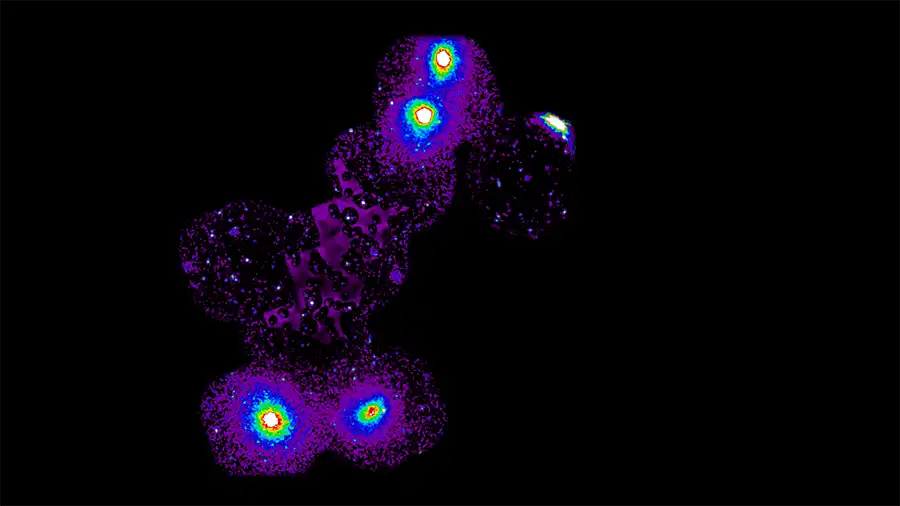
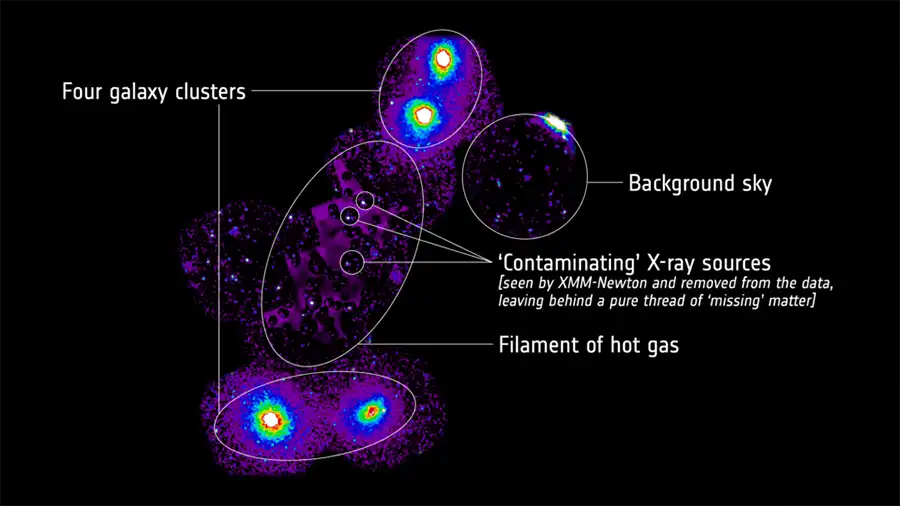
Now, combining these archival observations, Konstantinos Migkas (Leiden University, The Netherlands) and his group collected the equivalent of a multi-day stare at this region of sky. In doing so, they revealed the faint X-ray glow of a filament connecting the clusters, published the result in Astronomy & Astrophysics.
The matter in this filament is hard to see because it’s both sparse and hot. Hot gas does emit some low-energy X-rays, but that emission becomes quite faint when the gas is spread out over millions of light-years.
Not that astronomers haven’t tried, and with some success. One team has observed individual cosmic-web filaments; another study combined data from thousands of filaments to better understand their average properties. But in all previous cases, the measured densities were shockingly high — several times more than cosmological simulations predicted.
This time, Migkas’s team tried something new. In addition to observing the glow of the filament itself, using the sensitive Suzaku observatory, they also employed the sharper images of XMM-Newton to find and remove other sources of X-rays, such as supermassive black holes and galaxy halos.
The result is a measurement of just how hot and sparse this one filament really is. Its temperature hovers around 10 million degrees — that’s about the same temperature at which fusion begins within the Sun. But its density is so incredibly low that fusion would never happen: 10-5 particles per cubic centimeter, which works out to about five particles within the volume of an average bathtub.
That density, remarkably, is exactly what’s expected, Migkas notes. “Obtaining the first result ever that matches the cosmological model perfectly was indeed a surprise,” he says.
Mapping Cosmic Matter
There are countless filaments out there, some of which are amenable to direct imaging. But for the rest, there’s another way to see the cosmic web, via an unexpected beacon: fast radio bursts (FRBs).
Fast radio bursts are quick flashes of radio waves that astronomers think come from explosive events around dead stellar cores known as magnetars. For cosmologists, though, the exact source of the bursts isn’t important.
What is important is the ability to measure the dispersion of each radio flash, in which intervening matter spreads out the signal so that lower frequencies arrive later. The dispersion thus encodes how much matter lies between us and the burst. Combine that data with the burst’s distance, which requires pinpointing where on the sky it’s emanating from, then mix in some computer simulations of the evolving universe, and you get something akin to a map of cosmic matter.
On the simplest level, the change of dispersion with distance told the team about the amount of normal (baryonic) matter in the universe, which matched predictions. On a deeper level, the spread of the data — whether a group of FRBs at a certain distance have mostly the same dispersion or many different values — tells about the distribution of matter. If normal matter were mostly locked away in galaxies and clusters, our universe would be rather lumpy, and the dispersions at a certain distance would be spread out.
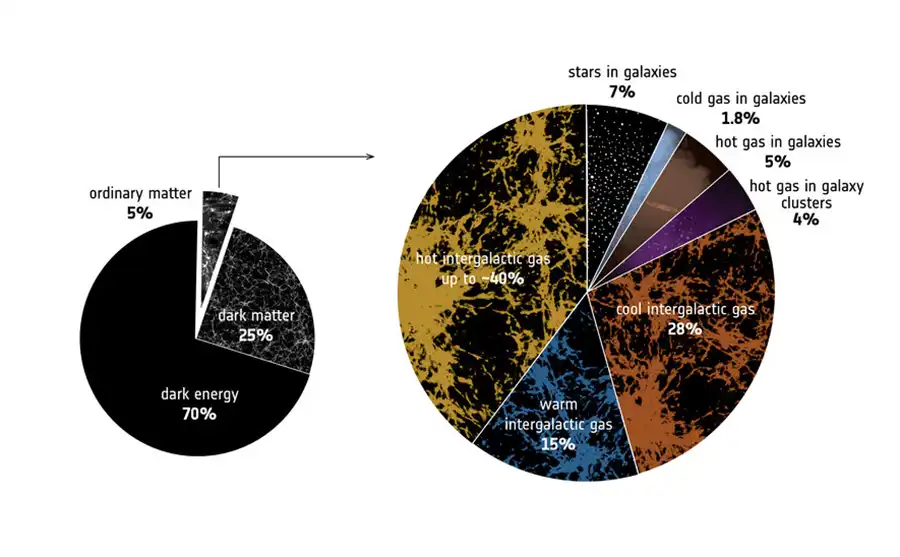
But that's not the universe we live in. Comparing distance and dispersion for 39 FRBs detected with the Deep Synoptic Array-110 in California, Liam Connor (Center for Astrophysics, Harvard & Smithsonian) and colleagues mapped normal matter out to when our universe was half its current age. They report in Nature Astronomy that the spread of matter is pretty smooth, with less than 15% of normal matter in stars and the cooler gas that could one day become stars.
The rest of the baryons aren’t in galaxies; they’re between them.
ESA
That some material should be in cosmic filaments isn’t unexpected. But that the filaments should contain three-quarters of the universe’s baryons suggests that something is sloshing gas back out of galaxies at a high rate.
“Unfortunately, we don’t yet have the granularity to pin down specific feedback scenarios,” Connor says. “We’ll have to wait for the large upcoming FRB samples for that.
“My suspicion is that you can’t produce our results without a good amount of active galactic nucleus feedback,” he adds, referring to the winds and jets that emanate from supermassive black holes. “But that’s just a hunch.”
Migkas points out that Connor’s study is exactly complementary to his own — whereas his own team measures the properties of a single filament, Connor’s team measures how much matter is in these filaments overall.
Connor likewise is glad to see the result from Migkas’s team: “Directly imaging filaments is really exciting and I agree that this result meshes with ours,” he says. “It’s fun to see a literal image of the gas our FRBs were dispersed by.”
About Monica Young
Monica Young, a professional astronomer by training, is News Editor of Sky & Telescope.




Comments
You must be logged in to post a comment.