 SUNSET:

 0
0Astronomers may have found the missing link required to understand one of the James Webb Space Telescope’s most puzzling discoveries.
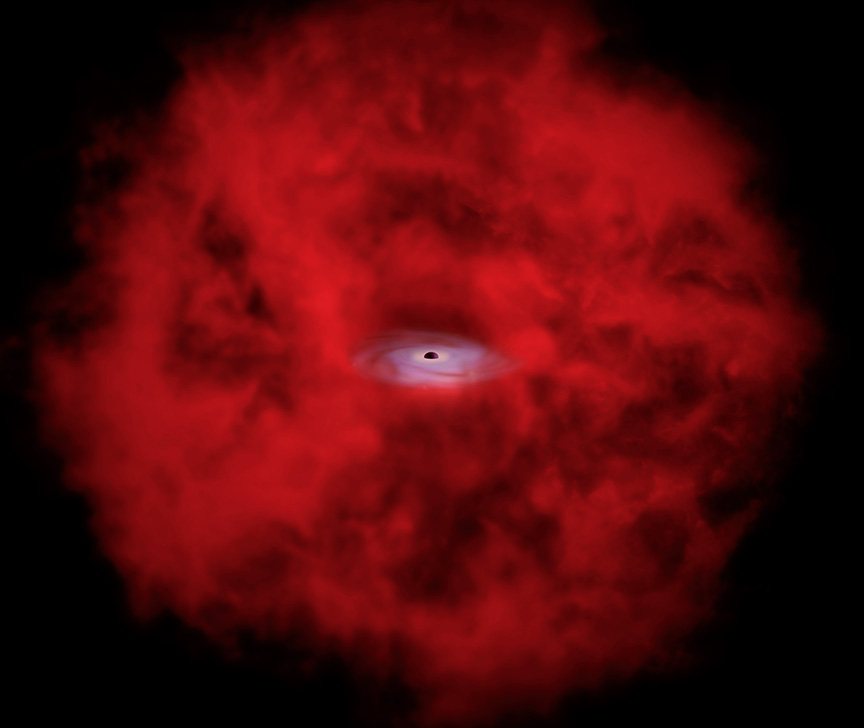
NASA / CXC / SAO / M. Weiss; adapted by K. Arcand & J. Major
Astronomers may have found the missing link required to understand one of the James Webb Space Telescope’s most puzzling discoveries.
The source of so-called Little Red Dots (LRDs) has remained debated since their discovery not long after Webb started sending back data. Spotted by the dozen in deep-field images, these dots are small (less than a few hundred light-years across). They’re also brighter at longer infrared wavelengths than shorter ones, which is why they appear crimson in Webb’s infrared images. And they’re very far away, appearing just a few hundred million years after the Big Bang.
Some astronomers have suggested that LRDs harbor growing black holes that will one day become the supermassive black holes we see at the center of most large galaxies today. But others counter that it’s not black holes we’re seeing; rather, stars are forming in ways that we’re not used to seeing in our more sedate modern times.
Key to the stars scenario is that the LRDs found to date emit hardly any X-rays, and X-rays are a key signature of black holes. That’s because black holes easily produce high-energy radiation. As inflowing gas whizzes around the black hole, it emits ultraviolet photons. A cloud of particles, collectively called the corona, crowds close to the black hole, and it can catapult a select few photons up to higher energies.
So, if there are no X-rays, then there’s no corona and thus no black hole. So, some have suggested dust-shrouded star formation might make a better explanation for LRDs.
But what if the X-rays are not missing, just blocked? That’s what Raphael Hviding (Max Planck Institute for Astronomy, Germany) and colleagues conclude in the Astrophysical Journal Letters, following the discovery of an object they’re calling an X-ray Dot. It appears at a later epoch than most other LRDs, dating to 2 billion years after the Big Bang. After identifying the source in a heap of archival data, the team targeted it for near-infrared spectroscopy with Webb. By spreading the object’s light into a spectrum, the team could see all the features it has in common with other LRDs.
But there’s one main difference: The object turns up nice and bright in archival Chandra X-ray Observatory images, meaning it’s emitting copious X-rays. In that way, it’s unlike any LRD known.
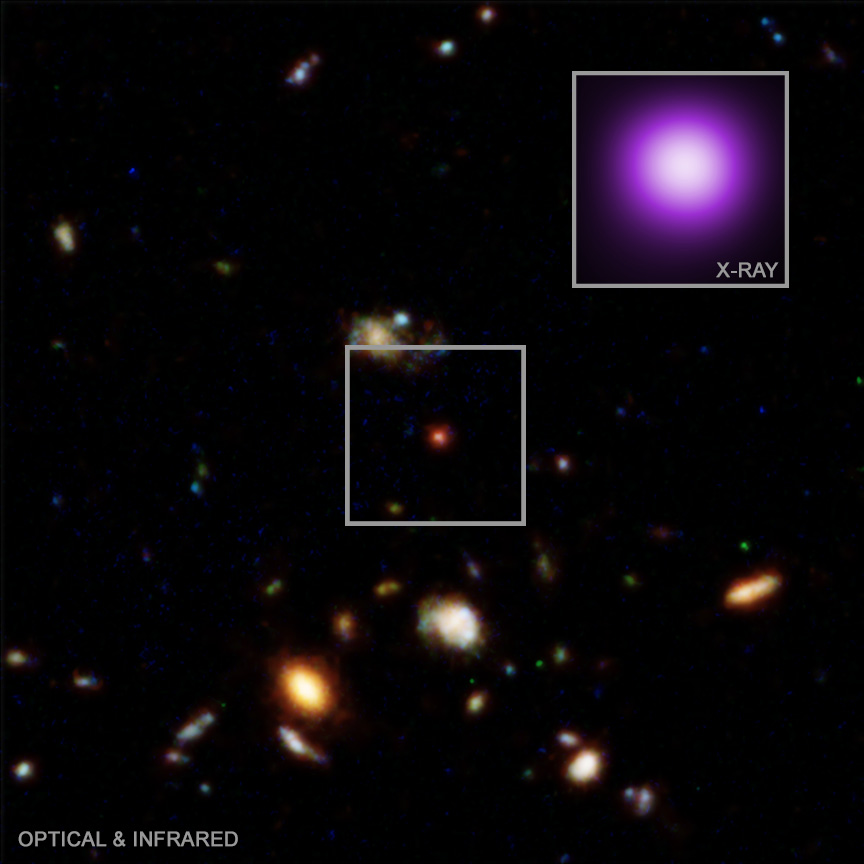
X-ray: NASA / CXC / Max Plank Inst. / R. Hviding et al.; Optical / IR; NASA / ESA / STScI / HST; Image Processing: NASA / CXC / SAO / N. Wolk
It’s not that the X-ray Dot is the first LRD to emit X-rays. In a study last year, cross-matching Webb images with data from the Chandra X-ray Observatory turned up 341 LRDs, two of which are detectable in X-rays. They’re both enshrouded in some gas and dust, though, which blocks some of the X-ray emission. If the X-ray Dot is the same type of object, then it has managed to clear out all of the dust and gas that was covering it up, providing a completely unobstructed view of the gas-guzzling black hole at its center.
“An ‘X-ray dot’ is very naturally interpreted as an advanced evolutionary stage of an LRD, rather than a fundamentally different class of object,” says Fabio Pacucci (Center for Astrophysics, Harvard & Smithsonian), who was not involved in this research. “If this interpretation is correct, the key takeaway is quite strong, as this would provide direct observational evidence that at least some LRDs are powered by accreting black holes.”
Indeed, the X-rays as well as the lack of dust are difficult to explain without a black hole. Pacucci calls this source a potential “smoking gun.” It, and others like it, could help us understand what LRDs are telling us about black hole growth in the early universe.
About Monica Young
Monica Young, a professional astronomer by training, is News Editor of Sky & Telescope.




Comments
You must be logged in to post a comment.