 SUNSET:

 0
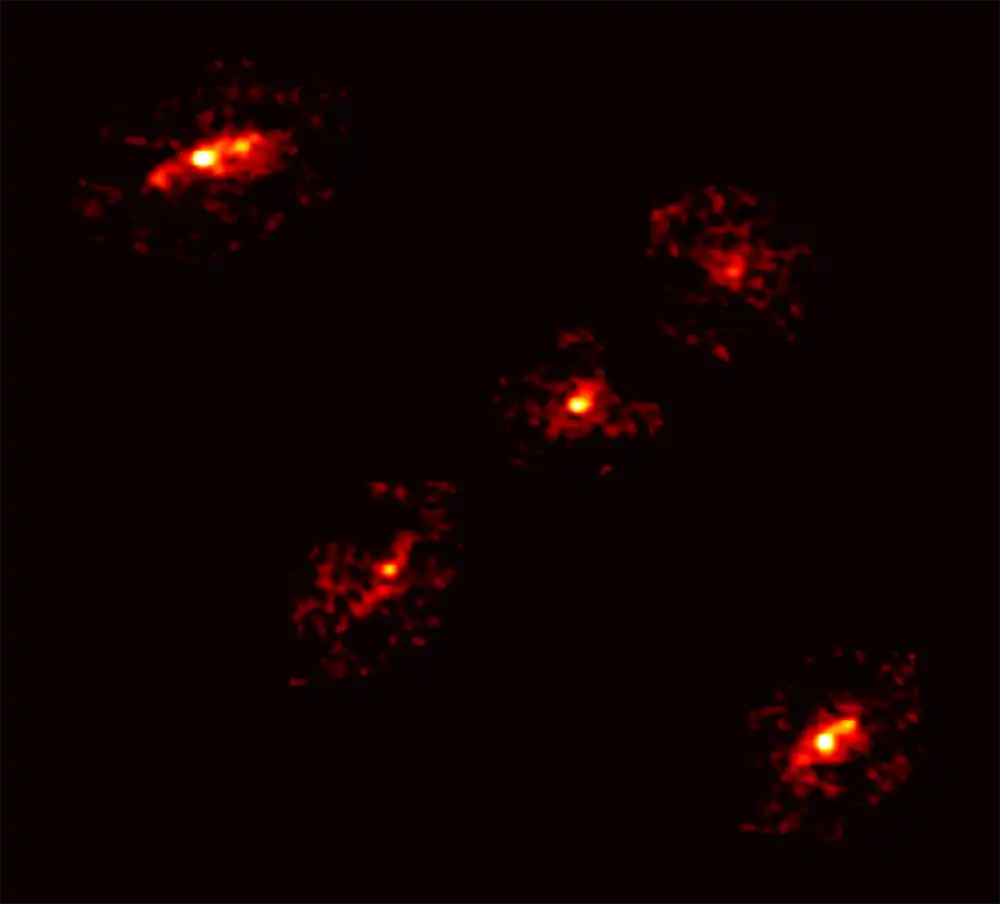
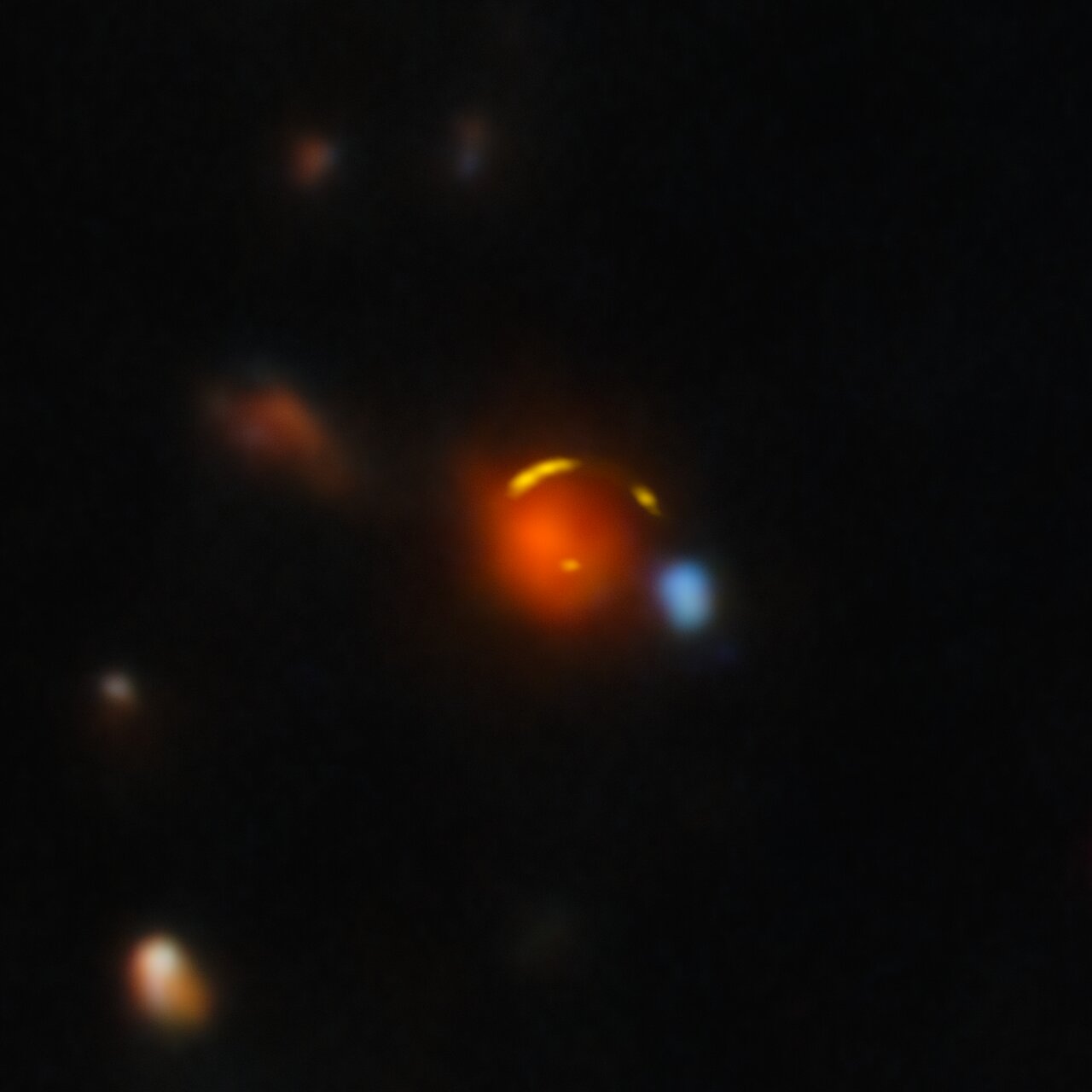
0The discovery of a rare Einstein Cross — five images of the same galaxy — reveals a trillion-solar-mass dark matter clump.
P. Cox et al. / ALMA (ESO / NAOJ / NRAO)
By using observatories including the Atacama Large Millimeter/submillimeter Array (ALMA), astronomers have spotted a rare Einstein Cross. Formed from five images of the same distant galaxy, the spectacle marks the first time astronomers have observed such a feature at submillimeter and radio wavelengths. The discovery has the potential to inform the long-running debate over the value of Hubble’s constant.
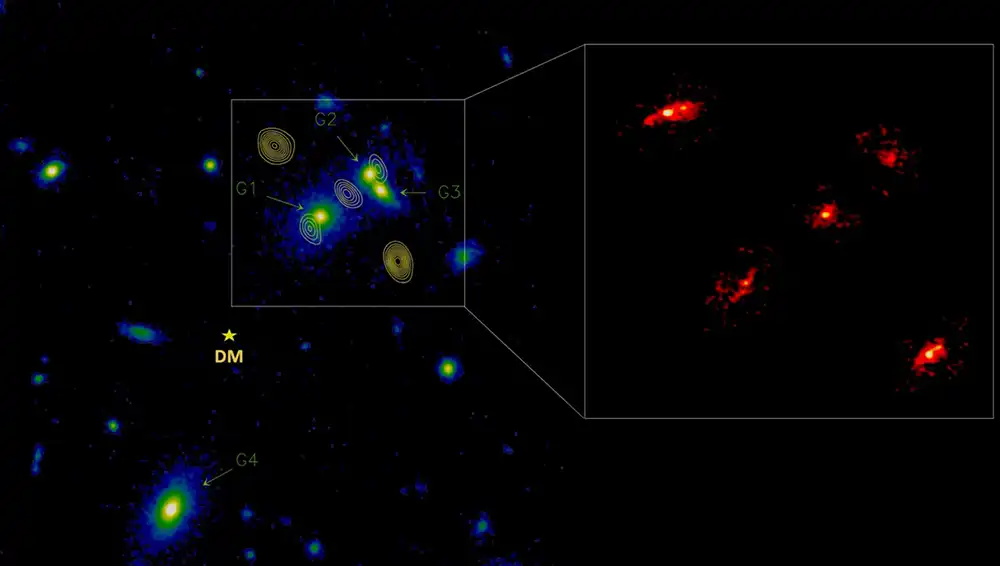
The background galaxy, known as HerS-3, lies 11.6 billion light-years away. On its way to Earth, the light from HerS-3 encountered a group of four massive galaxies, as well as at least 10 other galaxies, located 7.8 billion light-years from us. The gravity of this foreground group bent the light of HerS-3 into five separate images, in a phenomenon known as gravitational lensing. The result is a distinctive shape known as an Einstein cross.
Alongside ALMA, the team drew on data from the Northern Extended Millimeter Array (NOEMA) in France, the Very Large Array (VLA) in New Mexico and the Hubble Space Telescope. They used NOEMA and ALMA to map the cold molecular gas in HerS-3 fuelling star formation, the VLA to trace radio emission, and Hubble to provide the high-resolution optical view needed to pin down the positions and shapes of the lensing galaxies. The results are published in The Astrophysical Journal.
P. Cox et al / ALMA (ESO / NAOJ / NRAO) / NOEMA
What they found is unusual. Normally, Einstein crosses consist of four main images. A central fifth image, when it appears, is usually very faint because the inner mass distribution of the lens can both demagnify and outshine it.
With HerS-3, however, the fifth image was clear. What’s more, the researchers, led by Pierre Cox (Sorbonne University, France), found that the gravity of the intervening cluster’s visible galaxies could not by themselves explain the exact arrangement of the five images.
“The only way to reproduce the remarkable configuration we observed was to add an invisible, massive component: a dark matter halo at the center of the galaxy group,” Cox says. “This halo weighs several trillion times the mass of our Sun.” This means that the cluster’s center of mass is offset from the brightest galaxy, making the faint, fifth image visible.
“There are only a couple of known examples of crosses with a fifth image,” says Justin Read (University of Surrey, UK), who was not involved in the research. “So this discovery is indeed very interesting – it’s just really cool to find another one.”
Betting on a Supernova
The chance alignment might provide a serendipitous gift: “The magnification may allow unusually detailed studies of a starburst galaxy at redshift ~3 [when the universe was less than a fifth its current age], including its gas, star formation and possible outflows,” says Tansu Daylan (Washington University in St. Louis), who was also not involved in the research.
HerS-3 may also prove useful in the long-running debate over the value of the Hubble constant, the current expansion rate of the universe. Different ways of measuring it yield conflicting results for how fast space is expanding right now.
According to Read, HerS-3 could be used as another way to measure the Hubble constant. If the background object’s light varies over time, the time delay between when this variation appears in each of the lensed images we record today depends in part on the universe’s expansion.
“Usually, people use quasars for this, since they naturally vary rapidly as a function of time,” Read says. “But HerS-3 is star forming, raising the prospect of detecting a supernova that would arrive at each image at different times giving the time delay and, therefore, constraints on the Hubble constant.”
What started out as an interesting shape in the sky may turn out to hide deeper clues about one of the universe’s enduring mysteries.
About Colin Stuart
Colin Stuart (@colinstuartspace) is an astronomy author and tutor. He also runs a free online astronomy club.



Comments
You must be logged in to post a comment.