 SUNSET:

 2
2
Jared-Bowens
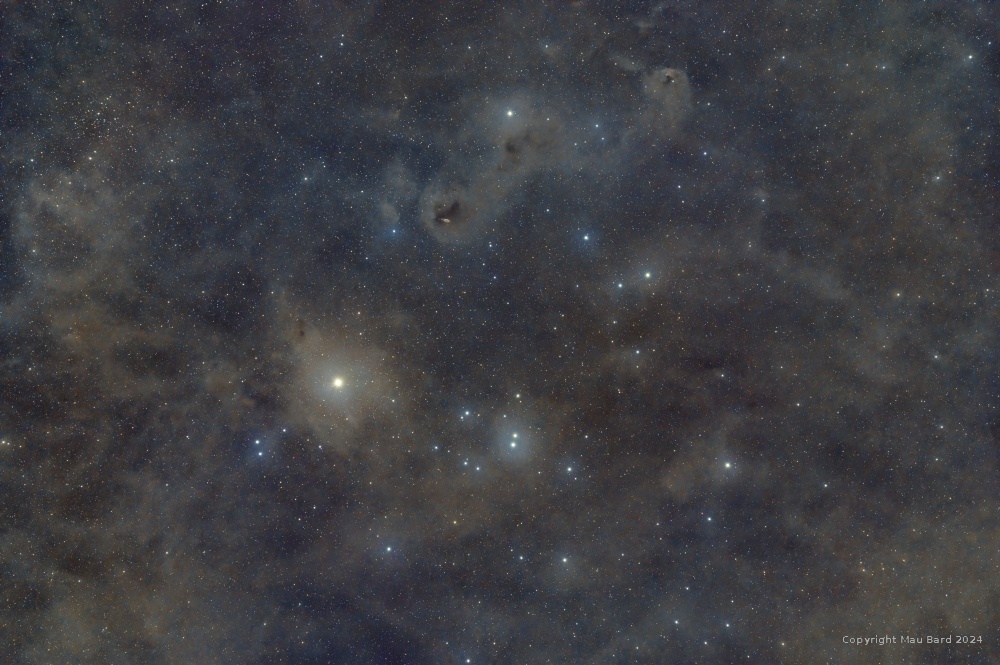
The Pleiades star cluster is one of the night sky's best-known astronomical sights. Alluring to the naked eye, it's even more amazing through binoculars or a small telescope, both of which reveal dozens more stars. As the cluster plows through space at 6 kilometers per second (13,400 mph), its hot, youthful suns illuminate a happenstance interstellar cloud, turning it into a gossamer nebula that temporarily enshrouds the stellar bunch.
Additional treasures lie within its bounds: There are also about a half-dozen double and multiple stars within the Pleiades. You might already be familiar with 2.9-magnitude Alcyone, a choice triple star located near the cluster's core. Also known as Eta (η) Tauri, it's the brightest Pleiad and the only one with a Bayer designation.
On cold February nights, it helps if you can complete an observing goal before your fingers and toes freeze. Finding all half-dozen Pleiades pairs with plenty of time to admire them will take under an hour. You can even observe all of these targets without repointing. Once the cluster's in the field of view, it's easy to hop from one star to the next using the map provided below.
| Star | Magnitudes | Separation(s) | Position angle of companion | Type |
| Taygeta (19 Tau) | 4.3, 11.0 | 71.7″ | 329° | Not a physical double |
| Σ444 (HD 23410) | 6.9, 10.1 | 3.4″ | 338° | True physical pair |
| S 437 (HD 23479) | 8.1, 9.4 | 1.1″ | 178° | True physical pair |
| Alcyone (Eta Tau) | 2.8, 6.3 (B) 8.2 (C), 8.7 (D) | 117.6″ (A-B), 182.0″ (A-C), 191.8″ (A-D) | A-B = 291° A-C = 313° A-D = 297° | True physical triple; D is not a member |
| OΣΣ40 (HD 23873) | 6.6, 7.5 | 86.8″ | 309° | True physical pair |
| Σ450 (HD 23631) | 7.3, 9.4 (A-B) | 5.7″ | 263° | Nature uncertain |
| OΣ64 (HD 23964) | 6.8, 10.2 (B) 10.5 (C) | 3.3″ (A-B) 10.1″ (A-C) | A-B = 234° A-C = 235° | A-B a true pair A-C is uncertain |

MegaStar, courtesy of Emil Bonanno, with additions by Bob King
Visual impressions
I used a beat-up 10-inch f/6 Dobsonian telescope with a primary mirror in serious need of recoating for the observations.
Taygeta — Bright primary strongly contrasts with the faint, pinpoint secondary to northwest. Sadly, not a true double.
Σ444 — Secondary star appears delicate and nearly overwhelmed by the much brighter primary. The stark contrast between the two, combined with their relatively close separation, made this one of my favorites. Note: The Cambridge Double Star Atlas incorrectly labels this pair as Σ450.
S 437 — One of the finest close pairs in the winter sky. When two stars nested in fluttering, concentric Airy rings barely touch, my heart goes pit-a-pat. This pair looked wonderful in calm seeing at 218×. Bonus! Just 40″ due west you'll see the only obviously red star in the Pleiades, HD 23463. It's nearly the same brightness as its neighbor and makes a splendid color contrast. HD 23463 is an orange dwarf, a main sequence star intermediate in size between red dwarfs and stars like our Sun.

Bob King
Alcyone — Brightest star in the Pleiades. I've always seen it as a quadruple with three companions dangling from the primary like a triangle instrument on a thread. But based on its parallax, the D star (see sketch) is an interloper. The C companion is the pulsating variable star V647 Tauri, which varies by a small fraction of a magnitude every 68 minutes. All of Alcyone's companions are easy to see at 20x in a small scope. Alcyone itself is brilliant B-type giant star with a bluish tinge in the 10-inch.
OΣΣ40 — A wide, bright pair for any size telescope — even a pair of 10× binoculars will split it.
Σ450 — This attractive duo is located a short distance southeast of the "dipper bowl" and forms a right triangle with Merope and Alcyone. The two-magnitude difference between primary and secondary and their somewhat tight separation make seeing the companion a worthy hunt. Use 200× for a clean split.
OΣ64 — Pleasantly surprised when I tracked down this fine, close-set triple star. How did it elude me all these years? The three stars form a short, almost perfect straight line. The arrangement is very compact with the secondary star snugged up near the primary. Use a magnification of 150×-200×.

Piqui Diaz
All these doubles are fair game for scopes as small as 4-inches. I hope you'll enjoy getting to know another facet of this familiar and beautiful star cluster.
Unique event: Comet 29P occults a star
If you're in the right place at the right time, you might have a look at the eruptive comet 29P/Schwassmann-Wachmann, which will occult a 12th-magnitude star in Leo on February 5th at 23:06-23:11 UT. This event will be visible to observers along a path about 60 kilometers wide crossing Asia and Europe. Occultation details and maps are available at the British Astronomical Association's MISSION 29P News webpage and Lucky Star Predictions webpage. To observe and record this rare event, a six-inch (150mm) or larger telescope is recommended.
Earlier this month, the comet underwent back-to-back eruptions, spewing cryogenic liquids from its interior into space. Some of that material may still be orbiting the comet's nucleus and be detectable during the occultation. The expected maximum duration of the event will be about 3.5 seconds.
About Bob King
I love the sky (day and night) and have been a skywatcher and amateur astronomer since childhood. I'm also a long-time member of the American Association of Variable Star Observers (AAVSO) and Astronomical League. I pen the Astro Bob blog and have written four books: Night Sky with the Naked Eye (2016); Wonders of the Night Sky You Must See Before You Die (2018) and Urban Legends from Space (2019) and Magnificent Aurora, published in 2024. The universe invites us on an adventure every single night. To accept the invitation, we only need look up.




Comments
Val Ricks
February 7, 2025 at 6:02 pm
I "discovered" S 437 one night by accident through my 10" f/6, which is large enough at 305x in excellent seeing to put space between the stars. Yes, it is a stunner for all the reasons mentioned here! Highly recommended. I look for it every time I'm in M45.
Val
You must be logged in to post a comment.
Starcrazy05
March 27, 2025 at 8:08 pm
Bob
Thanks for your wonderful enlightening monthly articles. Regarding double and triple stars, most often, they are identified by a Greek alphabet and the constellation they reside in. When I use the Autostar II hand box on an 8” Meade Lx 200, only a few of the stars show up in the “Named” or “Bright” listings. I found that I had to use Sky Safari to look up the Hd or Hr number and then Autostar would find the object I was looking for. Am I not using Autostar correctly.
When I am using my Argo Navis on an 18” Obsessio, I have similar problems with objects that not Messier, NGC and IC. Objects like ESO 383 - 87, 3C273, PK 303+40.1 (in Virgo region) are more difficult to fine in the Argo Navis listings.
Any assistance you can provide would be greatly appreciated.
Leary Wong
You must be logged in to post a comment.
You must be logged in to post a comment.