 SUNSET:

 0
0The Perseverance has found compounds associated with life on Earth. But whether they indicate life on Mars awaits sample return.

NASA / JPL-Caltech / MSSS
NASA has revealed what might be the strongest evidence ever found for the existence of some form of microbial life on Mars in the distant past. At a press conference in Washington, D.C., on Wednesday, September 10th, scientists reported that rocks examined last year by the Perseverance rover, after long and careful analysis, were found to contain chemical compounds that on Earth are associated with microbial life.
One rock, called “Chevaya Falls”, is dotted with colored spots, which the researchers say could have been remains left by ancient microbes. These spots take the form of both “leopard spots” (dark circles on the rock surface) and “poppy seeds” (tiny dark patches). Perseverance found the rock in Jezero Crater, alongside the river that long ago flowed into the crater, bringing sediments into the lake that formed there. The rock lies among layered deposits of clay and silt.
The images of this rock were downlinked from Mars in July 2024, as reported in Sky & Telescope at the time. The find immediately excited scientists, says Joel Hurowitz (SUNY Stony Brook), the lead author of a paper describing the finding in Nature. Speaking at NASA’s press conference, he says when team members first saw the images showing layers of mudstone with greenish rings and dark spots, they wondered if organic matter played a role in depositing that material. But it took careful analysis of data from the rover’s full suite of science instruments, including X-rays as well as Raman and luminescence spectroscopy, to learn as much as possible about the nature of these features. The team also investigated similar markings in two other rocks in the area, adding strength to that interpretation.
The leopard spots, it turns out, appear to be reaction fronts — areas of contact between an expanding chemical reaction and surrounding rock. The material in the rings is composed of two different iron-rich minerals: vivianite (iron phosphate) and greigite (iron sulfide). Both of these minerals, on Earth, are usually associated with decaying plant matter or are products of microbial activity.
The combination of these two minerals is considered a potential fingerprint for microbial life, the research team argues, because they are produced by chemical reactions which are typical of microbial metabolism.
The team cautions, however, that a non-biological formation process has not been ruled out. But Hurowitz says that those non-biological chemical processes usually require extreme heat or acidity. This particular rock doesn’t show any evidence of having endured such conditions, despite the team’s efforts to find such signs, he notes.
Nathalie Cabrol (SETI Institute), who was not connected to the research team, tells Sky & Telescope, “It’s reasonable to be cautious but excited, because to me this is probably the most compelling evidence we have so far” for past microbial life on Mars.
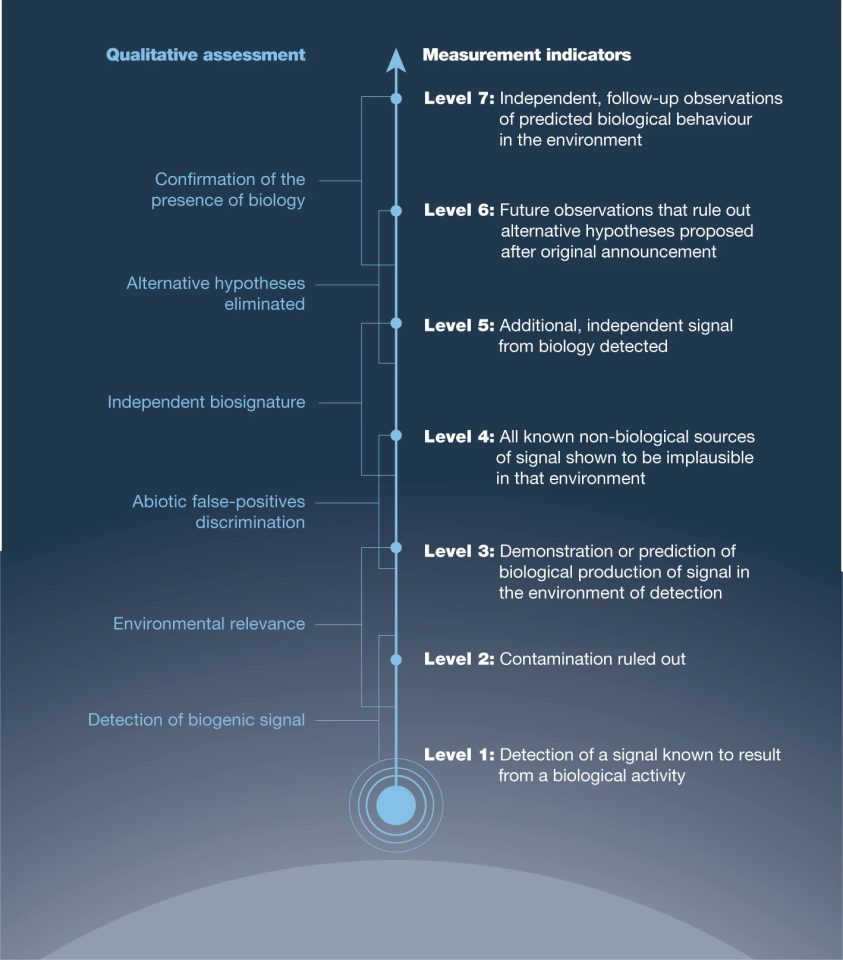
She points out three features that are consistent with a possible biological origin of these features: a habitable environment, since we have clear evidence that this was a lake for long periods; chemical and mineralogical material that is associated with the interaction of microbes with sediments; and shapes that resemble some that are formed by terrestrial microbes. “So I think we have to pay attention,” she says, “not because it tells us that it is life, but because it’s the most compelling thing that we’ve found so far.”
NASA
Cabrol applauded the approach taken by the researchers in presenting their findings. “There have been claims in the past that went a little bit overboard,” she says, “but you don’t see that here, and you also feel the depth of experience of the team that’s behind it.”
All of the data is being made publicly available, so that other scientists can do their own analysis and interpretation, says Nicky Fox, NASA Science Directorate associate administrator, “to confirm or refute its biological potential.”
While some of this data was previously reported at this year’s Lunar and Planetary Research Conference in Houston in March, as well as in NASA’s preliminary announcement last year, the details of the research and the many tests that were performed were just released with this week’s Nature publication. “Getting such a significant finding as a potential biosignature on Mars into a peer-reviewed publication is a crucial step in the scientific process, because it ensures rigor, validity and significance of our results,” says Perseverance Project Scientist Katie Stack Morgan (NASA-JPL).
Cabrol says that as Perseverance continues to explore, it might find other, similar formations. “If we can find other examples of these types of rocks, it will continue to add statistical weight to the observations,” she says. “It’ll be a lot more powerful if you have outcrops, or even floats, but lots of them.”
Ultimately, though, confirmation of this material’s biological origin awaits an eventual sample return mission, Hurowitz says. That mission would bring back the samples collected by Perseverance for detailed analysis in more advanced labs on Earth. But the sample return is currently on hold — it awaits NASA’s reassessment of its capabilities after Congress decides on vastly different proposed budgets for the agency this month.
“This achievement comes at a critical time,” says Ben Weiss (MIT), a co-author of the Nature paper. “Because the only way to determine whether these rocks contain fossils is to analyze them in Earth laboratories, this discovery provides a huge boost to the case for sample return.”







Comments
You must be logged in to post a comment.