 SUNSET:

 0
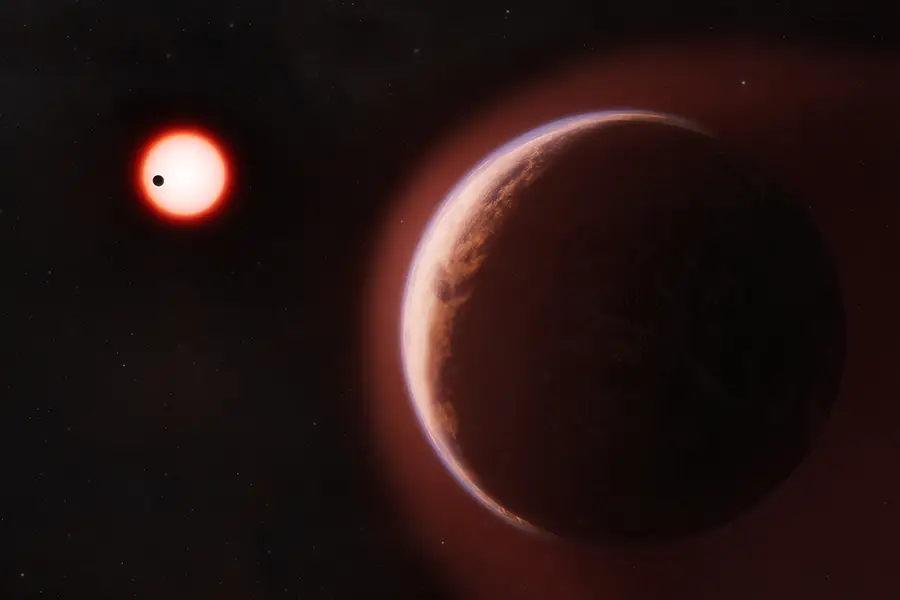
0In new observations, astronomers detect a moving wake of gas in the outer layers of the red supergiant Betelgeuse, offering fresh evidence for a long-suspected secondary star.
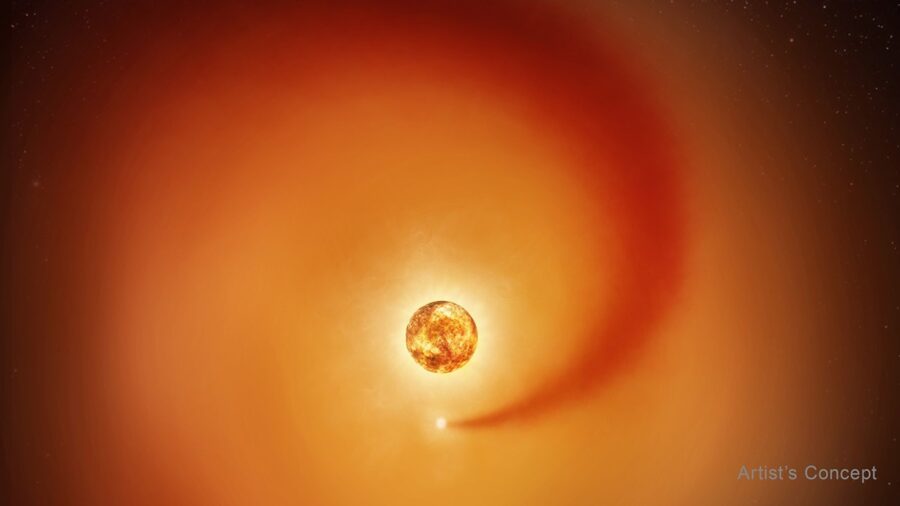
Artwork: NASA, ESA, Elizabeth Wheatley (STScI); Science: Andrea Dupree (CfA)
Betelgeuse, the bright orange star marking Orion’s shoulder, might have a companion star. While astronomers are still unable to observe this putative companion directly, they might have found what it leaves behind.
In a new study to appear in the Astrophysical Journal, researchers led by Andrea Dupree (Center for Astrophysics, Harvard & Smithsonian) report evidence for a dense, expanding wake, or trail of gas, in the red supergiant’s extended atmosphere. The result is consistent with a decades-old hypothesis that Betelgeuse hosts a companion moving through its outer layers on a roughly six-year orbit.
Betelgeuse is one of the most familiar objects in the night sky. Its brilliance means that any close-in orbiters would be extremely difficult to detect, as Betelgeuse’s glare saturates most instruments. Even so, astronomers have suspected a companion exists because the star’s brightness varies on two cycles: There’s a 400-day cycle, attributed to the star’s own pulsations, and a much longer, unexplained cycle lasting roughly 2,100 days. This period of about six years has raised the possibility of a yet-unseen secondary star occulting the red supergiant.
If real, the companion would be modest by stellar standards, roughly the Sun’s mass and vastly dimmer than Betelgeuse. So close to the primary star, it would be embedded within Betelgeuse’s outer atmosphere, or chromosphere, where the stellar light would be overwhelmed by the supergiant’s glare.
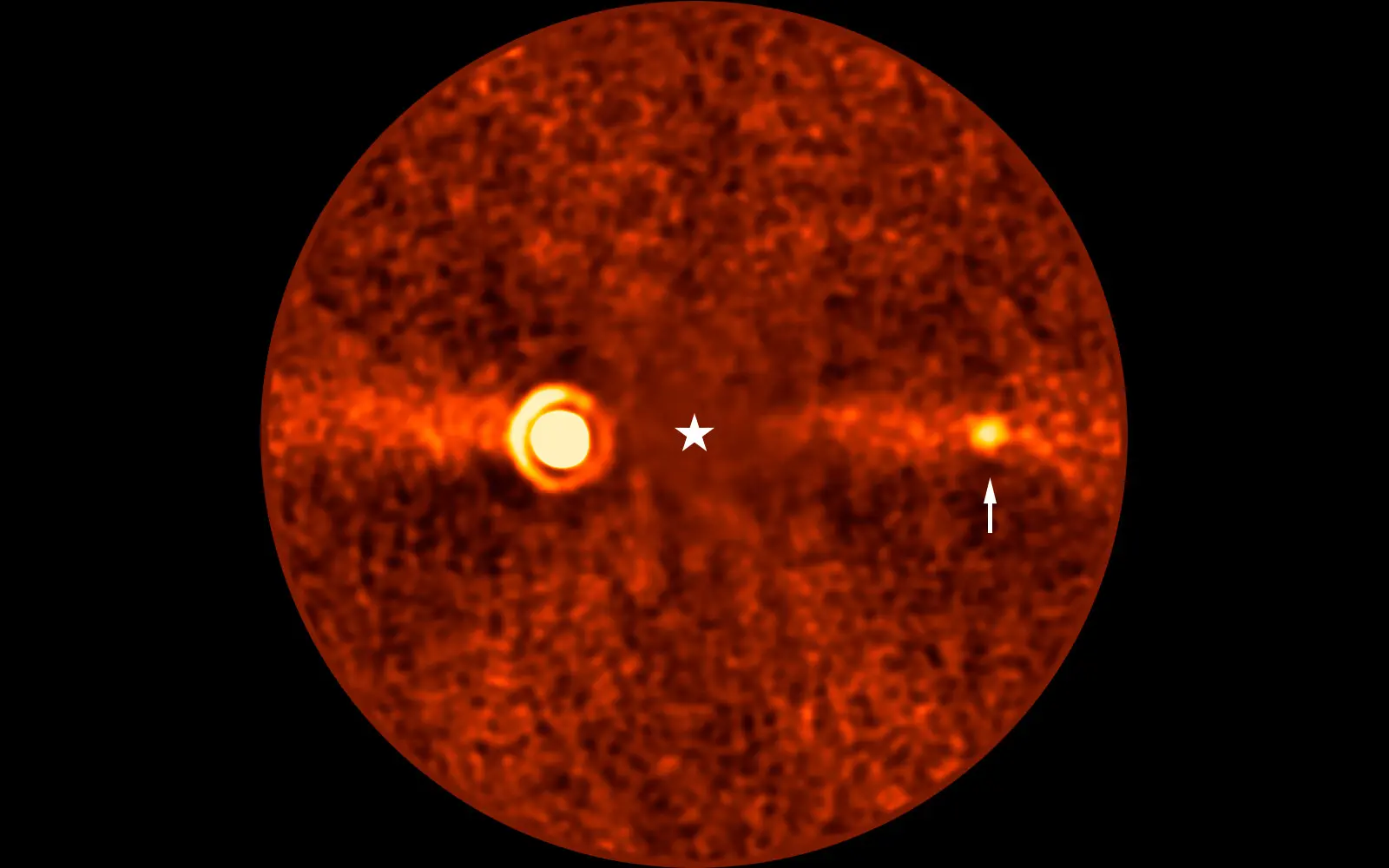
A hint of that companion was reported last year by Steve Howell (NASA Ames Research Center) and his team, who used speckle interferometry to glimpse a faint feature near Betelgeuse. The signal was intriguing, but not strong enough to count as a firm detection. As part of that work, Howell and colleagues named the proposed companion Siwarha, from the Arabic siwar, meaning “bracelet,” echoing Betelgeuse’s own name, derived from Yad al-Jauzāʾ, “the hand of the giant.”
Rather than trying to image the companion directly, Dupree’s team reasoned that an object orbiting this deep in the chromosphere would stir the surrounding gas. “If you’re in a speedboat driving around in water, what happens?” Dupree says. “There’s a wake.”
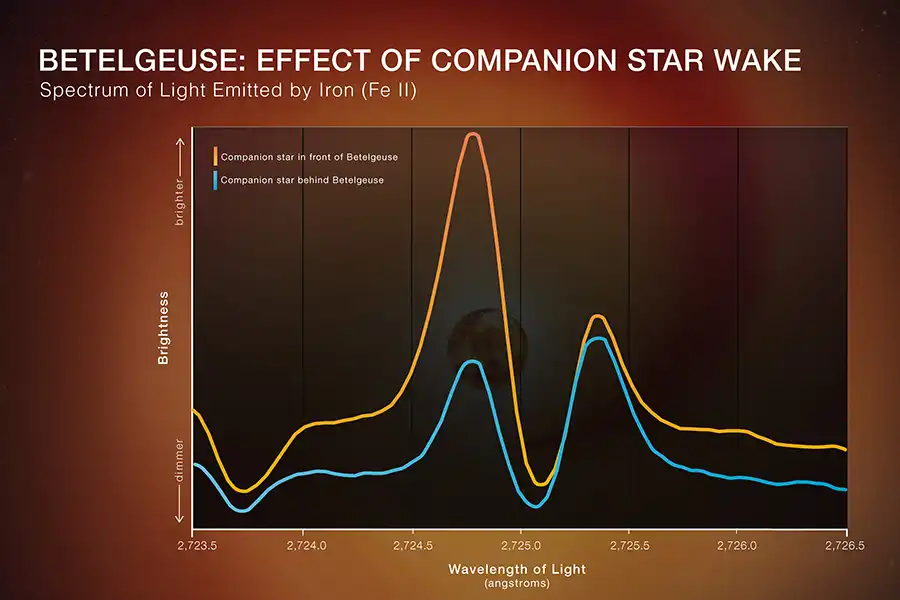
To search for that signature, the team analyzed 6.5 years of spectra measured from the Fred Lawrence Whipple Observatory in Arizona and the Roque de los Muchachos Observatory in Spain. The researchers focused on specific wavelengths of light that are absorbed by gas in Betelgeuse’s cool, outermost layers. They paired those data with ultraviolet observations from the Hubble Space Telescope, which can resolve changes across the star’s disk and probe hotter gas in the chromosphere.
Tracking how these features strengthened, weakened, and shifted with orbital phase, the researchers found patterns consistent with a moving trail of denser material.
“When we looked at the UV lines, we saw [the wake] drag out the whole atmosphere,” Dupree says. She describes the observed outflowing material as “strong confirmation of the presence of a companion star.”
In alternative scenarios, the long secondary period could be a pulsation rather than another star. But computational astrophysicist Jared Goldberg (Flatiron Institute) finds that implausible. Such pulsations would imply a much larger and more evolved supergiant star than observations support.
“The slowest pulsation you should see in a star like Betelgeuse” with its turbulent outer layers, says Goldberg, “is the fundamental pulsation mode.” Based on Betelgeuse’s characteristics and previous asteroseismic analyses, that fundamental mode matches the 400-day period, implying that the 2,100-day variation is unlikely to originate within the star itself. Dupree agrees, pointing to the shape of the signal itself. “The fundamental pulsation we see is very symmetric,” she says. But the longer period’s signal lags behind. “It goes up and it goes down, and it doesn’t return smoothly.” Such asymmetry, she argues, arises naturally when material is swept outward by an orbiting object. Goldberg, who was not involved in the study, adds that the wake detection fits theoretical expectations if a companion is present, even if it does not yet constitute irrefutable proof.
NASA / ESA / Elizabeth Wheatley (STScI)
Betelgeuse’s variability drew widespread attention during the Great Dimming of 2019–2020, when the star faded dramatically for several months. But Dupree emphasizes that the event “occurred as a result of a surface mass ejection,” and had “nothing to do, as far as we know and can conceive of, with a binary.”
Many red supergiants show similar long secondary periods, and Dupree’s team has already begun searching for comparable signatures in other stars. “It may be a broadly based phenomenon, and we were just slow to catch up with Betelgeuse,” she says.
“If we can conclusively say that those long secondary periods are caused by companions,” Goldberg says, “then we can start to learn about these systems at the population level.”
Confirming a close companion would also raise new questions about Betelgeuse’s long-term fate. “One of the big surprises about Betelgeuse was that it’s rotating very rapidly,” Dupree said. “It started out as a B star on the main sequence, and when it gets larger, as a supergiant, it should slow down, like a skater spinning on ice, not speed up.” Tidal interactions with a close companion, she suggested, may already have altered the star’s evolution.
The case for a companion is strengthening, though not yet closed. Researchers are now looking ahead to late 2027, when Siwarha is expected to emerge again from behind Betelgeuse and offer the clearest opportunity yet for its direct confirmation.
Editorial note (January 30, 2026): This article was corrected to reflect that Betelgeuse's companion, if it exists, has roughly the mass of the Sun.



Comments
You must be logged in to post a comment.