 SUNSET:

 13
13Don’t miss Spica’s dramatic disappearance at the Moon’s dark limb. We also check in on the status of current bright comets.

Stellarium with additions by Bob King
Lunar occultations are commonplace but often involve fainter, telescopic stars. This month we have a wonderful exception. On the night of July 13th, the Moon will cover Virgo's brightest star Spica for much of North and Central America. Sometimes moonlight overwhelms or diminishes the impact of an occultation. Thankfully not this time because the Moon will be in first-quarter phase. Through a small telescope you'll still be able to detect the outline of the earthlit western limb and anticipate the breathtaking moment of Spica's disappearance. Even binoculars will show the star blink out though they may lack sufficient light-gathering power to reveal the limb.
Like a traffic circle without exits the Moon's path is restricted to the ecliptic zone. Round and round the circle it goes, completing one revolution of the sky approximately every month. Because the Moon's orbit is tipped 5.1° relative to the plane of Earth's orbit — which defines the ecliptic — the Moon weaves above and below the plane, so its path over time more resembles a ribbon than a circle. Within that band are four 1st-magnitude stars — Antares, Aldebaran, Regulus, and Spica — that occasionally find themselves squarely in the Moon's path. When it covers one of them, we get to witness a relatively tiny, orbiting ball of rock temporarily "remove" a star several thousand times its size from the sky.
M. Tanikawa
Spica will disappear with surprising suddenness at the Moon's dark limb and reappear later with equal abruptness at the opposite bright limb. While the star appears single it's actually a spectroscopic binary system comprising a blue giant primary almost 8 times the Sun's diameter and a secondary sun about half that size. Although it's theoretically possible to use video to record a stepwise dimming of Spica's light as each star is occulted in turn, the challenge is great. They're separated by a third of the average distance between Mercury and the Sun and are 250 light-years away, factors that effectively shrink the duo to a point too small to resolve in even the largest instruments.
Most stellar occultations occur suddenly for that reason. It takes almost no time for a moving object to cover a point. When combined with the lack of a lunar atmosphere — which would otherwise dim the star upon approach — and the Moon's speed at the time (3,500 kilometers per hour), it's easy to see why Spica will vanish in a flash.

Bob King
Observers in the eastern states will see Spica disappear at the Moon's dark limb around 10:30–11 p.m. local time. In the Midwest, the occultation occurs in mid-twilight about 10 o'clock, while across the Mountain Time Zone it happens shortly after sunset. Although the Sun will still be shining from cities along the Pacific Coast, as long as the sky is haze-free, Spica should be visible in daylight through a small telescope. Point your instrument at the Moon and look for a pinpoint of light just to its east. With the dark limb invisible, Spica will disappear in a blue sky at occultation time. Stick around for the reappearance as well.

Map by Bob King using Stellarium
For the scoop on both immersion and emersion times for your city, pay a visit to the International Occultation Timing Organization's (IOTA) Spica occultation page. Times there are in UT or Universal Time. To convert to Eastern Daylight Time, subtract 4 hours and move the date back one day. For CDT, subtract 5 hours; 6 hours for MDT; and 7 hours for PDT. For example, Spica will disappear at 3:12 UT on July 14th from Lansing, Michigan. Subtract 4 hours (Eastern Time Zone) to get 11:12 p.m. local time on July 13th.
The Spica occultation season began on June 16th when the Moon covered the star for observers in Eastern Europe and northwestern Asia. Many more will follow until the current series ends on November 17, 2025. After that the rambling Moon won't pester the pair again until 2031.
Comet 13P/Olbers update

Bob King
Comet 13P/Olbers, which I reported on here last month, has been trending a little brighter than original expectations. As July opens it glows around magnitude 6.5 and is easily visible in 50-mm binoculars in late twilight. On June 29th in my 10×50s I noted a fuzzy coma about 5′ across with a brighter, more compact center and a wisp of a tail pointing upwards to the northeast. In my 15-inch (38 cm) Dob, 13P's bright head and half-degree tail made a beautiful sight.

Stellarium with additions by Bob King
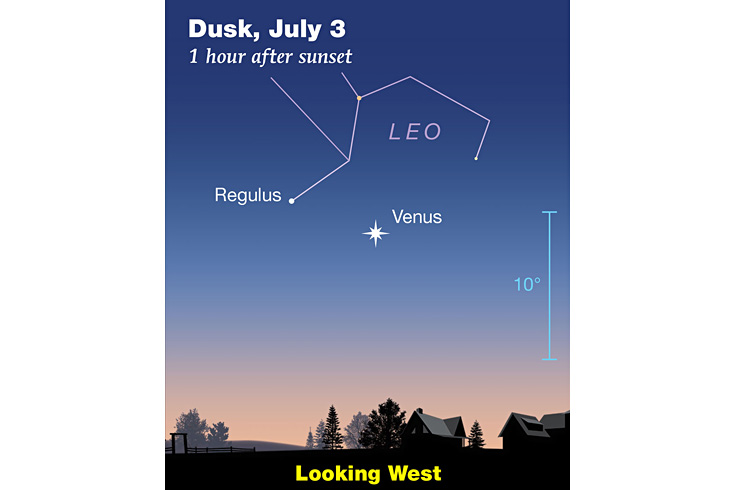
As the comet crosses from Lynx into Ursa Major it skirts the Three Leaps of the Gazelle asterism — three pairs of stars that represent the creature's hoof-marks in pond mud. Highly anticipated Comet Tsuchinshan-ATLAS (C/2023 A3) has stalled at around magnitude 10 even as its tail has increased in length. It's located in southern Leo very low in the southwestern sky at nightfall. Mid-northern latitude observers only have a week or two left before the comet disappears in the solar glow, not to return to view until late September at dawn.
About Bob King
I love the sky (day and night) and have been a skywatcher and amateur astronomer since childhood. I'm also a long-time member of the American Association of Variable Star Observers (AAVSO) and Astronomical League. I pen the Astro Bob blog and have written four books: Night Sky with the Naked Eye (2016); Wonders of the Night Sky You Must See Before You Die (2018) and Urban Legends from Space (2019) and Magnificent Aurora, published in 2024. The universe invites us on an adventure every single night. To accept the invitation, we only need look up.



Comments
misha17
July 3, 2024 at 1:06 pm
The caption for M. Tanikawa's video is wrong - Spica disappears (not reappears) at the lunar dark limb on the left, then reappears at the lunar bright limb (upper right)
You must be logged in to post a comment.
Bob KingPost Author
July 3, 2024 at 1:32 pm
Hi Misha,
Ha! Indeed it is. Funny thing — I had it right the first time Much appreciated and now fixed.
You must be logged in to post a comment.
misha17
July 3, 2024 at 5:01 pm
Bob: Here in Los Angeles, we ~might~ be able to see the reappearance. It will happen at 8:57pm PDT, about 50 minutes after Sunset. The difficulty is that it will happen along the lunar bright limb.
You must be logged in to post a comment.
Bob KingPost Author
July 3, 2024 at 5:20 pm
Misha,
If the sky is transparent with no haze or clouds I suspect you'll see it. You may even see the immersion! The key is to use a telescope. On Oct. 2, 2015 I observed Aldebaran (also magnitude 1) disappear at the Moon's bright limb 1 hour 33 minutes after sunrise and then reappear at the dark limb (in a blue sky) 2 hours 39 minutes after sunrise. The sky was very clear and I didn't struggle to see the star. I used a 10-inch Dob at the time but I'm sure Aldebaran would have been visible in a smaller scope. Check the story again for a photo illustrating this.
You must be logged in to post a comment.
misha17
July 3, 2024 at 8:50 pm
Bob, I only have binoculars so that will have to do.
I did manage to see Antares (similar magnitude) through binoculars only 10 minutes before sunrise back in January, just after an occultion. Solar separation was only about 40 degrees, compared to about 90 this month. Disappearance will occur 20 minutes before sunset in Los Angeles.
Sky was very clear in January, with humidity of about 10 percent. Skies will most likely be more hazy this month.
You must be logged in to post a comment.
Genac
July 7, 2024 at 8:17 am
How do we determine time for specific locale?
You must be logged in to post a comment.
Genac
July 7, 2024 at 8:28 am
ANSWER: Stellarium. You'll need a dang dark dark sky at the horizon to see this.
You must be logged in to post a comment.
bob kelly
July 14, 2024 at 11:59 am
Photo of Moon and Spica (2 second exposure to bring out the Earthshine on the Moon) on my Bob Kelly Facebook page and submitted to the S&T gallery.
You must be logged in to post a comment.
Bob KingPost Author
July 14, 2024 at 1:17 pm
Thanks, Bob! Glad you saw it and I appreciate you sharing your photo. It cleared in the nick of time here for the occultation. Spica was brilliant next to the moon. It was also easily visible in binoculars shortly before sunset.
You must be logged in to post a comment.
bob kelly
July 14, 2024 at 2:01 pm
Thanks! I'm happy the clouds got out of the way just in time for you to see it there!
Spica was hard to see with the eye due to the glare of the Moon in haze, some occasional high clouds and the low elevation.
Easy in 8x35 binoculars and the Canon camera's screen.I took a wide range of exposure times. Some photos in the 1/125 to 1/320 exposure range show more terrain on the Moon, but Spica was barely visible, and the Earth-lit side of the Moon was invisible in those photos.
You must be logged in to post a comment.
Bob KingPost Author
July 14, 2024 at 8:32 pm
Hi Bob,
Yes, that's the problem of getting a nice picture of the Moon AND Spica. The Moon will always be overexposed. To show the terminator my exposure erased virtually all detail from the Moon except its phase and some texture along the terminator. It was a necessary compromise.
You must be logged in to post a comment.
Dave Mitsky
July 14, 2024 at 7:51 pm
I observed the occultation of Spica last night from the Astronomical Society of Harrisburg's Naylor Observatory using the 17" f/15 classical Cassegrain housed in the French Dome. Spica disappeared at 11:24 p.m. EDT.
It was rather hot and humid in the dome. Clouds obscured the view of Spica at times but shortly before the occultation it cleared up somewhat.
You must be logged in to post a comment.
Bob KingPost Author
July 14, 2024 at 8:33 pm
Dave,
I can relate to the heat. Sweltering here that evening and lots of mosquitos, too. Thanks for sharing your observation.
You must be logged in to post a comment.
You must be logged in to post a comment.