 SUNSET:

 5
5Astronomers have found that star-forming galaxies in the early universe were far messier than modern-day disk galaxies.
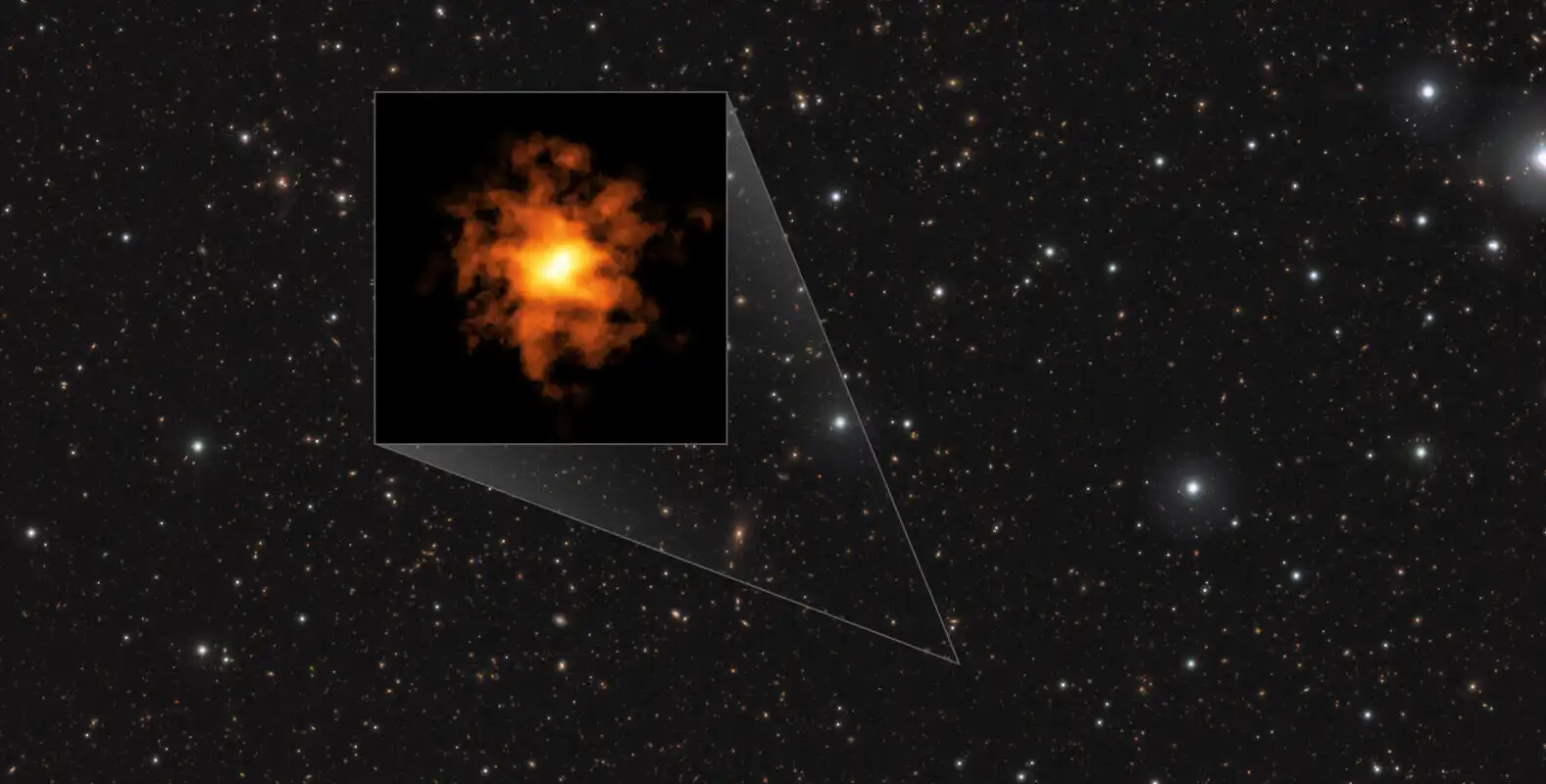
ALMA (ESO / NAOJ / NRAO) / L. Rowland et al. / ESO / J. Dunlop et al. Ack. / CASU / CALET
As astronomers gaze farther into the universe, they also peer back in time. That lets them see how some of the earliest galaxies formed. While most star-forming galaxies today have settled into orderly disks of gas and dust, a new study has found that galaxies in the early universe were far more turbulent.
A team led by Angelica Lola Danhaive (University of Cambridge, UK) used the James Webb Space Telescope to examine hot gas in 213 star-forming galaxies in a universe only 850 million to 1.6 billion years old. They found that most of these galaxies had messy, puffed-up disks, unlike the thin, orderly disks of today. What’s more, the higher the starbirth rate, the more turbulent the galaxy.
“Determining when the very first disks formed in the early universe is a key question,” says Andrea Ferrara (Scuola Normale Superiore, Italy), who was not involved in the paper. Previous studies have largely concentrated on galaxy evolution during “cosmic noon,” a period between 10 and 11 billion years ago when the most stars were forming in the universe. Astronomers never had the chance to look at such a large population of low-mass galaxies before that stellar baby boom.
The Webb observations also illuminate the specific formation processes causing these turbulent effects during this early period in the universe. The results, published in the Monthly Notices of the Royal Astronomical Society, trace galaxy formation from its chaotic beginnings in the early universe to today.
“The most exciting outcome, I think, is that we are now seeing the transition phase — the dawn of ordered disks emerging from turbulent, clumpy systems,” says Sandro Tacchella (University of Cambridge, UK), a coauthor on the paper. “It’s a key missing link between the earliest galaxies [...] and the more settled, rotation-supported disks we observe a few billion years later at cosmic noon.”
The Dawn of Disks
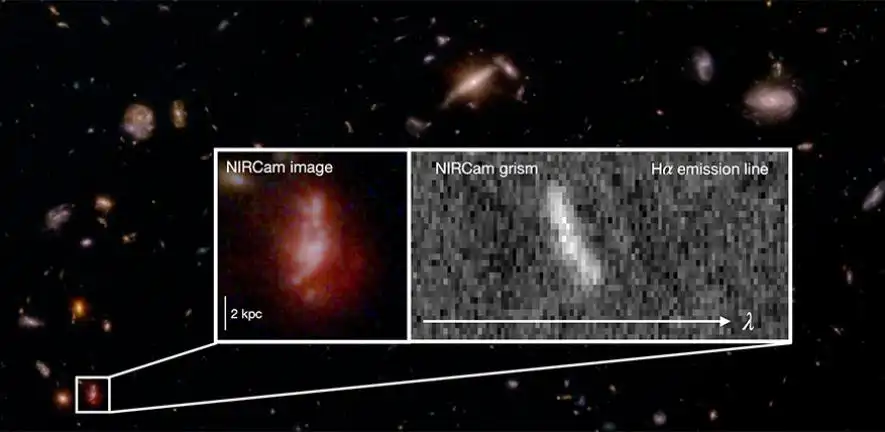
NASA / ESA / CSA / STScI, B. Robertson (UC Santa Cruz) / B. Johnson (CfA) / S. Tacchella (Cambridge) / P. Cargile (CfA)
The team used JWST’s Near-Infrared Camera (NIRCam) to measure warm ionized gas via hydrogen alpha emission — a specific wavelength of light that hydrogen gas emits when it’s been heated, such as by newborn stars. By mapping this spectral emission line across each galaxy, the team could observe the structure and motion of its ionized gas.
The team determined each galaxy’s rotational support — how well the galaxy can sustain a disk — and the velocity dispersion, which quantifies turbulent motions in the gas that puff up the galaxy.
The team found that turbulence dominates over rotation in more than 50% of galaxies; only a small number of early star-forming galaxies have the rotational support to form disks. The results suggest that most galaxies only settle into neatly rotating disks during and after cosmic noon. In other words, the Webb observations are probing the very beginning of galactic disk formation in the early universe.
Even galaxies of the same mass or level of star formation could have different amounts of turbulence, hinting at complex processes. “This suggests that the path toward ordered disk formation was neither uniform nor monotonic,” Tachella says. “Some galaxies were already beginning to settle, while others remained violently unstable.”
“Our results were partly anticipated but still striking,” he adds. Some previous studies had identified single, massive galaxies in this early epoch with stable, rotating disks, challenging galaxy formation scenarios that had predicted turbulent, unsettled systems in the early universe.
“With our study statistically characterizing more ‘typical’ lower-mass galaxies,” Danhaive says, “we found that actually most galaxies are in a turbulent state of assembly, which is more in line with what we expected.”
Mahsa Kohandel (Scuola Normale Superiore, Italy), who was not involved in the study, agrees that the work aligns with predictions. “What impressed me most was that the authors could recover such kinematic information from [the near-infrared spectra], a technically demanding task given the complexity of [the instrument],” she adds.
However, Kohandel cautions that measuring only warm, ionized gas can make galaxies appear more chaotic than they actually are. Systematic effects can become more pronounced at greater distances, underscoring the importance of observing multiple sources of emission over different wavelengths.
From Chaotic Systems to Graceful Spirals
The team’s findings shed light on early galaxy evolution. Since galaxies forming more stars tend to be more disorderly, it’s possible the effects of star formation — such as stellar winds, supernovae, and the pressure of the newborn stars’ intense light — could be heating and redistributing gas within the galaxy and disrupting the formation of a stable disk.
Messy periods of instability might disrupt a galaxy, but it could also signal processes that support its growth. Turbulence might come from galaxy mergers or large inflows of gas, which ultimately push matter inward and trigger star formation.
To understand those effects, the team plans to combine the Webb observations with those from the Atacama Large Millimeter/Submillimeter Array (ALMA), which measures longer-wavelength light coming from cold gas and dust, to study the assembly of the first galaxies.
“JWST has opened a completely new window for this type of study,” Tacchella says, “and future programs combining data from the Webb Near-Infrared Camera, Webb Near-Infrared Spectrograph, and the Atacama Large Millimter/submillimeter Array will allow us to follow how these chaotic systems gradually matured into the graceful spiral galaxies we see today.”
About Arielle Frommer
Arielle Frommer is a science writer for Sky & Telescope and astronomy PhD student at Yale, where she studies exoplanets. In her free time, she enjoys hiking, crocheting, drinking coffee, and reading and writing fiction.



Comments
tom-dasilva
November 4, 2025 at 1:43 pm
how did angular momentum get going in the early universe. I assume there's no net angular momentum taking the universe as a whole.
You must be logged in to post a comment.
Wait what
November 7, 2025 at 1:12 pm
It's all thanks to me, it was no problem.
You must be logged in to post a comment.
Brian of DRAA
November 11, 2025 at 11:30 am
Tom, the universe does not have a net angular momentum, as per the CMB. But variations in the mass distribution, caused by quantum fluctuations at the end of the Inflation era induced mass distribution of the hydrogen (and Helium) gas (our current understanding of cosmology). Higher density regions would have higher gravitational pull and these are where galaxies formed. As the gas falls in, it would have an angular momentum and induce rotation. All the angular momentum is there from the get-go, but just like a figure skater pulling his/her arms in to increase rotation speed, the new, puffy galaxy needs to be "compact" before high speed rotation occurs. If Super Nova shock waves, radiation from bright, large stars (Pop III and Pop II stars) push back on the infalling gas, then higher speed rotation will be delayed and we will see puffy, slowly rotating galaxies. Also see my comments below regarding Dark Matter influence on keeping a young galaxy puffy.
You must be logged in to post a comment.
Brian of DRAA
November 11, 2025 at 11:15 am
Arielle, this article does not mention Dark Matter (DM), however, if the DM was rotating in the opposite direction of the infalling gas, its gravitational pull would puff up the infalling gas too. Because DM is 5 times more prevalent than baryonic matter, this effect can not be ignored. Also, Dark Matter (DM), clumps faster than the gas (during the first 380,000 years of the universe when the gas was ionized and "locked in place" by radiation, DM is not impacted by the radiation and will clump). The gas galaxies form where the gravitational pull of DM directs it to go. Even if DM distribution followed the same, quantum fluctuations as the baryonic distribution (which we are not certain of), the early clumping could cause a different angular momentum than the one the baryonic matter follows and hence could cause the DM and Baryonic matter to have different angular moments leading to turbulence and "puffing". This scenario is not mentioned. Is anyone considering it?
You must be logged in to post a comment.
Brian of DRAA
November 11, 2025 at 11:44 am
Correction: "Because DM is 5 times more prevalent than baryonic matter, this effect can not be ignored" should read "Because DM has 5 times more mass (and hence 5 times more gravitational pull) than baryonic matter, this effect can not be ignored.
You must be logged in to post a comment.
You must be logged in to post a comment.