 SUNSET:

 1
1Euclid’s first data release allows scientists to sharpen the tools they’ll need to unravel the nature of dark matter and dark energy.
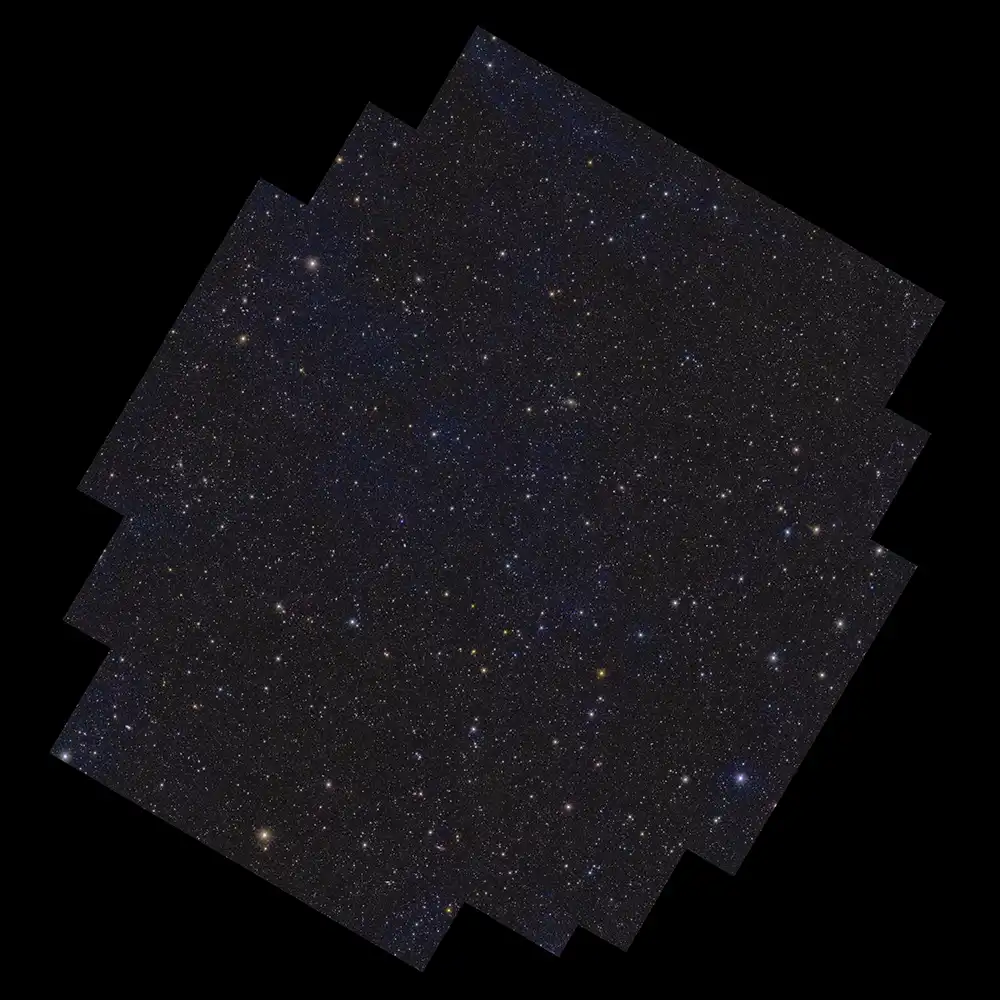
ESA / Euclid / Euclid Consortium / NASA; image processing by J.-C. Cuillandre, E. Bertin, G. Anselmi
The observable universe is little more than dust filming the surface of an immense hidden world – 95% of the cosmos is governed by obscure quantities dubbed dark matter and dark energy. The European Space Agency (ESA) Euclid space observatory is on a six-year mission to find out what they are. Today, the Euclid team published its first science data, “a treasure trove of information for scientists to dive into and tackle some of the most intriguing questions in modern science,” as Carole Mundell, ESA’s Director of Science, puts it.
The heart of today’s release are mosaics of the three fields on the sky where Euclid will eventually provide the deepest observations of its mission. The fields, “North”, “South” and “Fornax”, cover a total area of 63 square degrees, the equivalent of more than 300 full Moons. With one scan of each region so far, Euclid has spotted 26 million galaxies up to 10.5 billion light-years away. Complementing these images, the team released 34 scientific papers on various topics including galaxy clusters, gravitational lenses, and quasars.
The North and Fornax fields were chosen for maximum overlap with other space observatories, such as NASA’s Spitzer, Chandra, and Hubble as well as ESA’s XMM-Newton. The South field has never before studied by any deep survey. “We will observe each field between 30 and 52 times over Euclid’s mission, each time improving the resolution [...], and the number of objects we manage to observe,” explains Valeria Pettorino, ESA’s Euclid project scientist. Thus, the fields won’t reach their full resolution until the end of Euclid’s nominal mission. But they already can help scientists refine the analysis tools they’ll use to map the “dark side” of the cosmos.
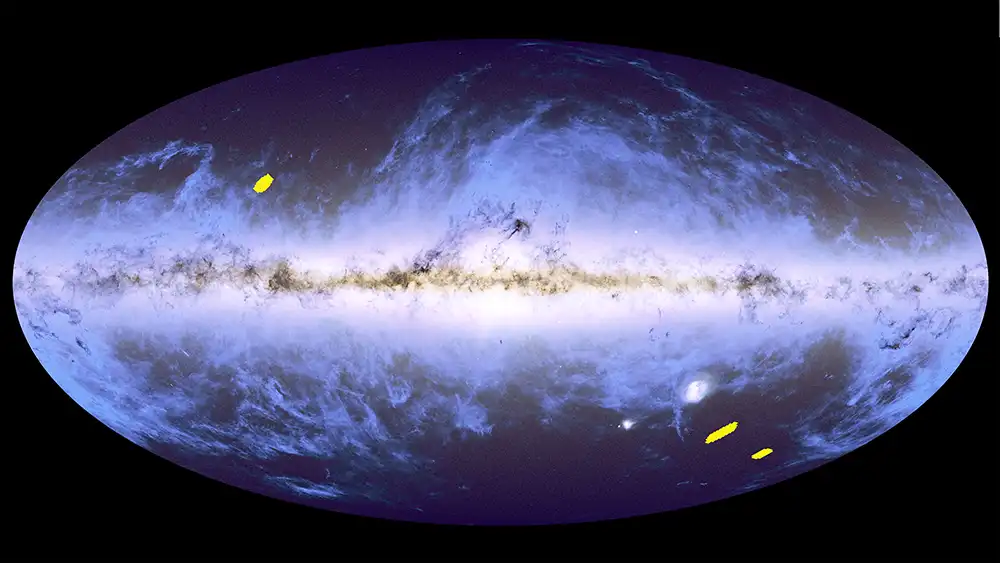
ESA / Euclid / Euclid Consortium / NASA; Stars: ESA / Gaia / DPAC; Dust: ESA / Planck Collaboration
Mapping Dark Matter
One major goal for Euclid is to map dark matter in 3D. To accomplish this, ESA launched the satellite in July 2023 and placed it at the L2 Lagrangian point about 1.5 million km (1 million miles) from Earth opposite to the Sun. It will eventually scan one-third of the sky, seeing into the farthest reaches of the observable cosmos and imaging the cosmic web of galaxies, clusters, and large empty voids. More precisely, it will record positions, distances and shapes of up to 1.5 billion galaxies, filling an atlas that will cover about 14,000 square degrees.
Dark matter is not directly visible even to Euclid, but the observatory can see its effect in these images as it bends and distorts light coming from far-away galaxies, an effect known as gravitational lensing. Most of the time, those distortions are so tiny that the lensing effect is weak. Even Euclid’s extremely sharp images, created by its Visible Instrument (VIS), will reveal them only after analyzing a large number of galaxies. The anticipated map of dark matter’s distribution will thus be ready only at the mission’s end.
But astronomers have already started work categorizing the millions of galaxies by their features, such as spiral arms, central bars, and tidal tails. Knowing these details is essential to later determine any possible distortions. “AI is a fundamental and necessary part of [this] process,” says Euclid Consortium scientist Mike Walmsley (University of Toronto). Out of the 26 million galaxies in today’s release, AI algorithms categorized 380,000 of them, about 0.4% of the total number expected in Euclid’s lifetime. But humans aren’t out of the picture even then: The AI received the help of 9,976 volunteers, who helped “train” the algorithm.
They also found 500 strong-lensing candidates, where a massive foreground galaxy (and its dark matter halo) act as a lens together, distorts the image of a background galaxy into arcs or even an Einstein ring. This is far more than the team expected, Walmsley adds: Until now, strong lensing candidates were found mostly by ground-based telescopes with wide-angle views. Euclid is the first space telescope designed to discover them in large quantities.

ESA / Euclid / Euclid Consortium / NASA; image processing by M. Walmsley, M. Huertas-Company, J.-C. Cuillandre
Homing in on Dark Energy
Dark energy is even harder to catch. It’s not concentrated in clusters, like dark matter, but spread out over the entire universe. And it drives space itself apart, instead of clumping together. Much like with dark matter, scientists know its effects — an accelerating expansion of the cosmos — but not what it actually is.
To track down dark energy, Euclid will observe the effects of baryonic acoustic oscillations. These density waves formed fractions of a second after the Big Bang, and when the universe cooled down, these waves imprinted themselves on galaxies’ large-scale distribution. Cosmic expansion has stretched this fingerprint over time.
By comparing snapshots of galaxies’ arrangements at a dozen or so different times in cosmic history, astronomers can track the universe’s expansion at early times — and in doing so, quantify dark energy. Euclid’s Near Infrared Spectrometer and Photometer (NISP), for which NASA provided the detectors, comes into play in measuring the galaxies’ redshifts, giving their distances.
By the end of Euclid’s mission, scientists may test if one particularly mysterious property of dark energy is true: Its energy density, contrary to that of matter, seems to be constant as space expands, which means that its influence is growing as the universe gets bigger, potentially leading to a complete “rip” of the entire cosmos.
Euclid’s data does not yet allow such insights. The full potential will be reached only when the mission has completed the entire survey by the end of the decade. But already, the next data release scheduled for October 2026 is supposed to contain more cosmology-related results. “What we have been seeing so far is a tiny taste of what’s to come,” Mundell adds. “Our scientists have a lot of work ahead of them in the next six years, and it will be phenomenally exiting and groundbreaking work!”



Comments
Andrew James
March 22, 2025 at 2:40 am
The 6.5x6.5 degree image centre is near the Cat's Eye Nebula, NGC 6543, located at 17h 57.2m +66° 00′. Larger images are here: https://euclid.caltech.edu/image/euclid20250319g-euclid-deep-field-north-preview
You must be logged in to post a comment.
You must be logged in to post a comment.