 SUNSET:

 0
0EZIE has launched successfully, poised to probe a poorly understood aspect linking space weather to dazzling aurora.

NASA / Johns Hopkins APL / Steve Gribben
Auroras put on an amazing show, but they also provide a window into space weather, where the Sun's magnetized wind of particles and Earth's protective magnetic shield meet. Now, a new, low-cost mission has launched to explore this poorly understood link.
The Electroject Zeeman Imaging Explorer (EZIE) went to space on a SpaceX Falcon 9 rocket on Friday, March 14th, at 11:43 p.m. PDT (local time) from Vandenberg Space Force Base in California. Launching as part of the Transporter 13 rideshare mission, which deployed 74 satellites, the three EZIE satellites separated from the payload just over two hours after liftoff. EZIE is now in a Sun-synchronous low-Earth orbit about 600 kilometers (373 miles) above Earth's surface.
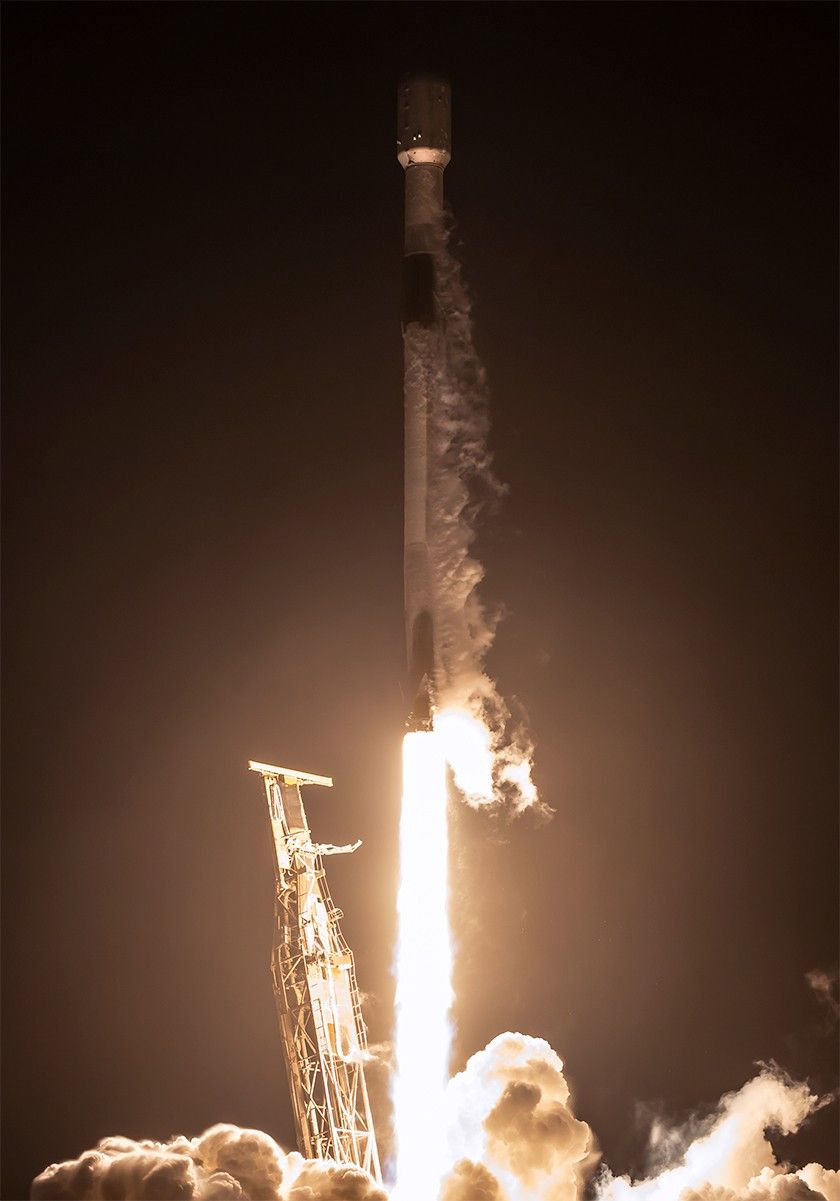
SpaceX
EZIE is a partnership between NASA's Jet Propulsion Laboratory, the Johns Hopkins Applied Physics Laboratory, and Blue Canyon Technologies of Boulder, Colorado, which supplied the CubeSat frames. Part of the Heliophysics Mission division of NASA’s Science Directorate, EZIE is an Explorer class mission, with a budget of only $53.3 million.
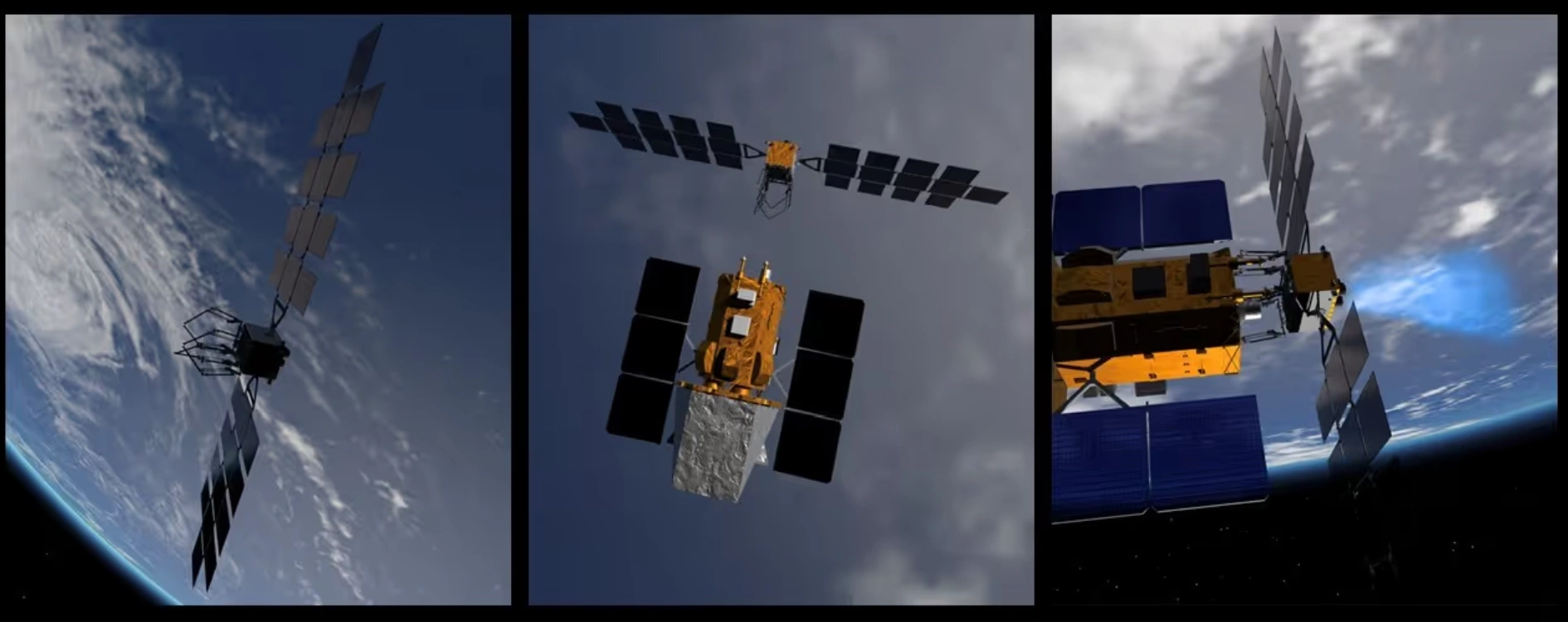
The three EZIE satellites are built on standard 6U cubesat chassis, using commercial, off-the-shelf technology. These do not incorporate active propulsion and will instead skip along the tenuous upper atmosphere by rotating and adjusting for drag as they speed along at 17,000 miles per hour (7.6 km/s).
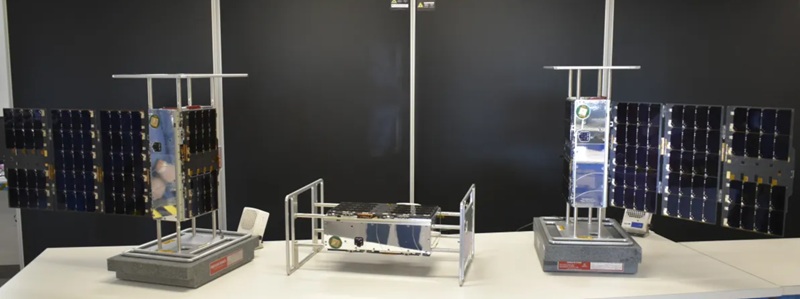
Blue Canyon Technologies
EZIE Will See Auroral Electrojets
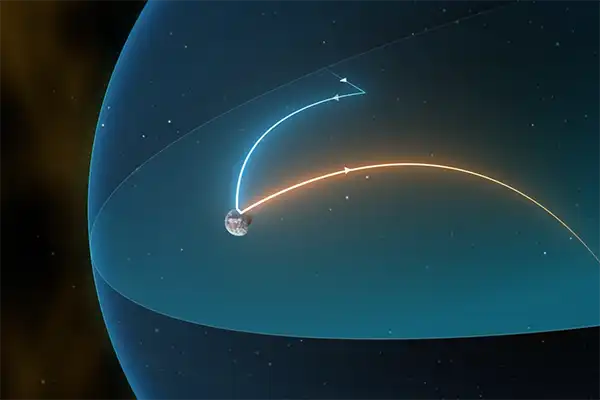
A key aspect of the mission is understanding electrojets, the streams of electrons that link the broader magnetosphere that envelopes Earth to the auroras within our planet's atmosphere. When you witness an auroral display, you're only seeing the very bottom of these currents as the electrons interact with atoms and molecules in the upper atmosphere — those colorful curtains are actually part of a long electromagnetic loop that extends far into space.
Johns Hopkins University Applied Physics Laboratory
“EZIE will reveal the structure and evolution of the electrojets—the most intense and persistent electrical currents in the Earth’s ionosphere.” says Jesper Gjerloev (Johns Hopkins Applied Physics Laboratory) “The electrojets are a key part of a vast current system coupling different regions of near-Earth space, including the atmosphere, ionosphere, and magnetosphere. By imaging the magnetic fingerprint of the electrojet currents, EZIE’s innovative remote sensing technique will provide long-sought closure to decades-old and much-debated mysteries of the dynamic and complex interaction between the Earth’s upper atmosphere and the surrounding space.”
To study the broader phenomenon, the trio of EZIE satellites are looking at the oxygen layer below them. Each spacecraft's spectrometer will pick up oxygen molecules as they interact with the electrons embedded in Earth's magnetic field. As each spacecraft sweeps by a few minutes after the one before it, together the three units will watch electrojets evolve. The information the probes collect will help determine if electrojets are as simple as the diagram above or if their structures are more complex.
Johns Hopkins University Applied Physics Laboratory
"Missions have studied these currents before, but typically either at the very large or very small scales," says Larry Kepko (NASA Goddard Space Flight Center) in a recent press release. "EZIE will help us understand how these currents form and evolve, at scales we've never probed."
The mission is also linked to the Polarimeter to Unify the Corona and Heliosphere (PUNCH), a quartet of coronagraph missions launched just last week. The area explored by EZIE is expected to overlap with PUNCH’s generous 90 degree-wide field of view, so the two missions will complement each other. The mission also shares another link with PUNCH, as both missions were launched on the same Falcon 9 stage 1 booster, marking the fastest turnaround for a reusable SpaceX booster, with one launch just four days before the next.
“The spatially distributed and temporally resolved nature of the EZIE measurement technique will be instrumental to validating and improving global magnetosphere and ionosphere-thermosphere models, which will help the development of forecasting capabilities for space weather.” Says Gjerloev.
“The Microwave Electrojet Magnetogram instrument carried on each of the three Electrojet Zeeman Imaging Explorer (EZIE) spacecraft utilizes the Zeeman effect to derive the vector magnetic field. EZIE makes precise measurements of the emissions and uses these to derive the magnetic field at the altitude of the emissions. As such EZIE ‘images the magnetic field’ produced by the electrojet currents.”
EZIE launches at an ideal time, as we’re in the peak of the 11-year Solar Cycle 25. The mission should have lots of space weather to look at during its 18-month nominal mission.
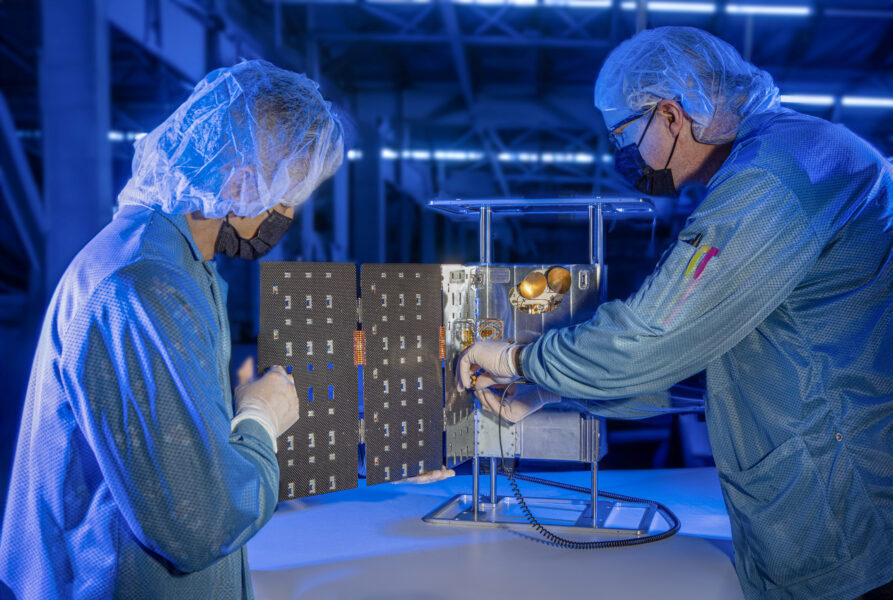
Blue Canyon Technologies
The project is getting students involved as well. EZIE-Mag kits enable students to compare terrestrial magnetometer readings on Earth against what EZIE sees in space. The EZIE project will incorporate this information, making student groups effectively part of the team.
EZIE is pushing the limits for small mission technology as it explores the links and boundaries of space weather.
About David Dickinson
David Dickinson is a freelance science writer, high school science teacher, retired enlisted U.S. Air Force veteran and avid stargazer. He currently resides with his wife Myscha in Bristol, Tennessee. David also writes science fiction in his spare time. He posts as @AstroDave on BlueSky about space news and sky-watching worldwide.



Comments
You must be logged in to post a comment.