 SUNSET:

 3
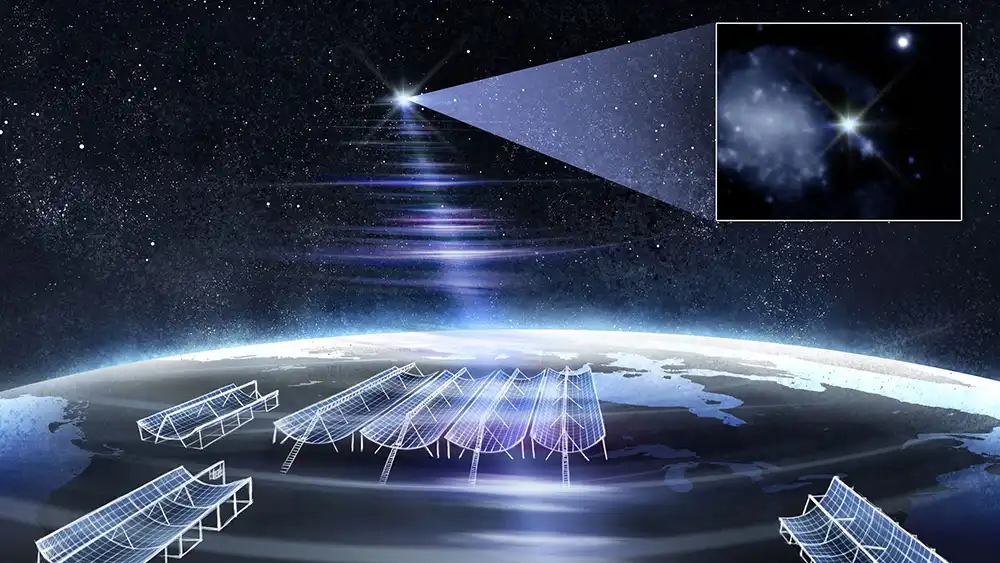
3Astronomers have pinpointed the location of an one-time fast radio burst to a spiral arm of a nearby galaxy.
Daniëlle Futselaar / MMT Observatory
Using a new radio telescope network spread across Canada and the United States, astronomers have observed one of the brightest fast radio bursts to date — and pinpointed its origin to a star-forming region in a spiral galaxy. The new information reinforces the idea that these millisecond-long bursts originate from the highly magnetized remnants of massive stars.
Fast radio bursts (FRBs) are incredibly powerful but extremely short-lived pulses of radio emission. Almost all of them come from outside our galaxy, so they appear at random locations on the sky. FRB 20250316A was no exception: The Canadian Hydrogen Intensity Mapping Experiment (CHIME) radio telescope in British Columbia, Canada, picked up the brief flash on March 16th 2025 from the direction of the Ursa Major constellation.
But this FRB outshone most others: “It was so bright that our pipeline initially flagged it as radio frequency interference, signals often caused by cell phones or airplanes that are much closer to home,” says Wen-Fai Fong (Northwestern University), who led the team that published the study in Astrophysical Journal Letters.
The newly upgraded CHIME observed FRB 20250316A with all four of its stations. Since 2018, CHIME’s core station has been watching a wide stretch of the northern sky at frequencies between 400 and 800 MHz, becoming the most prolific FRB discoverer. Since it started monitoring, the number of known bursts has risen from a few dozen to almost 4,000. But until recently, CHIME’s ability had a limited ability to locate these flashes on the sky. At best, it could narrow down the location to within a few arcminutes, pinpointing the galaxy (or group of galaxies) of origin, but astronomers wanted more.
Linking several radio telescopes together in a technique called interferometry, astronomers have located the source of 100 FRBs, mostly “repeaters” that flash more than once. These cases have revealed that FRBs tend to be linked to star-forming regions, which has in turn led to the working theory that FRBs may be violent eruptions on stellar remnants called magnetars. These extreme versions of neutron stars sport some of the strongest magnetic fields known in the universe. But it’s far from certain that the same astrophysical class of objects produce both one-time and repeated bursts.
Measuring the position of a one-time burst is far more challenging, because astronomers must have their telescopes observing in concert before a new FRB appears. That’s why the CHIME team added three “outrigger” stations in recent years, one in British Columbia, one in California, and another one in West Virginia, at distances of 6, 956, and 3,370 kilometers (4,100, and 2,090 miles) from the core telescope, respectively.
Since 2025, these stations have worked together to observe the same stretch of sky at the same time. Combined, they can pinpoint an FRB’s source to to within tens of milliarcseconds: “That’s like spotting a quarter from 60 miles away,” says Amanda Cook (McGill University, Canada).
FRB 20250316A was the first radio flash that all four telescopes caught — and astronomers were able to pinpoint its origin to a spiral arm of NGC 4141, a face-on galaxy about 130 million light-years away.
Turns out FRB 20250316A churned out as much power in a millisecond as our Sun does over four days, which is average for an FRB. Its brightness was due to its proximity.
At this distance, a tenth of a milliarcsecond translates to a spatial resolution of about 45 light-years, about the diameter of the core of the Pleiades star cluster in the Milky Way.
Observationally however, FRB 20250316A was exceptional, comments Laura Spitler (Max Planck Institute for Radio Astronomy, Germany), who in 2016 discovered the first repeating FRB but was not involved in this research. “It is not the first non-repeating FRB whose position has been measured, but due to the combination of CHIME outrigger's capabilities and its close proximity to the Earth, its position within the host galaxy is the most precisely known.”
Follow-up observations with the MMT 6.5-meter telescope in Arizona and the 10-meter Keck telescope on Mauna Kea, Hawai‘i, show that the FRB originated within 600 light-years of a prominent star-forming region. “This location is intriguing because we would expect it to be located within the clump, where star formation is happening,” says Yuxin “Vic” Dong (Northwestern University), the principal investigator of the MMT program. “This could suggest that the progenitor magnetar was kicked from its birth site.” Alternatively, he says, the magnetar might have been born right where it is now
NGC 4141 contains large clouds of ionized gas and hosted two recent core-collapse supernovae, SN 2008X and SN 2009E, both of which indicate a high rate of starbirth and death — just the kind of environment that magnetars frequent.
The astronomers looked for radio emission at the burst’s location, both in archival CHIME data reaching back more than six years, as well as with other radio telescopes after the event, but didn’t find any. That makes it likely that FRB 20250316A isn’t a repeater, though it’s still possible the burst repeats only every couple of years. There were also no signs of continuous radio waves or X-rays.
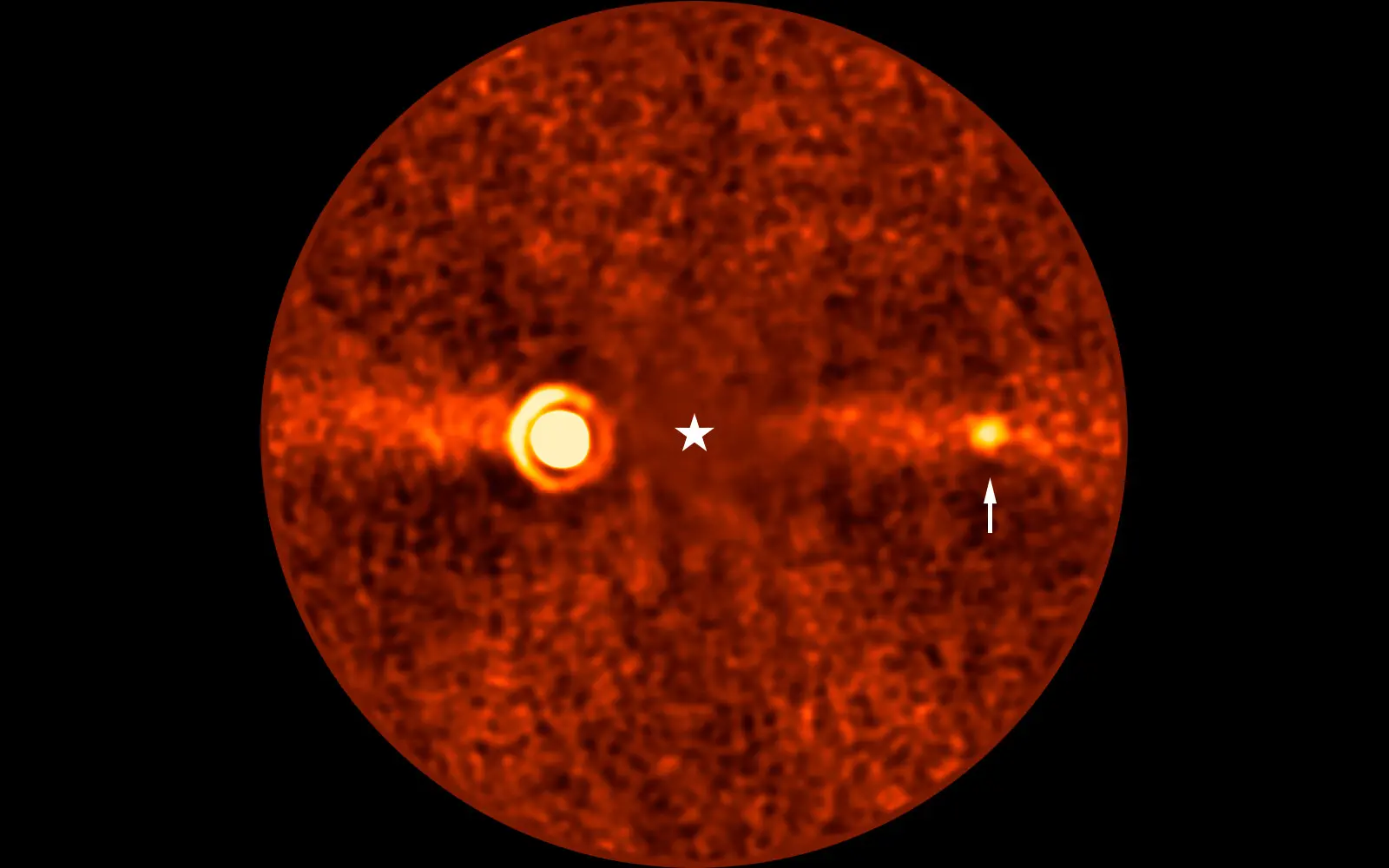
NASA / ESA / CSA / CfA / P. Blanchard et al.; Image processing: CfA / P. Edmonds
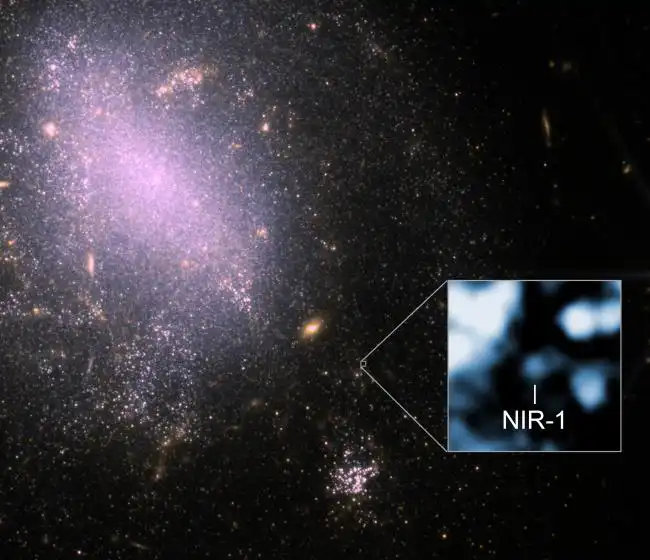
However, when a team led by Peter Blanchard (Center for Astrophysics, Harvard & Smithsonian) turned the James Webb Space Telescope to NGC 4141, they found something interesting: “We see a faint source of infrared light very close to where the radio burst occurred,” Blanchard says. “This could be the first object linked to an FRB that anyone has found in another galaxy.”
The object can’t be a magnetar though; a magnetar would be too faint at infrared wavelengths to be seen. The infrared object, dubbed NIR-1, is likely a red giant star or possibly a massive main-sequence star. These stars are unlikely to directly produce FRBs themselves, but if the star in the image has a neutron star as a companion, and if this neutron star is pulling material away from the red giant, this process may have triggered the burst. "Whether or not the association with the star is real, we’ve learned a lot about the burst’s origin," Blanchard adds.
“It is remarkable that only a couple of months after the full outrigger array went online, we discovered an extremely bright FRB in a galaxy in our own cosmic neighborhood,” Fong says. “This bodes very well for the future.”
Spitler agrees: “The CHIME outriggers will be a game changer in the field by both significantly increasing the number of identified host galaxies, but also enabling more such in-depth, multi-wavelength investigations of FRB environments.”



Comments
Mark Kaye
August 31, 2025 at 1:38 pm
66,956 kilometres. Hmm, California is reported to be a bit "out there", but really, is it that far away? That is nearly 2/5 of the way to the Moon. I suspect a typo.
You must be logged in to post a comment.
Monica Young
August 31, 2025 at 4:31 pm
Thanks, Mark! Typo indeed, that should have read 6,956 km.
You must be logged in to post a comment.
Mark Kaye
August 31, 2025 at 2:27 pm
Fat fingers,1/5 of the way to the Moon.
You must be logged in to post a comment.
You must be logged in to post a comment.