 SUNSET:

 33
33Comet Tsuchinshan-ATLAS has delighted observers across the world for the past two weeks, but its morning run was only a warm-up — wait till you see what’s coming.

Gerald Rhemann, Michael Jäger & Denis Möller
I'm mostly a nighttime observer, but Comet Tsuchinshan-ATLAS (C/2023 A3) has turned my schedule upside down. For the past 10 days, I've been up at dawn, peering through the horizon murk for brief views of the comet, then sticking around for an extra hour to see sunup. In that time I've met a whole new group of people — runners, birders and of course, sunrise-watchers.
From the northern U.S., the comet has primarily been a photographic object too faint to see without binoculars. But those in the southern U.S. and southward, where the comet stands higher and suffers less from atmospheric absorption, have seen a bright, strongly condensed coma and a tail more than 15° long. Observers there simply have to look up, and there it is. Even smartphones suffice for capturing the comet with a favorite twilight scene.

Michael Mattiazzo
Groups devoted to comet-observation on Facebook such as Comet Watch and ICQ Comet Observations are brimming with images of the Oort Cloud emissary. With a current magnitude of about 1.5, it's the brightest comet since NEOWISE (C/2020 F3) in 2020.
And we're only getting started. Tsuchinshan-ATLAS is right in line with the most optimistic brightness models described in our earlier post as it prepares to transition to the evening sky on October 9th. Closest approach to Earth — it'll come within 70.5 million kilometers — occurs three days later. Given October's early sunsets, the comet's timing couldn't be better both for amateurs and the viewing public with its armada of smartphone cameras. I suspect this icy dirtball will become the most photographed comet in history.
Still a Few Mornings Left

Paulo Régis
The comet remains visible low in the dawn sky, approximately 45 minutes to an hour before sunrise — that will be true through about October 4th for observers at latitude 45°N, Oct. 5th for those at 40°N, and Oct. 6th for those southward of latitudes 25°-30°. The comet should rapidly brighten as its dust-rich coma and tail strongly forward-scatter the sunlight. On the last date of visibility, the comet should gleam around magnitude –1.

Stellarium with additions by Bob King
Then the comet slides into the daytime sky; predictions suggest it will rocket to magnitude –4.5 by October 9th. Even when its head is doused by the solar glare, photographers may still be able to photograph the tail standing up from the horizon in the relatively dark skies of early dawn. Time-exposures will capture its extreme limits.
Given those forecasted magnitudes, I won't be the only one attempting to see the comet in daylight, whether through a carefully positioned telescope or by hiding the Sun behind a post or roofline and searching for the comet's position with binoculars. Whichever way you choose, be extremely cautious in two regards — never look directly at the Sun even for a moment or you'll put your vision at risk. Second, be sure your instrument is protected from direct solar rays that might damage a component of the optical system.
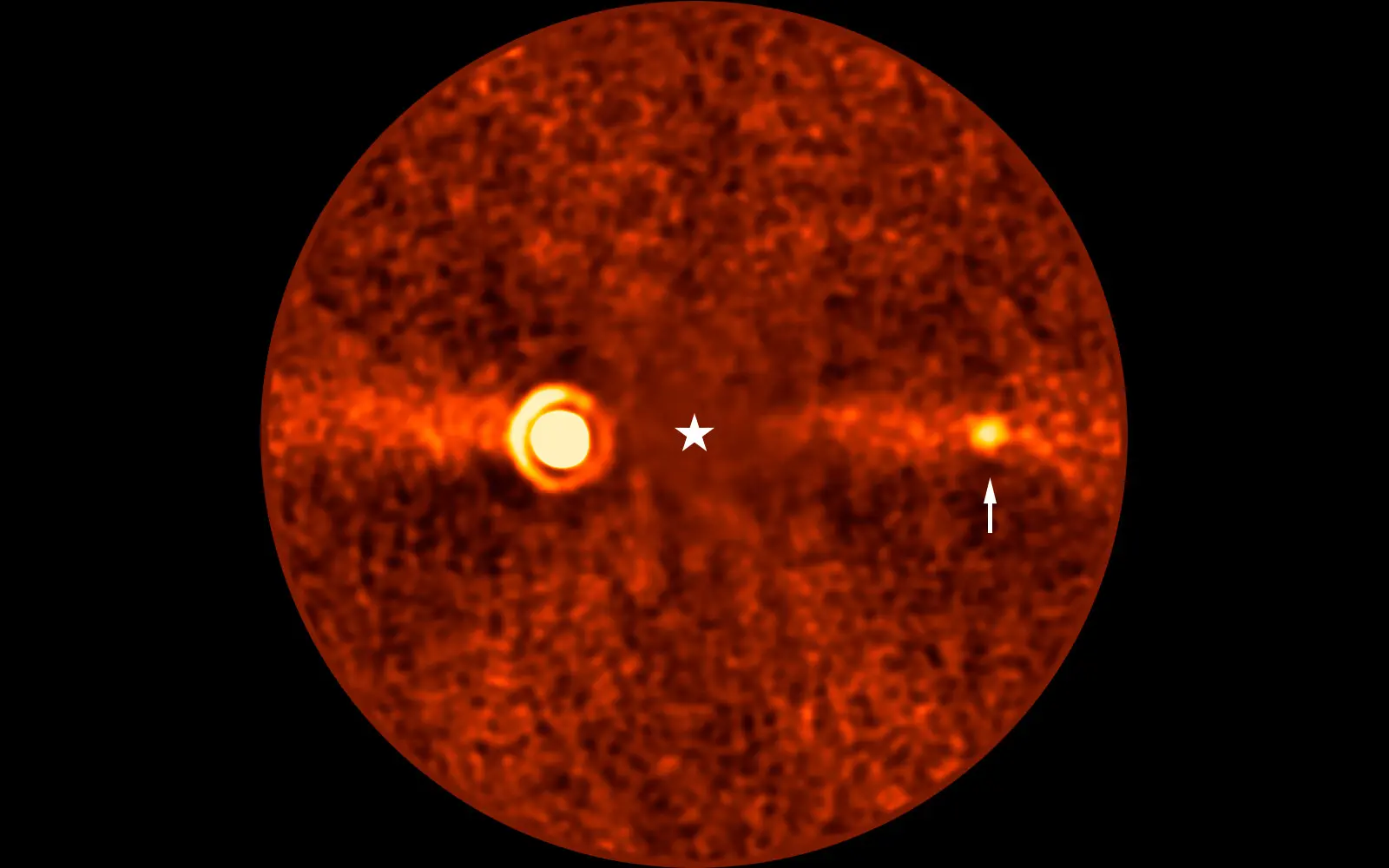
A less perilous alternative is to watch the comet pass through the field of view of the LASCO C3 coronagraph of the ESA-NASA Solar and Heliospheric Observatory (SOHO) from Oct. 7th through 10th.

ESA / NASA / SOHO
Act II: Spectacle at Dusk

Sky & Telescope graphics
When C/2023 A3 first appears at dusk on or about Oct. 11, the dust tail will point downward toward the horizon but then quickly flip up in the anti-solar direction by Oct. 13. In the same way we might photograph the comet's lengthening tail at dawn we can do the same in the evening sky beginning at that time, albeit diluted by a modicum of moonlight.
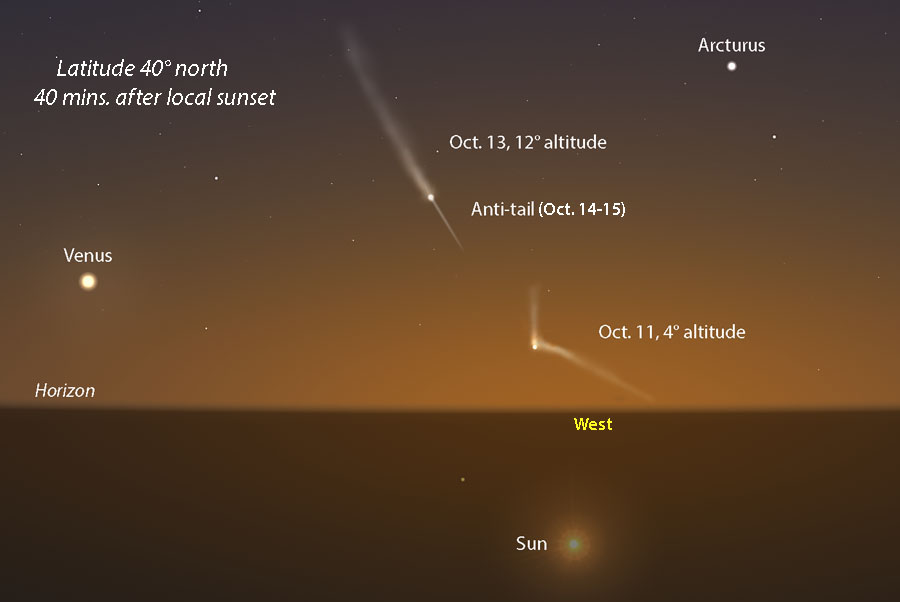
Stellarium with additions by Bob King
The tail will likely exceed 20-25° during early-mid October as the comet's overall magnitude fades from around –1.6 on Oct. 11 to 0 on Oct. 13. My simple attempt at illustrating the comet's appearance at the start of the evening apparition (above) shows how the tail angle rapidly changes in just two days time. To see the "full story" from dawn through solar conjunction to dusk take a look at Nicolaus Lefaudeux's excellent simulation below.

Nicolaus Lefaudeux
Keeping Tabs on the Weather
Although Comet Tsuchinshan-ATLAS will be visible in both hemispheres, the northern one is favored because the comet tracks north. Also, sunsets are getting earlier and twilights shorter, while the opposite is happening in southern latitudes.

Tobias Yoder
Observers should be aware that the Moon will interfere for several nights, from about Oct. 15-20 (full Moon is on Oct. 17th), around the same time the comet climbs out of twilight. Something tells me that won't stop any of us from taking advantage of every opportunity to look at and photograph the comet!
To aid in finding a clear sky to do so I suggest using a weather app. I'm sure most of you already have a favorite, but in case you don't I recommend the free Windy app. It offers easy-to-read nighttime cloud maps and a handy two-hour time-lapse feature that reveals weather trends, so you can see at a glance whether clouds are coming or going.

Left: Diliff, CC BY-SA 3.0 with additions by Bob King; right: Makreb Larnaout
What to Watch For
C/2023 A3's path takes it across Serpens and Ophiuchus this month. On the night of Oct. 15th, it will pass just 1.1° south of the glorious 6th-magnitude globular cluster M5 — a not-to-miss opportunity for photographers.
Besides a prominent dust tail, the comet will also exhibit a fainter ion (gas) tail, best viewed in binoculars and telescopes. Time-exposures clearly reveal its vivid blue color due to carbon monoxide emission stimulated by ultraviolet sunlight. Watch for kinks and blobs within the tail, which are caused by its interaction with the variable solar wind. Telescopes and especially cameras are excellent for detecting synchronic bands in the dust tail. These occur when chunks of comet material break off, crumble into dust and get spread into linear streaks by solar radiation pressure.

Bob King
One of my favorite things to look for are jets and fountains of dust emanating from the comet's pseudo-nucleus, the dense ball of dust and gases surrounding C/2023 A3's true nucleus, estimated to be about 2 kilometers (1.2 miles) across. Use high magnifications — 250× and up — to discern these low-contrast features.

Orbital diagram: Gideon van Buitenen with additions by Bob King; Comet image: public domain
Earth crosses the comet's orbital plane on Oct. 14th, when we'll view its orbit edge-on. This special perspective is expected to create a prominent anti-tail and other enhancements:
"The orbital plane crossing won't just cause an overall brightening of the normal dust tail," writes Qicheng Zhang, a postdoctoral fellow working on small-body astronomy at Lowell Observatory in Arizona), "but will create the appearance of a sharp, bright line (from the dust in the orbital plane, viewed edge-on), superimposed on top of that normal dust tail, that should also extend far in the opposite direction (likely many degrees) toward the Sun. This effect will give the comet a distinctive appearance different from most other recent comets." Comet Arend-Roland (C/1956 R1) sported a similar dusty goatee back in 1957.
Another Bright Comet Coming?

Dennis Möller, Michael Jäger, Gerald Rhemann
The Asteroid Terrestrial-impact Last Alert System (ATLAS) spotted a new comet on Sept. 27th, now confirmed as a Kreutz sungrazer. Kreutz comets are thought to be fragments of a once much-larger object that broke apart. The most famous of them is Comet Ikeya-Seki from 1965. All have perihelia that bring them searingly close to the Sun.
This one passes perihelion on Oct. 28th at a distance of only 1.2 million kilometers (745,650 miles). Should it survive the heat and tidal forces, we could be in for a spectacular show. Designed Comet ATLAS (C/2024 S1), the object is currently around 12th magnitude in the morning sky in Hydra. As the orbit and predictions are refined, we'll post them here. Wishing clear skies and many happy (comet) trails!
About Bob King
I love the sky (day and night) and have been a skywatcher and amateur astronomer since childhood. I'm also a long-time member of the American Association of Variable Star Observers (AAVSO) and Astronomical League. I pen the Astro Bob blog and have written four books: Night Sky with the Naked Eye (2016); Wonders of the Night Sky You Must See Before You Die (2018) and Urban Legends from Space (2019) and Magnificent Aurora, published in 2024. The universe invites us on an adventure every single night. To accept the invitation, we only need look up.



Comments
Anthony Barreiro
October 2, 2024 at 7:04 pm
Thank you Bob. Thanks to your timely progress reports on this comet, I've been waiting for a chance to see it.
I observed the comet Monday and Tuesday mornings, September 30 and October 1, through 10x42 binoculars from Bernal Hill across San Francisco Bay. The comet was a lovely sight above the east bay hills. I first saw the comet when it was a few degrees above the horizon, about 10 minutes after nautical dawn, and was able to see it easily for 10 to 15 minutes, despite the local light pollution and brightening dawn sky. The coma (false nucleus?) looked quite condensed, and I could see about 1/4 degree of the dust tail with direct vision, maybe twice as much with averted vision. The dust tail was much brighter on the edges, as you describe. Thanks for explaining how that works.
I'm making plans to travel to a dark sky later this month.
If I can see this comet through binoculars from San Francisco, everybody should be looking for it when your weather cooperates!
You must be logged in to post a comment.
Bob KingPost Author
October 3, 2024 at 5:16 pm
Anthony,
Thank you, and I enjoyed reading your description of the comet through binoculars. Agreed — if you can see it from San Fran this will be a comet for everyone.
You must be logged in to post a comment.
Torsten Eide
October 8, 2024 at 2:06 pm
Thank you!! I’ve been hoping for another good comet viewing since Neowise! Before that just decades of disappointment…
Your article is the most informative and accurate one I have ever had the pleasure of reading about a comet in my life. Everything you need, no embellishing the information with unlikely scenarios or sensationalism. Just good solid information and graphics. Everything a person could ever ask for. You’re my go to person from this day forward when it comes to comets!
Thanx again!
You must be logged in to post a comment.
Bob KingPost Author
October 8, 2024 at 2:47 pm
Dear Torsten,
That is a great compliment. Thank you so much for your kind words. I hope you have lots of clear nights so you can enjoy Comet T-A as much as you did Neowise. I'm just as eager as you for my first dusk sighting this weekend!
You must be logged in to post a comment.
Anthony-Mallama
October 3, 2024 at 11:18 am
Thanks for this article, Bob. I had been looking for a comprehensive set of predictions. Now I am ready to observe!
You must be logged in to post a comment.
Bob KingPost Author
October 3, 2024 at 5:17 pm
You're welcome and thank you, Anthony M. Let's hope it also has lots of surprises, too!
You must be logged in to post a comment.
Roy Sivertsen
October 6, 2024 at 8:02 am
Thanks for this great and informational article. I havent observed a good comet since Hale-Bopp exept a brief glimpse of Neowise from my car.
You must be logged in to post a comment.
Bob KingPost Author
October 8, 2024 at 2:56 pm
Hi Roy,
You're welcome. The comet looks like it's holding up just fine and should give a great show in just a few days.
You must be logged in to post a comment.
Sandeep Joshi
October 6, 2024 at 9:14 am
Thanks for the very informative article, Bob!
I had been trying to have a glimpse of this comet here in Pune, India in this past week but the weather had not been co-operating in the early mornings except on Monday when it was excellent but this comet was somehow not even on my mind! 🙁 The weather was better yesterday and I decided to give it a try with my 10x50 binocs. Earlier I had seen differing numbers for its visual magnitude (here 1.5 and 4-5 elsewhere), so I was not really sure what to expect. I knew roughly where to look from Stellarium and so tried scanning the horizon for about 20 odd minutes without getting a trace of it. Then somehow I went a bit too off towards the right (South) and there it was! It could not be missed when I saw it and the magnitude mentioned here (1.5) appeared to be correct since it was visible instantly (when it showed up) without having to make any guesses of whether it was there or not even in the brightening sky at about 6 am! I was really overjoyed seeing it and it really made my day.
I again tried today, yet it was a different day and I could not see it (likely due to hazy horizon and it moving more sunward)!. I hope to get better chances when it swings into the evening sky in the next week. Fingers crossed! 🙂
You must be logged in to post a comment.
Bob KingPost Author
October 8, 2024 at 2:56 pm
Thank you so much, Sandeep. Amazing you spotted it so low! I experienced that exact same feeling of satisfaction when I finally saw the comet in binoculars on Oct. 1. Good luck this weekend when the comet returns at dusk!
You must be logged in to post a comment.
Ike
October 14, 2024 at 1:18 pm
Thank you.
You must be logged in to post a comment.
Prathameshpatankar303
October 10, 2024 at 10:54 am
Hey sandeep, i am also planning on observing a glimpse of the comet in the coming days during the evenings, i will be in pune around that time, could you tell me some spots around where it will be best to view. Thanks
You must be logged in to post a comment.
Jim Case
October 8, 2024 at 5:24 pm
Thanks, Bob. These detailed predictions are very helpful. I was able to find a location in my hilly suburban location yesterday that should provide a good view of the comet on October 12th or 13th when it is less than 20 degrees from the horizon. The location may also be a good one for twilight photography with the DSLR so I will give it a try. On October 15th I should be able to frame it when M5 is a close neighbor in a western gap in my backyard with the 80mm APO. You have provided the best detail I have seen yet and it is appreciated.
You must be logged in to post a comment.
misha17
October 8, 2024 at 6:01 pm
re: "A less perilous alternative is to watch the comet pass through the field of view of the LASCO C3 coronagraph of the ESA-NASA Solar and Heliospheric Observatory (SOHO) from Oct. 7th through 10th." -
The comet is now in the LASCO C3 video:
https://soho.nascom.nasa.gov/data/LATEST/current_c3.mp4
You must be logged in to post a comment.
bob kelly
October 9, 2024 at 12:29 pm
Thanks for this wonderful set of info and graphics!
I tried by eye and with binoculars about 11am EDT today, using Stellarium to see which way to look from the Sun. Used a corner of the roof of the house to block the Sun. No luck.
I've seen Venus 8 degrees from the Sun, so I may have a better chance tomorrow. A super-clear day would help, too.
SOHO is super-impressive with the comet, Mercury and a shower of particles hitting the detector.
bob kelly, ardsley, ny
You must be logged in to post a comment.
misha17
October 9, 2024 at 2:45 pm
1. ''SOHO is super-impressive with the comet, Mercury ... "
It looks like the comet won't make it into the view of the C2 camera, which catches details closer to the Sun.
2. "... and a shower of particles hitting the detector."
I found an article that says that the outflow from one of the Sun's recent Corona Mass Ejections might interact with the comet's tail:
https://www.iflscience.com/giant-coronal-mass-ejection-may-hit-comet-tsuchinshan-atlas-before-it-hits-earth-76269
You must be logged in to post a comment.
misha17
October 9, 2024 at 7:44 pm
Daylight photo from Italy, not mine:
https://x.com/GJDonatiello/status/1844131097363538255
You must be logged in to post a comment.
Ike
October 11, 2024 at 4:33 pm
Why does this article have content like " that will be true through about October 4th" and comments from as early as Oct 2, but have a by line date of October 11? If the article was written (or updated) on Oct. 11, it should at least say something about the comet's magnitude as of Oct. 10, no?
You must be logged in to post a comment.
Anthony-Mallama
October 11, 2024 at 11:28 pm
Very little, if anything, is known about the comet's magnitude on October 10. Tonight on the 11th one person estimated mag 2 or 3 on the Comet forum of the CloudyNights web site.
You must be logged in to post a comment.
bob kelly
October 12, 2024 at 4:16 pm
It's an updated version of the earlier October article on this site.
You must be logged in to post a comment.
Bob KingPost Author
October 14, 2024 at 5:59 pm
Hi Ike,
As Bob mentioned it's an updated article that I've continue to add small bits to. No one could estimate the Oct. 11 magnitude because the comet was not yet visible. It entered the evening sky on Oct. 11. I will have a completely updated article tomorrow, Oct. 15. Keep an eye out for it. Lots of great images!
You must be logged in to post a comment.
Joaquin Tall
October 12, 2024 at 3:07 pm
Hello Bob et.al,
Thank you for the great article!
The last really good look at a comet for me was the Hale Bopp. I remember it distinctly because that was the year that I met by beloved wife. It indeed was a good omen for me!!
I remember the Kohoutek comet from 1973 as well. It was a good view even from the city blight of urban San Diego. It caused such a stir that the local PBS tv/radio station produced a gate-fold flyer introducing the comet to anyone who would send in a SASE to the station for a copy.. Somewhere around here I have my copy stashed away.
You would think that the A3 would be a great view for me; I'm 10 miles SW of the Mt. Palomar Observatory..Regrettably, there is a 100' high hill to my SW, so the comet will be obscured for a while. I think that my hill climbing days are behind me, as it were...
So, I relish in all the photos that you younger folks send in. Please, keep them coming!!
Alain
You must be logged in to post a comment.
misha17
October 12, 2024 at 10:04 pm
I was at a viewing site 20 minutes after sunset, but it had already sunk into a cloud bank low on the horizon. Another couple saw it and showed me a photo, it had a short "horned" tail.
My sister was there before me, and said it was visible even before sunset.
All 3 said it was very bright, but not as bright as Venus.
You must be logged in to post a comment.
Bob KingPost Author
October 13, 2024 at 1:10 pm
Hi Misha,
I wonder if that couple photographed an airplane contrail. 20 minutes after sunset was pretty early see the comet as a "bright" object last night. It didn't show well until around 40 minutes after sundown. A contrail seen at a distance often mimics a comet's appearance. I've seen this many times. Some are even distinctly "horned," caused by dual contrails, one for each engine. Unfortunately, the comet isn't bright enough to show before sunset, making it even more likely the group saw an airplane contrail. The comet should become very obvious by tonight, so I'm sure you'll have lots more opportunities to see it.
You must be logged in to post a comment.
misha17
October 14, 2024 at 11:58 pm
Bob, I have seen contrails (I even had to tell my sister that she was seeing one when she called me as I was on my way to the lookout point), but this trail was shorter, and I confirmed with her a couple of other observers that it is was not moving it. If it was a contrail, it was very distant for the trail to appear so thick and foreshortened.
Anyhow, it turns out that it was much lower in the sky that the comet was based on photos taken around the same time after sunset.
Definitely saw it Sunday night through binoculars and phone camera but not naked eye before sky clouded over.
Sighted tonight (Monday) through binoculars again. Another viewer also briefly saw it with the naked eye, but the city lights made it hard to see otherwise.
You must be logged in to post a comment.
Bob KingPost Author
October 15, 2024 at 12:15 am
Misha,
Glad you saw it for sure on Sunday and Monday. I only mentioned contrails because I was fooled once by a very distant one. It looked like a comet and just sat there. The reason it appeared to move so slowly or not at all was because it was headed away from me rather than across the sky.
You must be logged in to post a comment.
Karl
October 13, 2024 at 1:59 am
Long tail easily visible to naked eye in bright dusk from New Mexico.
The head appeared dimmer and redder than Arcturus, but likely would have outshone it at the same altitude. Arcturus was much higher. This comet would be spectacular in a dark sky.
I wasn't prepared to photograph it because I wasn't expecting to see much so soon after sunset! But I will have the camera set up tomorrow.
You must be logged in to post a comment.
Bob KingPost Author
October 13, 2024 at 10:50 am
Fantastic to hear, Karl. Thank you for your observation.
You must be logged in to post a comment.
Joe-Abramo
October 14, 2024 at 5:18 pm
https://www.instagram.com/abramo.joe/p/DBHnE70TMpg/
Oct. 13, 7:20pm Princeville Kauai Hawaii
You must be logged in to post a comment.
Anthony-Mallama
October 14, 2024 at 10:08 pm
I observed A3 this evening when it was about 15 degrees above my horizon. A nice binocular object with a distinct tail even in light polluted skies.
You must be logged in to post a comment.
Robert-LaPorta
October 14, 2024 at 10:44 pm
Easily visible in Tucson right above Kitt peak. Beautiful sight better than neowise.
You must be logged in to post a comment.
Karl
October 14, 2024 at 11:25 pm
Clouds interfered 10/13 🙁
On 10/14 it's much fainter than 2 days ago but still an easy naked eye object in twilight. At least 10 degrees of tail visible to the naked eye, even with moonlight pollution. Above that it was hidden by a persistent cloud.
I could not see the anti-tail but my camera could! Long and narrow, vanishing into the twilight glow maybe 7 degrees below the head.
You must be logged in to post a comment.
Anthony-Mallama
October 17, 2024 at 7:51 pm
I had a good view of the comet’s head on the evening of the 17th. The inner coma was almost stellar in appearance through a 105 mm reflector at 35 power.
You must be logged in to post a comment.
You must be logged in to post a comment.