 SUNSET:

 6
6A new brightness forecast for Comet Tsuchinshan-ATLAS whets our hopes for a fine appearance in late September and early October.

Terry Lovejoy
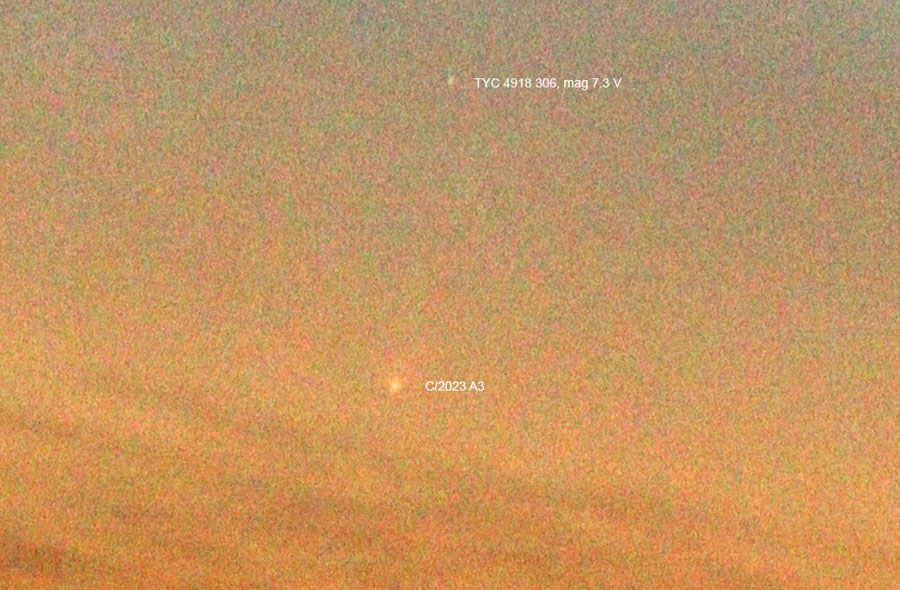
We're all hungry for news about C/2023 A3 Tsuchinshan-ATLAS. Well, I've got some. First, Australian amateur astronomer and six-time comet discoverer Terry Lovejoy posted the first ground-based photo of C/2023 A3 since it was overcome by solar glare in mid-August. Until Lovejoy corralled it on September 11.8 Universal Time, the comet was only accessible remotely by orbiting spacecraft.
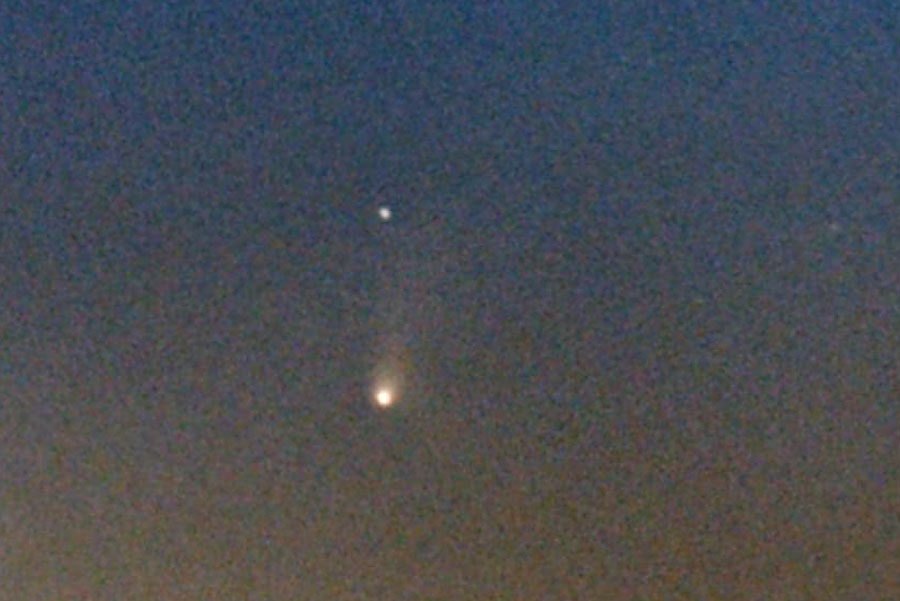
Lovejoy recovered the comet in Sextans just 14° from the Sun in bright morning twilight at magnitude 5.5. The photo shows that the Oort Cloud visitor is still intact with a bright, compact coma and a faint, feather-shaped tail extending to the upper right (southwest). The comet's solar elongation is increasing at the moment, so we should see more images and observations from Southern Hemisphere observers soon. Comet-lovers at 40° north will get their first crack at it on or about September 23rd.
The other good news comes to us from the Central Bureau for Astronomical Telegrams which issues timely astronomical news flashes called CBETs (Central Bureau Electronic Telegrams). In CBET #5445, posted on September 10, comet researcher Joseph Marcus predicts strong forward-scattering enhancement of the comet's light around the time it reaches its greatest phase angle, which will occur on October 9th.

Bob King

Left: Nathanael Callon, public domain; Right: NASA / JPL-Caltech
Observations indicate that C/2023 A3 appears to be a particularly dusty comet based on the structure and form of its tail and the fact that the nucleus has produced far more dust than diatomic carbon (C2) emissions, the gas that gives so many comets their radiant green hue.
Marcus cautiously predicts the following magnitudes and phase angles (he gives scattering angles, which I converted to phase angles):
| Date | Phase angle | Baseline magnitude | Enhancement magnitude | Visual magnitude with forward-scattering | ||||
| Sept. 29.0 UT | 100.5° | 2.4 | –0.3 | +2.1 | ||||
| Oct. 2.0 | 121.3° | 2.2 | –1.1 | +1.1 | ||||
| Oct. 5.0 | 143.3° | 2.1 | –2.5 | –0.4 | ||||
| Oct. 6.0 | 150.9° | 2.1 | –3.2 | –1.1 | ||||
| Oct. 7.0 | 158.6° | 2.1 | –4.1 | –2.0 | ||||
| Oct. 8.0 | 166.1° | 2.1 | –5.3 | –3.3 | ||||
| Oct. 9.0 | 172.1° | 2.1 | –6.7 | –4.6 | ||||
| Oct. 9.4 | 173.0° | 2.1 | –6.9 | –4.8 | ||||
| Oct. 10.0 | 171.5° | 2.1 | –6.5 | –4.4 | ||||
| Oct. 11.0 | 164.9° | 2.2 | –5.1 | –2.9 | ||||
| Oct. 12.0 | 157.0° | 2.3 | –3.9 | –1.6 | ||||
| Oct. 13.0 | 148.9° | 2.4 | –3.0 | –0.6 | ||||
| Oct. 14.0 | 140.9° | 2.5 | –2.3 | +0.2 | ||||
| Oct. 15.0 | 133.2° | 2.7 | –1.7 | +0.9 | ||||
| Oct. 18.0 | 112.9° | 3.2 | –0.7 | +2.5 | ||||
| Oct. 21.0 | 96.9° | 3.8 | –0.2 | +3.6 |
Taken together, the comet's dustiness, phase angle, and efficient forward-scattering all point to it potentially becoming visible during daylight. These factors also mean a brighter appearance at twilight, when the comet will best be visible during the upcoming apparition. During the October 7-11 interval C/2023 A3 may exceed magnitude –2 and possibly spike at –4.8 . If so it would be visible to careful observers with telescopes and binoculars in the daylight sky not far from the Sun. I'm reminded of Comet McNaught (C/2006 P1), which was visible in daylight at about magnitude –6 in January 2007.

Stellarium

Jan Mark Vornhusen, CC BY-SA 3.0
Like Tsuchinshan-ATLAS, forward-scattering due to a high phase angle (149° at peak on Jan. 14, 2007) played a significant role in boosting McNaught's brightness. Can we expect a similar performance from C/2023 A3? Yes and no. Marcus is confident in the forward-scattering model because it's been tested and proven in observations of earlier comets.
"What I am less confident about is the comet's baseline brightness forecast," he wrote in an email.
We still don't know the intrinsic brightness of Comet Tsuchinshan-ATLAS since solar glare has essentially curtailed observations since early August — more than a month before its September 27th perihelion. Lacking that data, visual magnitude predictions "could easily be off one or two magnitudes in either direction by the time we get to October," said Marcus. Hopefully, Lovejoy's recovery will spur more observations to help refine that value.

S. Deiries / ESO
Another reason C/2023 A3 may not necessarily be a repeat of Comet McNaught — despite the favorable forward-scattering situation — relates to its close pass by the Sun. C/2006 P1 experienced more intense heating, and therefore dust release, than C/2023 A3 did, because its perihelion passage brought it much closer to the Sun. (Comet McNaught passed 25.4 million kilometers, or 15.8 million miles, from the Sun versus 58.3 million for Comet Tsuchinshan-ATLAS).
Rob Kaufman
Comets will always be iffy, but I like the new forecast. Like most amateur astronomers, I'm an optimist, so fresh information and images only heightens my anticipation.
Terry Lovejoy

Michael Mattiazzo
About Bob King
I love the sky (day and night) and have been a skywatcher and amateur astronomer since childhood. I'm also a long-time member of the American Association of Variable Star Observers (AAVSO) and Astronomical League. I pen the Astro Bob blog and have written four books: Night Sky with the Naked Eye (2016); Wonders of the Night Sky You Must See Before You Die (2018) and Urban Legends from Space (2019) and Magnificent Aurora, published in 2024. The universe invites us on an adventure every single night. To accept the invitation, we only need look up.


Comments
Zubenelgenubi 61
September 15, 2024 at 3:59 pm
This is very encouraging, although the maximum brightness would take place when T-A is just 4 degrees from the Sun. The best visibility would definitely be just a few nights later, starting around the 12th, when it would be a few degrees above the western horizon an hour after sunset from 40 degrees north, getting higher with each day. At the moment the comet appears to be about a magnitude above the "baseline." Could it be possible to get a total eclipse, a huge auroral display, and a Great Comet or at least very good one in the same year? Stay tuned!
You must be logged in to post a comment.
Bob KingPost Author
September 15, 2024 at 5:33 pm
Zubenelgenubi,
Let's hope it holds or exceeds in which case your dream will come true 🙂 Almost forgot — let's add in that hoped for outburst of the recurrent nova T CrB!
You must be logged in to post a comment.
Chris-Schur
September 15, 2024 at 9:31 pm
Really nice article Bob. This will certainly be at least a photographers comet, I can only imagine some of the beautiful landscapes with a comet hovering in the sky overhead we will be seeing. And certainly in the next ten days we will see who is the first imager in the USA to get a shot of this splendor!
You must be logged in to post a comment.
Bob KingPost Author
September 15, 2024 at 11:52 pm
Thank you for saying, Chris. You're in a good position to be the first imager, and I suspect this is going to be a fine comet at dusk next month for those who have a clear view to the west.
You must be logged in to post a comment.
rezaamini
September 17, 2024 at 2:12 am
Dear Bob, thank you for your useful article. I hope to be able to see and photograph this beautiful comet in my city, Tehran.
You must be logged in to post a comment.
Bob KingPost Author
September 17, 2024 at 10:33 am
Hi Rezaamini,
You're welcome! I'm glad you found it useful. The comet is still on target to put on a good show. Good luck!
You must be logged in to post a comment.
You must be logged in to post a comment.