 SUNSET:

 3
3The Clinton B. Ford Observatory, once used for variable star observations, has fallen to wildfires.
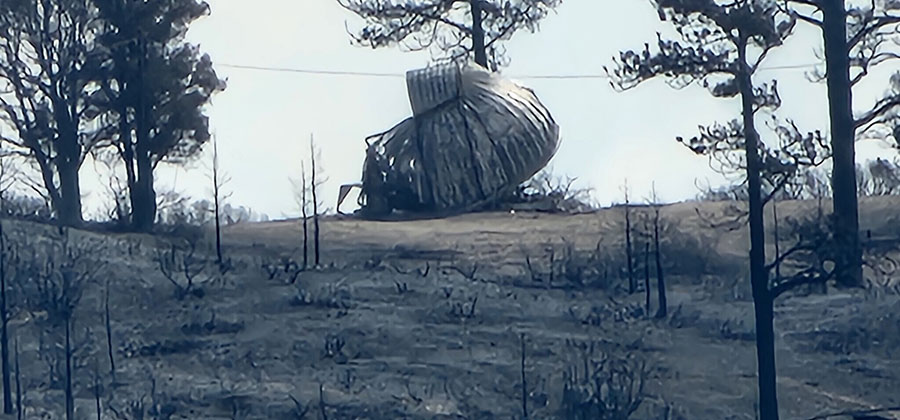
Stan Sander (JPL / NASA)
As wildfires continue to threaten California, one of its historic amateur observatories has fallen to the flames. The Clinton B. Ford Observatory near Wrightwood was destroyed on September 10th in a wildfire that raged across California over the past month, setting more than 54,000 acres ablaze.
Beginning on the afternoon of September 8th, the Bridge Fire spread quickly from the San Gabriel Mountains across the Los Angeles and San Bernardino counties; by the following morning, it had burned through around 4,000 acres. Since then, the fire has felled 81 structures and injured 8 firefighters. One of these casualties was the historic Ford Observatory, which was nestled within the same mountains where the fire originated.
An Undefendable Location
Until recently operated for recreational use by the Los Angeles Astronomical Society (LAAS), the observatory was once an asset to the American Association of Variable Star Observers (AAVSO). When AAVSO member Claude Carpenter desired a better seeing location for his telescope, he came together with half a dozen amateur astronomers — including Clinton B. Ford, who financed the project — to build the Ford Observatory in 1965. Carpenter donated his 18-inch Newtonian reflector mirror to the observatory.
Obtaining a special permit from the U.S. National Forest Service, the group placed the observatory on the eastern end of Table Mountain at 7,500 feet elevation. They dubbed the site Mount Peltier and called themselves the Mount Peltier Association, honoring prominent AAVSO member Leslie C. Peltier.
Unfortunately, the secluded mountain top that made the Ford Observatory a superb observing site was also the cause of its downfall. “There was no chance of response by firefighters to this remote location,” says LAAS President Darrell Dooley. The fast-moving wildfire took out the entire observatory — photographs show the now blackened dome shell on the ground, the skeleton of the structure clearly visible.
The observatory was not the only site threatened by the fire — the community of Wrightwood, a mountain ski town at the northeast corner of the San Gabriel Mountains, was in the path of destruction by the evening of September 10th. “The fire got into perfect alignment to run into Wrightwood, and it burned approximately 30,000 acres between 11 am and 5 pm,” says John Miller, a spokesperson with the U.S. National Forest Service on the Angeles National Forest.

Stan Sander (JPL / NASA)
Luckily, the firefighters were able to evacuate all the residents and save more than 99% of the residences. The “number one mission of firefighters” is “life safety,” according to Miller, and in a location that is frequently plagued with dangerous and fast-moving wildfires, firefighters have to act fast to prioritize human lives and homes.
A large part of Table Mountain was also saved, and most of the buildings — including a Jet Propulsion Laboratory facility, a campground, and facilities for a ski resort — survived the fire. This success is due to an ongoing fuels reduction project, which aims to reduce dangerously flammable vegetation in fire-prone areas such as Table Mountain. The Ford Observatory was not so lucky.
“It was undefendable because of the location,” Miller explained, citing the observatory’s secluded perch on the eastern fringe of the mountain, closer to the fire’s origin. The observatory lay directly in the fire’s path as it threatened Wrightwood.
The Bridge Fire has been 98% contained as of September 30th, and the lack of civilian or major property casualties is seen as a success. Firefighters are also battling two other major fires — the Airport Fire in Orange and Riverside counties and the Line Fire in San Bernardino county.
This loss is not the first one the California astronomy community has seen. In September 2020, the Tri-Valley Stargazers in Livermore, California lost their main observatory to a fire that nearly destroyed the Lick Observatory as well.
Remembering the Ford

AAVSO
The Ford Observatory was once used for research purposes by the AAVSO, the world’s largest association of variable star observers. Since the association’s inception in 1911, its members have dedicated themselves to observing the changing brightness of stars. The Ford Observatory was specifically intended for “serious amateurs mainly to do photoelectric work on variable stars and to have an observatory close by the Los Angeles area,” according to their website.
The observatory was donated to the LAAS in 2012, where it has since been operated and maintained by members for viewing and astrophotography purposes. Over the years, it has been used for a variety of different astronomical activities, still including variable-star observations as well as asteroid and comet searches, star parties, and imaging of planets and deep-sky objects.
Ultimately, its destruction was total. “The fire came through this area very, very fast,” Dooley says. “So it is looking like a total loss.”
Clinton B. Ford himself said: “Never sleep more than 90 feet from your telescope,” but with the wildfires that threaten California observatories, it appears that that adage may no longer hold true. Nevertheless, the observatory will be remembered as a historic research telescope for variable-star observations and a source of viewing, outreach, and community for the amateur astronomers in the Los Angeles area.
About Arielle Frommer
Arielle Frommer is a science writer for Sky & Telescope and astronomy PhD student at Yale, where she studies exoplanets. In her free time, she enjoys hiking, crocheting, drinking coffee, and reading and writing fiction.




Comments
John Ray
September 30, 2024 at 4:29 pm
So very, very sad to lose such a historic landmark. Were they still using the original 18 inch telescope?
You must be logged in to post a comment.
Alan MacRobert
October 2, 2024 at 10:11 am
The cover of one of my very first issues of Sky & Telescope, when I was a young teen, featured the just-built Clinton B. Ford Observatory. I still remember the impression the project made on me. BTW, Clint Ford later went on to become a major benefactor of the AAVSO.
Later when I was a full-time editor at Sky & Telescope, I covered the wildfire that destroyed Australia's Mount Stromlo Observatory, a name that had been mentioned in the magazine for decades. That had never happened before to a large observatory as best as we knew. There was discussion in Australia about Australia's growing wildfires being an early sign of climate change. I was too cowardly to mention that in print. I wish I had.
Later I wrote up S&T's coverage of the fire in California that came within yards of Mount Wilson Observatory and its historic 100-inch. This time I did end with a mention of "the long-term drying of the American West," with a link to research backing this up. Then another fire threatened Palomar and its 200-inch. I hope Lick, Kitt Peak, Mount Graham, and the rest are taking all possible fire-protection measures -- I'm sure they must be.
--Alan MacRobert
You must be logged in to post a comment.
skynr13
October 5, 2024 at 3:11 pm
It appears to me that it is entirely rebuildable, with the exception of the 18" telescope. The article doesn't make mention of whether it was saved or not. I'd sure like to know!
You must be logged in to post a comment.
You must be logged in to post a comment.