 SUNSET:

 5
5A new model explains how Ganymede got its molten core — which in turn has given Jupiter’s largest moon its magnetic field.
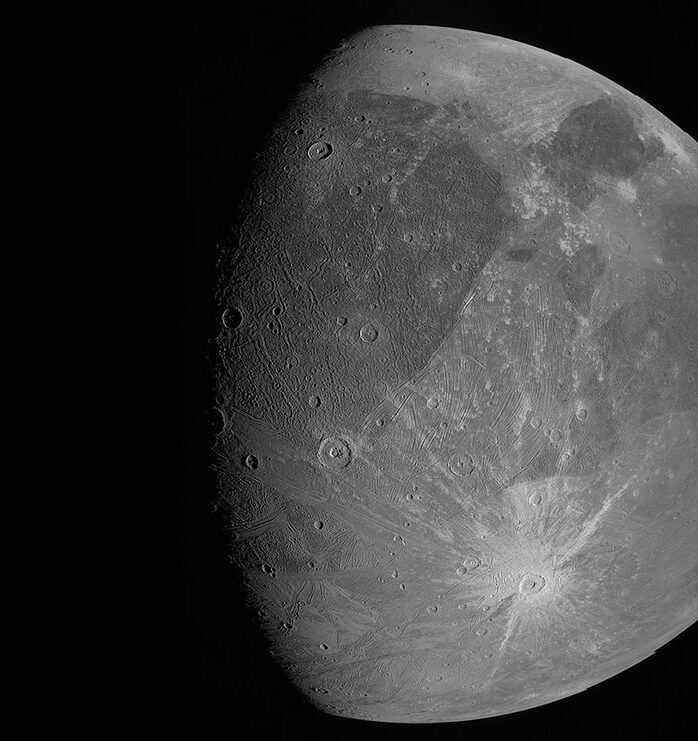
NASA / JPL-Caltech / SwRI / MSSS
Ganymede is the only moon in the solar system that generates its own magnetic field. That field in turn suggests that within the moon is a molten core. But a new study suggests the core might have appeared only recently.
Planets make magnetic fields in hot, electrically conductive liquid layers, like Earth’s outer core. Despite Ganymede’s size (the moon is larger than Mercury), it’s unclear how it could have formed with a metal core, much less how such a core would stay molten through all of the solar system’s history to make a magnetosphere today.
A new study in Science Advances, led by postdoctoral researcher Kevin Trinh (Caltech), suggests that maybe Ganymede’s metal core wasn’t present from birth. Rather, it might have come along later — and might still be forming now.
Melting a Moon Is Hard to Do
Planetary formation generates enough heat to melt things — sometimes. As far-flung planetesimals gather into a single object, the kinetic energy of the planetesimals’ motion and the potential energy of their gravitational attraction converts into heat within the newly formed world. Any radioactive atoms incorporated into the planet add further heat as they decay. At the same time, the newborn planets’ surface is exposed to cold space and loses heat through radiation. The smaller the planet, the higher its surface area relative to its volume, and the more rapidly it loses heat.
Given sufficient mass, accretion can raise the interior temperature above the melting point of water (100°C or 273 kelvin) and even of silicate rock (around 1000-1500K) and iron (1811K). It helps if a planet forms rapidly. Then, the rapid decay of short-lived radionuclides like aluminum-26 deliver an extra punch of heat. Mercury, for example, came together quickly and probably melted all the way through, rapidly separating its interior into an iron-rich core and rocky mantle.
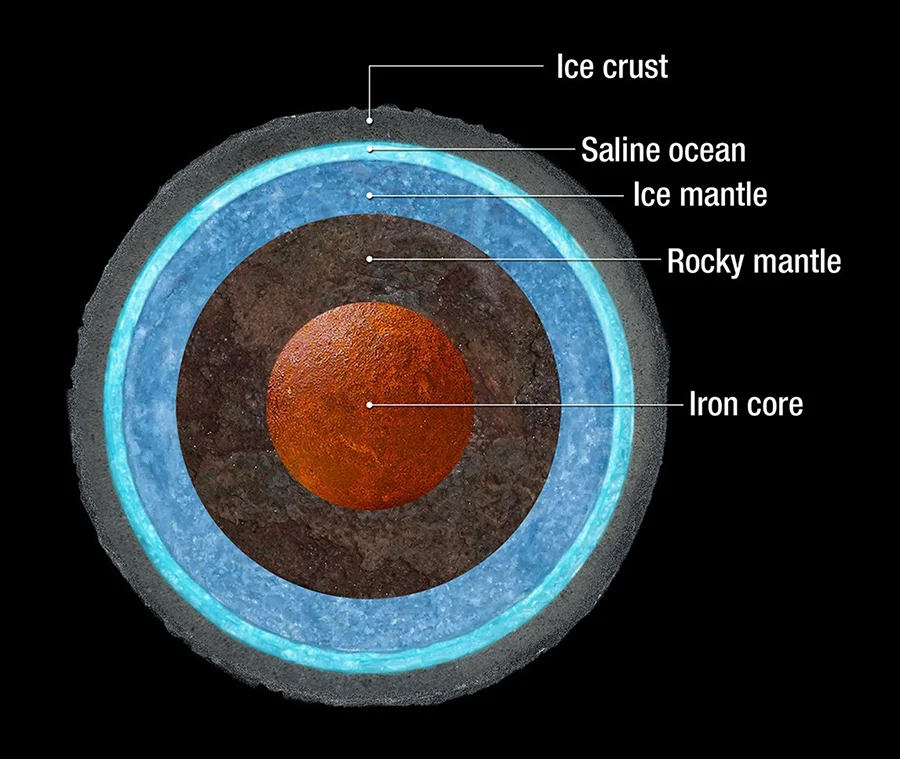
NASA / ESA / A. Feild (STScI)
Despite Ganymede’s similar diameter, its history is quite different from Mercury’s. Ganymede is only partly rock and iron; more than half of its volume is a mixture of lighter materials, mostly water. It formed much more slowly and less energetically than Mercury did, likely after most of the solar system’s aluminum-26 had decayed. The moon became (and remained) hot enough for its water to melt, making its global ice-water mantle. But it’s not obvious how it heated up so much that its rocks could also melt. Without melting the rock, the metal wouldn’t separate; Ganymede’s interior would have remained an undifferentiated mixture of metal and rock.
Sweating Rocks
Scientists interested in Ganymede’s magnetic field usually assume the molten metal core has been around for 4.5 billion years. Yet scientists interested in how Ganymede formed can’t figure out how it would have formed with a metal core. Trinh’s study asks: What if the core only appeared more recently?
The study goes back to physics basics, assuming Ganymede initially warmed enough to melt ice, separating it from rock, but no warmer than that, with a starting temperature of 250K. How much it heated up depends on when exactly it formed, but if it formed more than 4 million years after the solar system began, there wouldn’t have been much aluminum-26 left.
Still, other slower-decaying radioactive isotopes of uranium, thorium, potassium, iron, and manganese have contributed heat to the interior over time. Since Ganymede is big enough that radioactive heat can’t escape completely, the temperature inside it slowly, inexorably builds.
Trinh’s simulations show a critical moment happening around 2 to 2.5 billion years after the moon’s formation, when the deep interior reached about 1250K. At that temperature, the rocky mixture begins to sweat droplets of iron sulfide. The dense liquid percolates downward through pores in the still-solid rock. It may take thousands of years for a droplet to reach the center, but the solar system has lots of time. Within a few tens of millions of years, a molten metal core forms that is big enough to generate Ganymede’s detectable magnetic field.
Crucially, only the very center of Ganymede is hot enough for iron sulfide to melt, at least initially. And as long as iron sulfide is in the process of melting, the temperature of the rest of the moon doesn’t continue to increase. Just as melting ice floating in water keeps the water at freezing temperature until all the ice has melted, Ganymede’s core and mantle don’t heat beyond 1250K while there is still sulfur around to melt into the liquid. Any additional radioactive decay melts a tiny bit more iron sulfide, a slow process that could continue for billions of years.
The implication: Ganymede didn’t have a metal core at its birth, but it could definitely have started making one about 2 billion years later. It’s still making molten core material today. Late formation not only explains how the molten core formed in the first place, it also solves the problem of how it stayed molten. Drop by drop, more molten metal adds to the core every day.
About Emily Lakdawalla
Sky & Telescope contributing editor Emily Lakdawalla is a freelance planetary scientist, space artist, and author of The Design and Engineering of Curiosity: How the Mars Rover Performs Its Job. Find her on Bluesky at elakdawalla.bsky.social and explore her space-inspired, ultra-nerdy art and jewelry on Etsy.



Comments
[email protected]
May 19, 2026 at 12:08 pm
Very intriguing! Is there any chance ESA's Juice spacecraft will be able to discern anything about Ganymede's core?
You must be logged in to post a comment.
Monica Young
May 20, 2026 at 9:41 am
Indeed! This page says more about the science goals of the JUICE mission: https://sci.esa.int/web/juice/-/59905-juice-s-primary-target-ganymede
You must be logged in to post a comment.
[email protected]
May 20, 2026 at 10:11 am
Wonderful, thank you!
You must be logged in to post a comment.
accurateye
May 20, 2026 at 10:36 am
"...above the melting point of water (100°C or 273 kelvin)..."
Interesting outcome from the model.
You must be logged in to post a comment.
Dave Wickholm
May 21, 2026 at 12:13 am
Did anyone else notice the abundance of concentric craters in the JunoCam image? What are the current thoughts about their origin?
You must be logged in to post a comment.
You must be logged in to post a comment.