 SUNSET:

 6
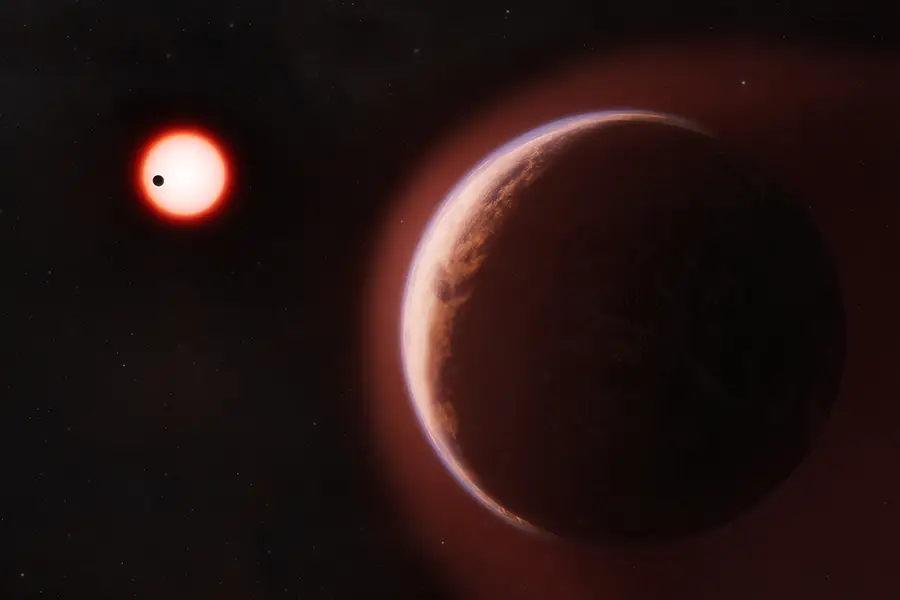
6The Saturn-mass planet candidate is probably newly formed and orbits a young star that’s only 6.4 million years old.
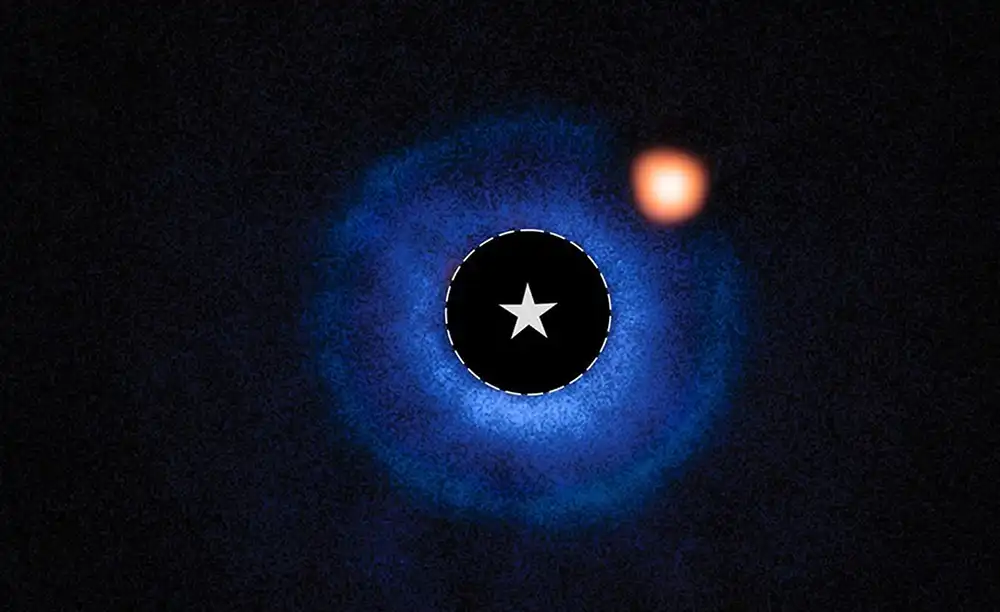
NASA / ESA / CSA / Anne-Marie Lagrange (CNRS, UGA) / Mahdi Zamani (ESA / Webb)
Astronomers using NASA’s James Webb Space Telescope have directly imaged what appears to be a Saturn-mass exoplanet, marking Webb’s first direct detection of a planet outside our solar system. If confirmed, it would be the lightest planet ever photographed in this way.
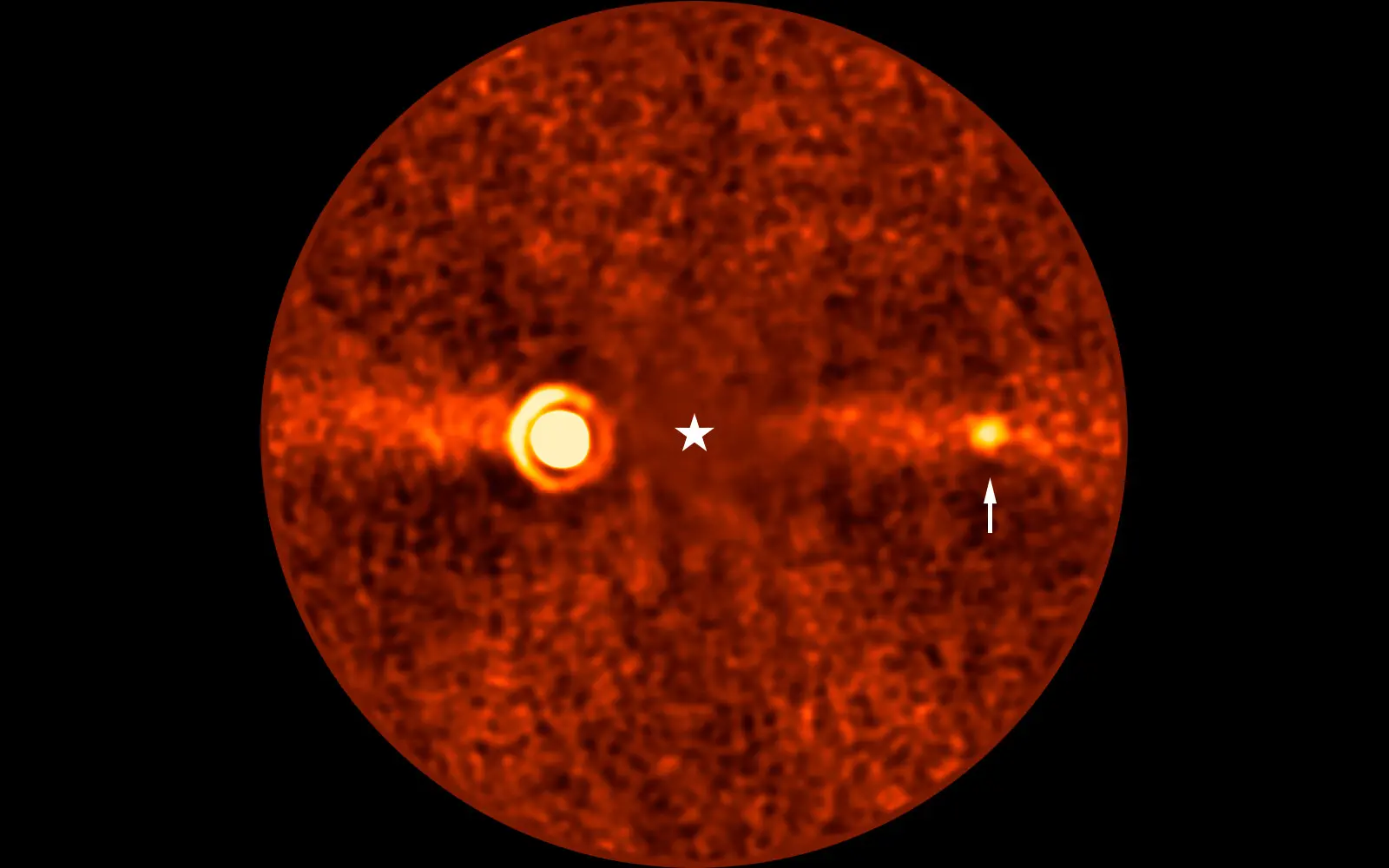
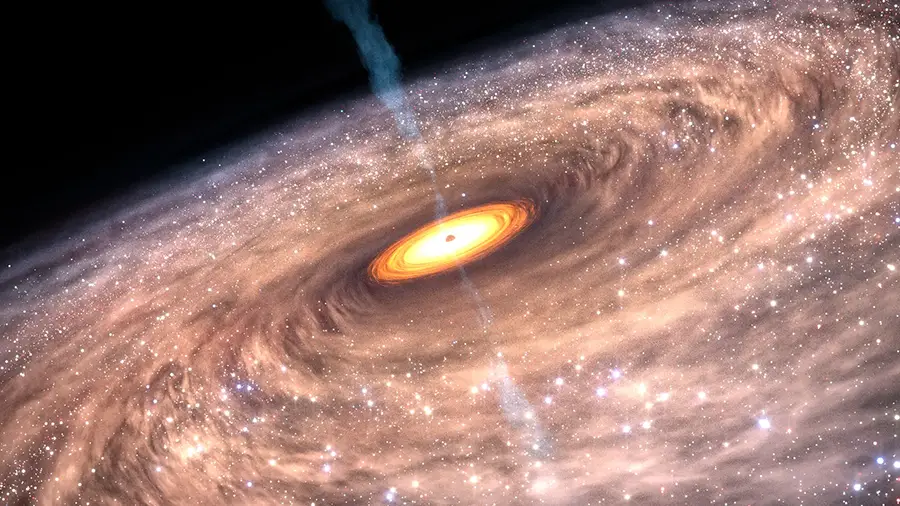
The planet candidate, TWA 7b, orbits a young red dwarf star (known as a T Tauri star) located around 111 light-years away in the southern constellation Antlia. At just 6.4 million years old, the star is still encircled by a sprawling debris disk — a remnant of its formation. Using Webb’s Mid-Infrared Instrument (MIRI), a team led by Anne-Marie Lagrange (Paris Observatory) detected a faint infrared source nestled within one of three concentric dust rings. (The rings had previously been seen with ground-based telescopes.)
After ruling out more mundane explanations, including a foreground interloper in our own solar system, the team concluded that the object is almost certainly local to the TWA 7 system. “Our observations reveal a strong candidate for a planet shaping the structure of the TWA 7 debris disk, and its position is exactly where we expected to find a planet of this mass,” Lagrange says. She and her team published the result in Nature.
TWA 7’s combination of youth, orientation and relative proximity made it a prime target for Webb’s infrared capabilities. “[This discovery] represents an exciting step forward in our understanding of planetary systems, including our own,” says team member Mathilde Malin (Johns Hopkins University).
Imaging a planet directly is technically demanding. Most exoplanets are found indirectly, by their effects on their host stars. Directly imaging planets requires isolating their dim glow from the overwhelming glare of its sun. To date, nearly all such images have involved massive, hot planets several times the mass of Jupiter. Spotting a Saturn-mass object like TWA 7 b represents a big step forward.
TWA 7 b appears to orbit roughly 50 astronomical units from its star — more than five times farther out than Saturn is from the Sun. That would usually mean the planet is cold but, because the system is so young, the planet still radiates heat from its formation. Lagrange's team concluded that its temperature is a balmy 47°C (117°F), still markedly cooler than previous directly imaged planets.
“This is a hugely important discovery,” says Beth Biller (University of Edinburgh, UK), who was not involved in the research. “I think TWA 7b is going to be amazing for opening up a new realm of cool exoplanet atmospheres to characterize.” Among other things, direct imaging allows astronomers to glimpse a planet’s atmospheric molecules, clouds, and weather.
The discovery hints at more than just the planet itself. Its location within the debris disk suggests it may be shaping the structure of the surrounding material. If confirmed, it would mark the first time a directly imaged planet has been linked to the sculpting of a debris disk.
Intriguingly, Webb may have also picked up evidence of “Trojan” dust — material that’s clustered around stable points both ahead of and behind the planet in its orbit. These zones mirror the way Trojan asteroids share orbits with planets in our own solar system, most notably Jupiter.
About Colin Stuart
Colin Stuart (@colinstuartspace) is an astronomy author and tutor. He also runs a free online astronomy club.



Comments
Anthony Barreiro
June 28, 2025 at 12:24 am
A team led by Anne-Marie Lagrange found evidence of Trojan dust at this planet's L4 and L5 Lagrange points!
You must be logged in to post a comment.
Andrew James
June 28, 2025 at 4:37 am
Agreed.
You must be logged in to post a comment.
Claude
June 28, 2025 at 7:25 am
Aptly named!
You must be logged in to post a comment.
skynr13
June 28, 2025 at 5:08 pm
It says in the article, the planet is still hot from formation. But not too hot for me! I wonder at this temp. what it would be like to live on this planet. I suppose the atmosphere would have to have oxygen, but if it did, at 117 degrees it wouldn't be impossible to handle. What kind of wonders do you think I would see as this planet forms?
You must be logged in to post a comment.
mxyzptlk
June 29, 2025 at 3:15 am
Why is the matter surrounding star TWA 7 called a "debris disk" and not a "debris sphere". Doesn't the debris extend outward in three dimensions?
You must be logged in to post a comment.
Anthony Barreiro
June 29, 2025 at 3:37 pm
The dust settles into a disk around the young star.
https://science.nasa.gov/exoplanets/how-do-planets-form/
You must be logged in to post a comment.
You must be logged in to post a comment.