 SUNSET:

 7
7Titan joins its shadow for a “grand finale” this October.
Brian Martin
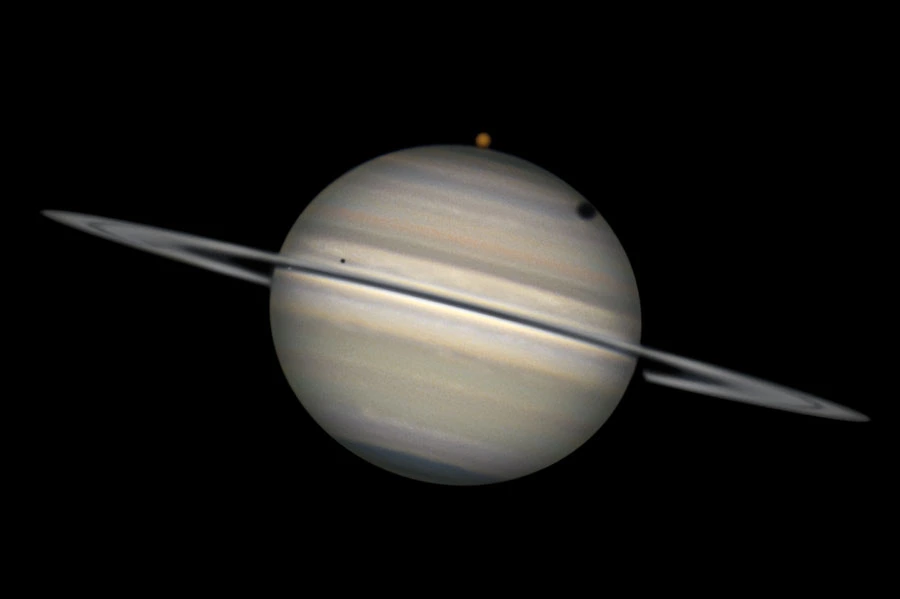
My summer's been a success. A goal has been met. I finally saw my first Titan shadow transit on July 18th, then followed that with additional transits on August 3rd and September 4th. There would have been others but for clouds. No complaints here. Even one would have been enough. I loved the anticipation, the challenge of discerning the black blip in sometimes rocky seeing, and then finally spotting Titan's perfect, pinpoint shadow materialize on Saturn's cloud tops. We are fortunate in having a hobby that tests our mettle in so many ways. Disappointments are inevitable along the way, but each achievement makes us ring with inner delight like a struck bell.
Bob King
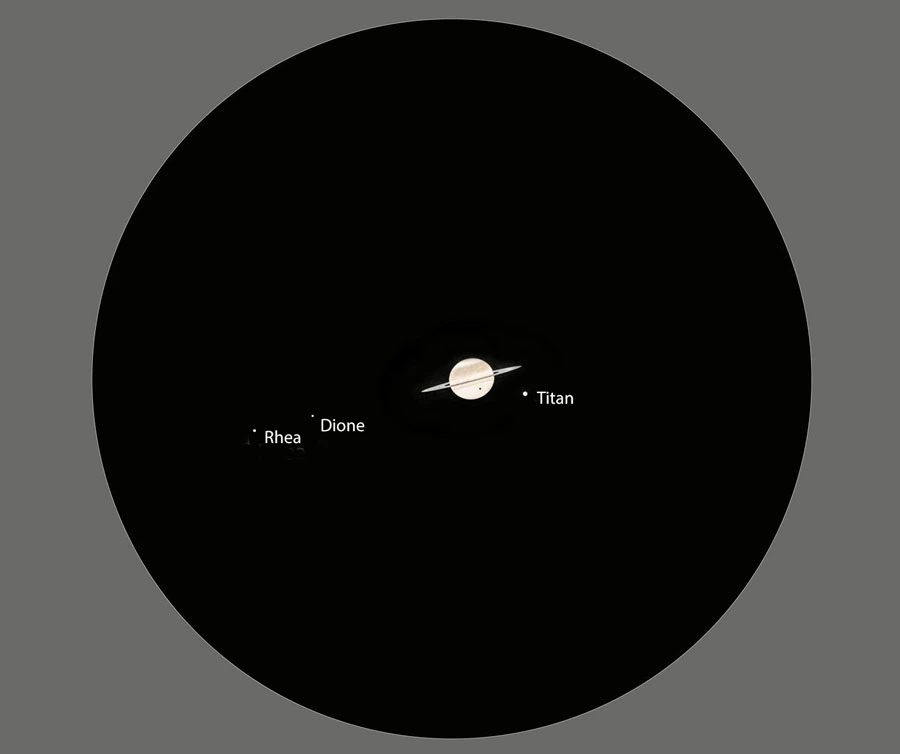
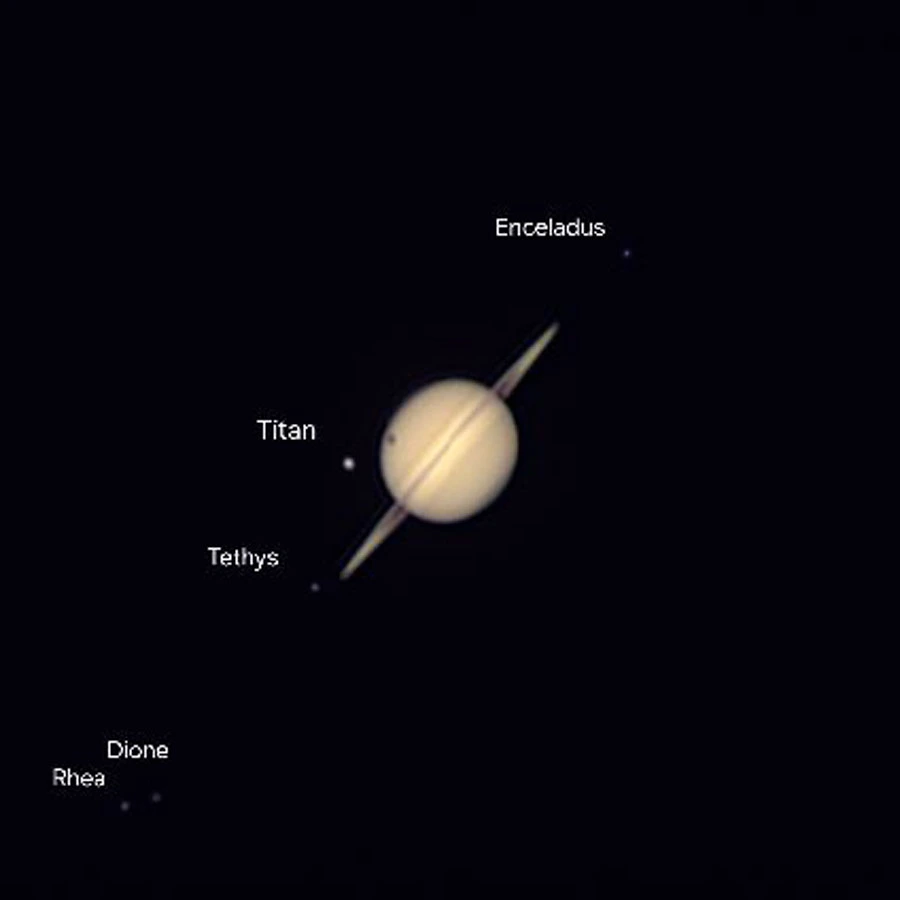
Two things surprised me when watching the shadow transits — how small Titan's shadow appeared visually (very different from most photos I've seen) — and the striking three-dimensionality of the scene with the moon so close by. There were also bonuses for having made the effort, including ravishing views of the needle-like rings and seeing the subtle differences in the width and shading of the equatorial belts.
WinJUPOS
WinJUPOS
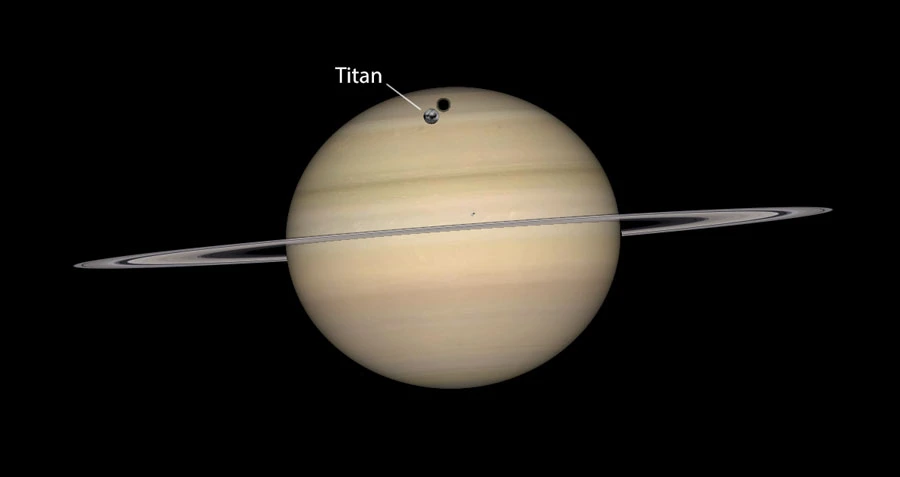
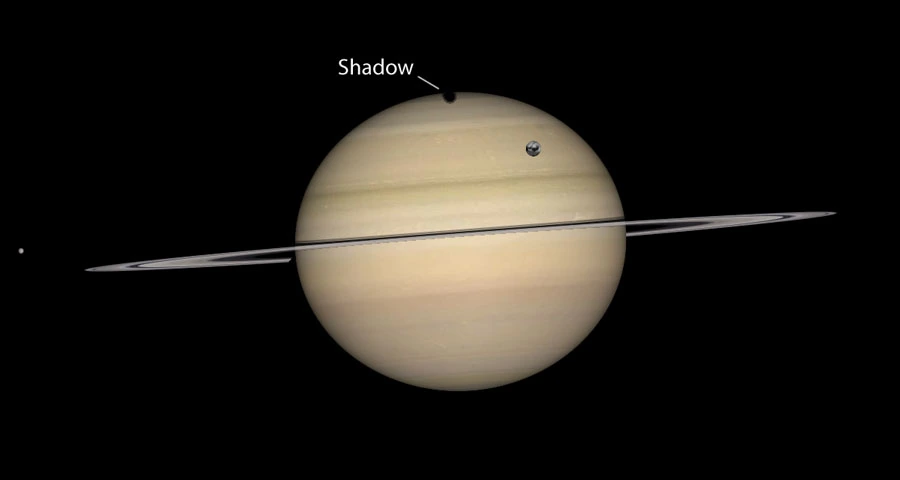
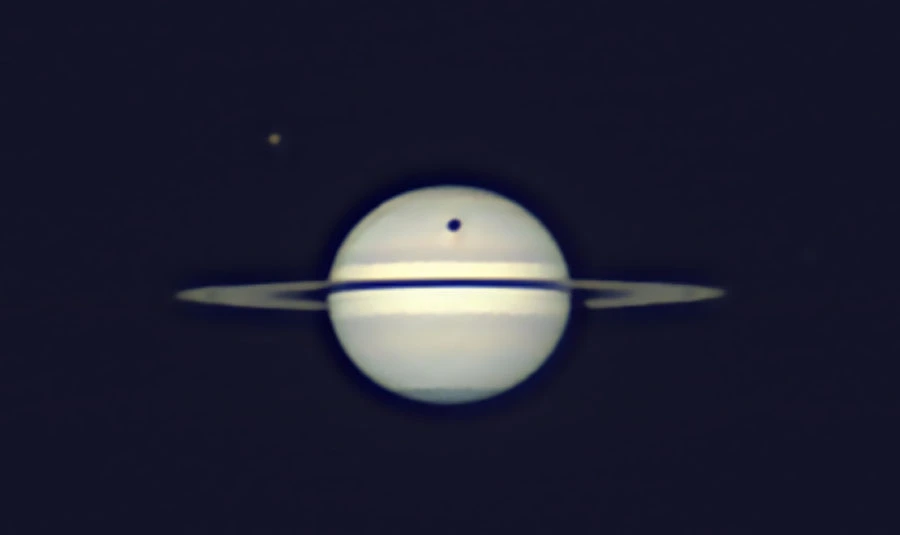
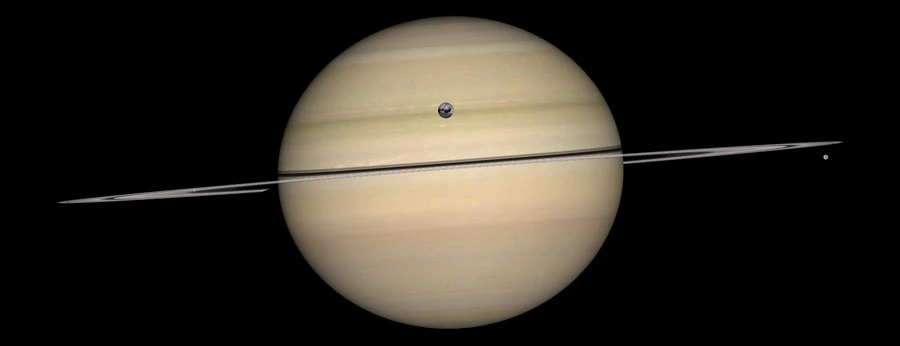
I'm going to miss circling shadow transit dates on my observing calendar. There are just two left in the current apparition, and then no more until July 29, 2038. Of those two, only the September 19–20 event is a full shadow transit. On the October 5–6 finale, approximately three-quarters of the shadow will notch Saturn's North Pole before departing the disk. Titan, which has hovered off-disk during the previous transits, will simultaneously join its shadow during the final two. At the September 20th event, the paler moon will lie less than 0.5″ southeast of its dark shadow. In smaller scopes they'll appear to touch and resemble an imperfectly resolved double star.
Robert Lunsford
Titan is more challenging to spot compared to its shadow. The moon is lighter-toned and less contrasty against Saturn's clouds. Its apparent diameter will be 0.8″ — equal to Jupiter's moon Europa. With good seeing and a magnification above 150×, it will appear as a minute, gray dot. As with Jupiter's moons, Titan will be easier to see as it enters and exits Saturn's disk due to limb darkening, where the edges of the planet appear darker than its center because our line of sight only passes through the cooler, upper layers of the planet's atmosphere. For many observers these final transits will present a rare opportunity to see both the moon and its shadow together on the disk.
Omar Dominguez
On the 20th, Titan will enter the disk a few minutes before its shadow, and both will traverse the North Polar Region. The shadow first fully enters Saturn's globe starting at 1:09 a.m. Eastern Daylight Time (5:09 Universal Time). Mid-transit, when the duo will be square-on and easiest to see, occurs at 2:20 a.m. EDT (6:20 UT). The shadow transit ends at 3:34 a.m. EDT (7:34 UT), though Titan lingers longer, beginning its exit around 4:08 a.m. EDT (8:08 UT).
Suresh Sreenivasan
Titan sans shadow will continue to transit Saturn every 16 days (its orbital period), moving equatorward through November 22nd before turning back north on December 8th. The moon's path follows the rhythm of our changing perspective on Saturn as both Earth and the gas giant circle the Sun on orbits slightly tilted with respect to each other. The final Titan transit of the current apparition occurs on January 24, 2026.
WinJUPOS
To observe a shadow transit, you'll need a 6-inch or larger telescope. Make sure your scope has cooled to ambient air temperature prior to the transit so it doesn't become a heat source that distorts or blurs the image. I use a magnification between 250× and 400×, but others have seen the shadow at 150× without difficulty. Look for something tiny.
I'm interested in your impressions of the shadow and the moon together and how easy or difficult they'll be to see. Please leave a comment and let us know!
About Bob King
I love the sky (day and night) and have been a skywatcher and amateur astronomer since childhood. I'm also a long-time member of the American Association of Variable Star Observers (AAVSO) and Astronomical League. I pen the Astro Bob blog and have written four books: Night Sky with the Naked Eye (2016); Wonders of the Night Sky You Must See Before You Die (2018) and Urban Legends from Space (2019) and Magnificent Aurora, published in 2024. The universe invites us on an adventure every single night. To accept the invitation, we only need look up.



Comments
Collin
September 17, 2025 at 5:36 pm
Bob, thanks for this wealth of information on these last two Titan shadow transits. The one Saturday night (wee hours of Sunday) the 20th will be the easier for me to catch, since at least it's on a weekend evening. Just hope the atmosphere will cooperate, cloud-wise.
You must be logged in to post a comment.
Bob KingPost Author
September 18, 2025 at 12:14 am
You're welcome, Collin. Hope you get clear skies. My buddies and I will be out that night as well hoping for the same. Good luck!
You must be logged in to post a comment.
StarsInMyAugen
September 20, 2025 at 3:20 am
That's Saturday morning, not Sunday morning, when the shadow transit occurs. That's on night of Sept.19-20 in U.S. time zones.
You must be logged in to post a comment.
John
September 20, 2025 at 3:07 am
Thanks, Bob! Got the link to your article in today's Sky & Tel email and saw that tonight was a Titan transit. We're still getting monsoon weather in Tucson, but there was enough of a clearing around Saturn that I got to see a Titan shadow transit tonight for the first time in my life! Yeah, that's 63 years! It looked good through my 10-inch Dob at 141X. I've seen a lot of moon/shadow events on Jupiter (and even the Shoemaker-Levy-9 impacts back in 1994), but for some reason, I never gave much thought to the possibility of seeing Titan's shadow transiting Saturn until this year. I missed this year's earlier transits due to weather or forgetfulness. I really lucked out on this one, though, thanks to you!
You must be logged in to post a comment.
Jim-Gasser
September 20, 2025 at 11:26 am
A few of us from Toledo Astronomical Assn saw it last night! First time for a few of them. We used 12” Skywatcher Dob. Good seeing, still, and some high haze. Shadow was EASY to see from the very start. We experimented with color filters, polarizing filter, and not too much difference in visibility. Some benefit to reducing Saturn’s brightness but since we could use pretty high power, dimming wasn’t really necessary. We used 150-375x. Sweet spot about 288x. A lower power gave a nice crisp black “speck” but more gave a nice round shadow. Neat 3D look. Cannot say anyone could spot Titan itself. I hope to see it in 2038. I better clean up my diet….;)
You must be logged in to post a comment.
[email protected]
September 24, 2025 at 11:08 am
Saw my first ever Titan shadow transit Sept 20 with my wife. She is not an experienced observer and even she called the shadow obvious in my C14. I didn’t tell her where the shadow was on the disk and she correctly called out it’s location. I was able to see the shadow distinctly as a sharp black spot in scopes as small as a 5 in apo. Cannot see Titan’s disk in either scope-seeing wasn’t great. Thanks Bob for the very informative article.
You must be logged in to post a comment.
Bob KingPost Author
September 24, 2025 at 11:43 am
Changstars,
You're welcome, and that's a great story. Glad you both got to see it. Thanks for your comment.
You must be logged in to post a comment.
You must be logged in to post a comment.