 SUNSET:

 3
3As the comet prepares for its perilous perihelion passage, we look at what to expect.
Gerald Rhemann and Michael Jäger
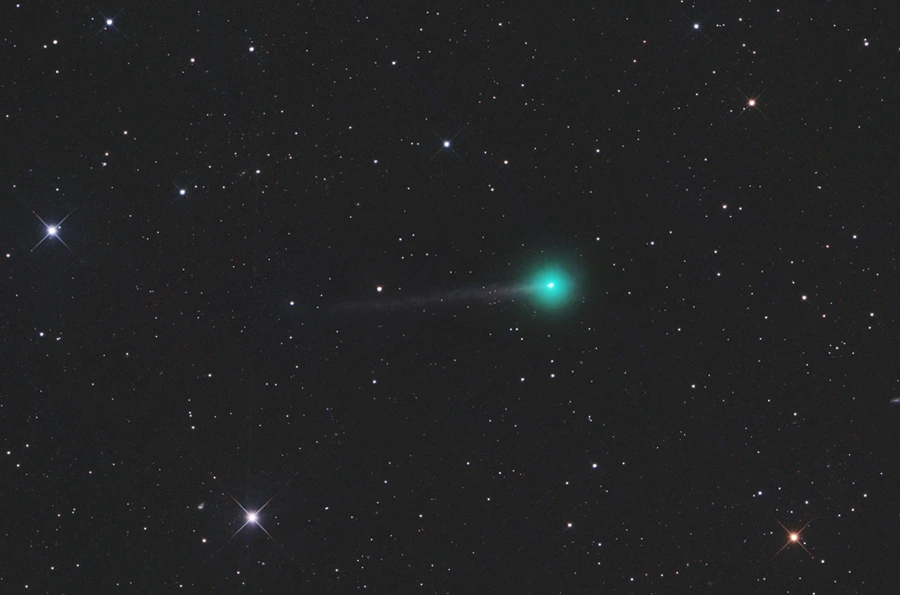
We're all wondering the same thing. How bright will Comet C/2026 A1 MAPS get? Will it become a splendid sight like some of its sungrazing siblings of the past or will it fracture and fade? With perihelion less than three weeks away, a definitive answer is lacking, but we can still speculate. First, let's examine its recent behavior.
Between March 6th and March 9th, C/2026 A1 quickly brightened by almost 1.5 magnitudes, from 12 to 10.5. At the same time, its coma (the comet's gaseous envelope) expanded 50% from 6′ to 9′, and its core became more compact. Exciting news! Then from March 11–17, in a seeming setback, the comet's brightness plateaued and its well-condensed coma shrank back to 6′.
Regardless, these swift changes made it possible to finally catch a brief glimpse of this fickle fuzzy through my telescope. Comet MAPS has been notoriously difficult to spot due to its very low altitude (less than 10°) in the western sky at the end of evening twilight. I pinned it down in the trees just a few degrees above the horizon on March 13th. Through my 15-inch Dobsonian reflector, I saw a moderately condensed coma that spanned about 4′ with an overall magnitude of 10.0.
Nicolaus Lefaudeux
Gazing into the Crystal Ball
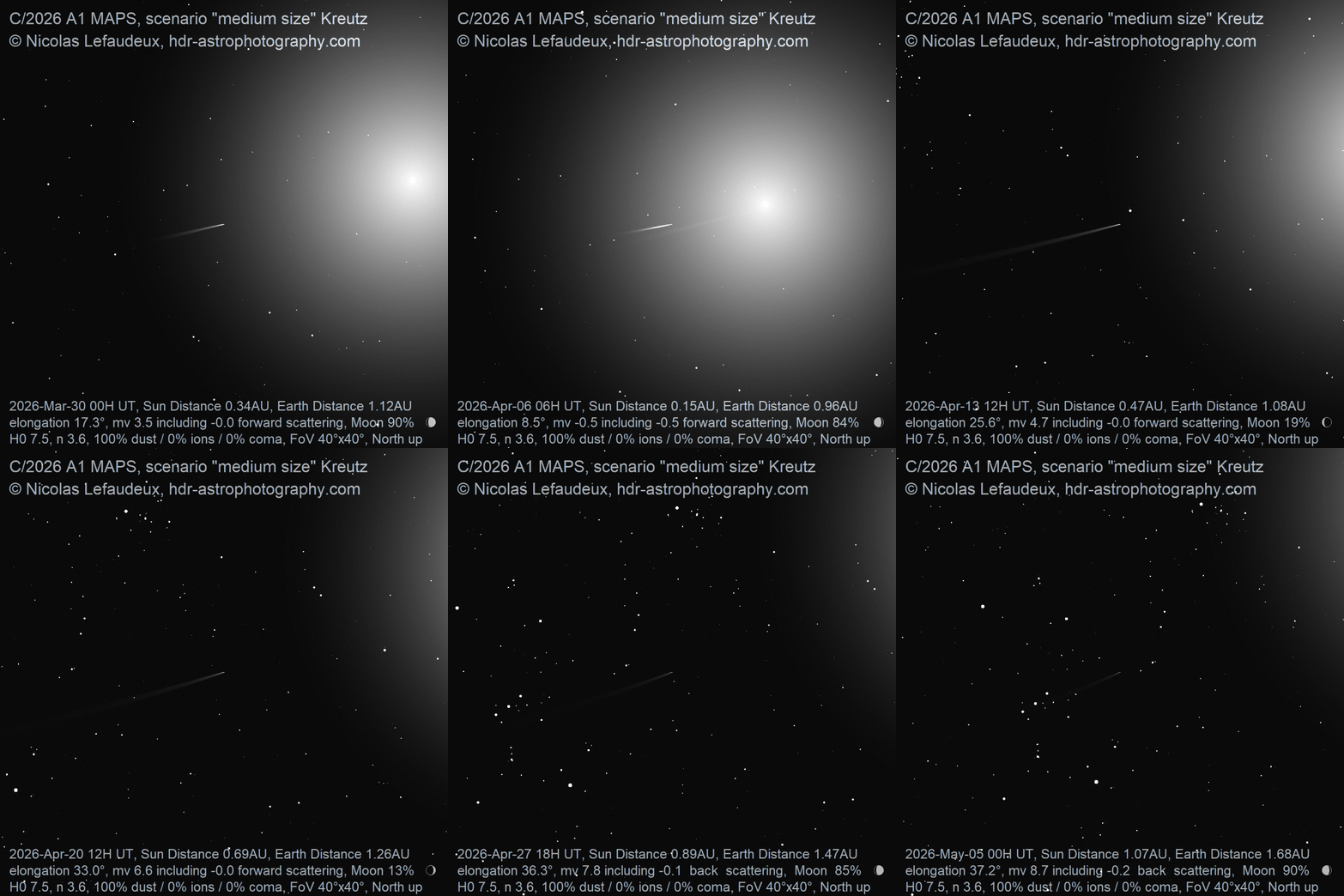
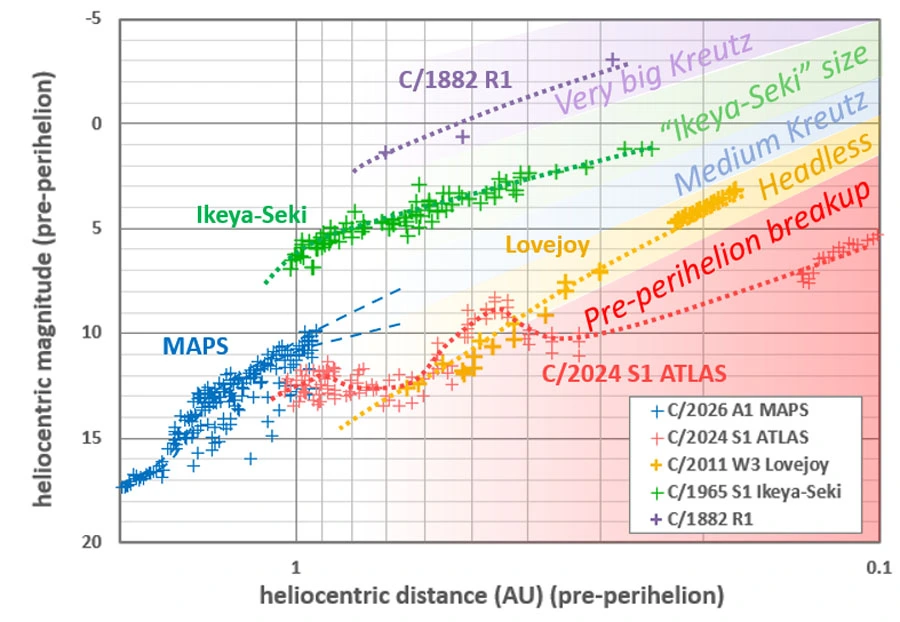
French optical engineer and amateur photographer Nicolas Lefaudeux has kept abreast of the comet's evolution and created tail simulations based on four possible scenarios:
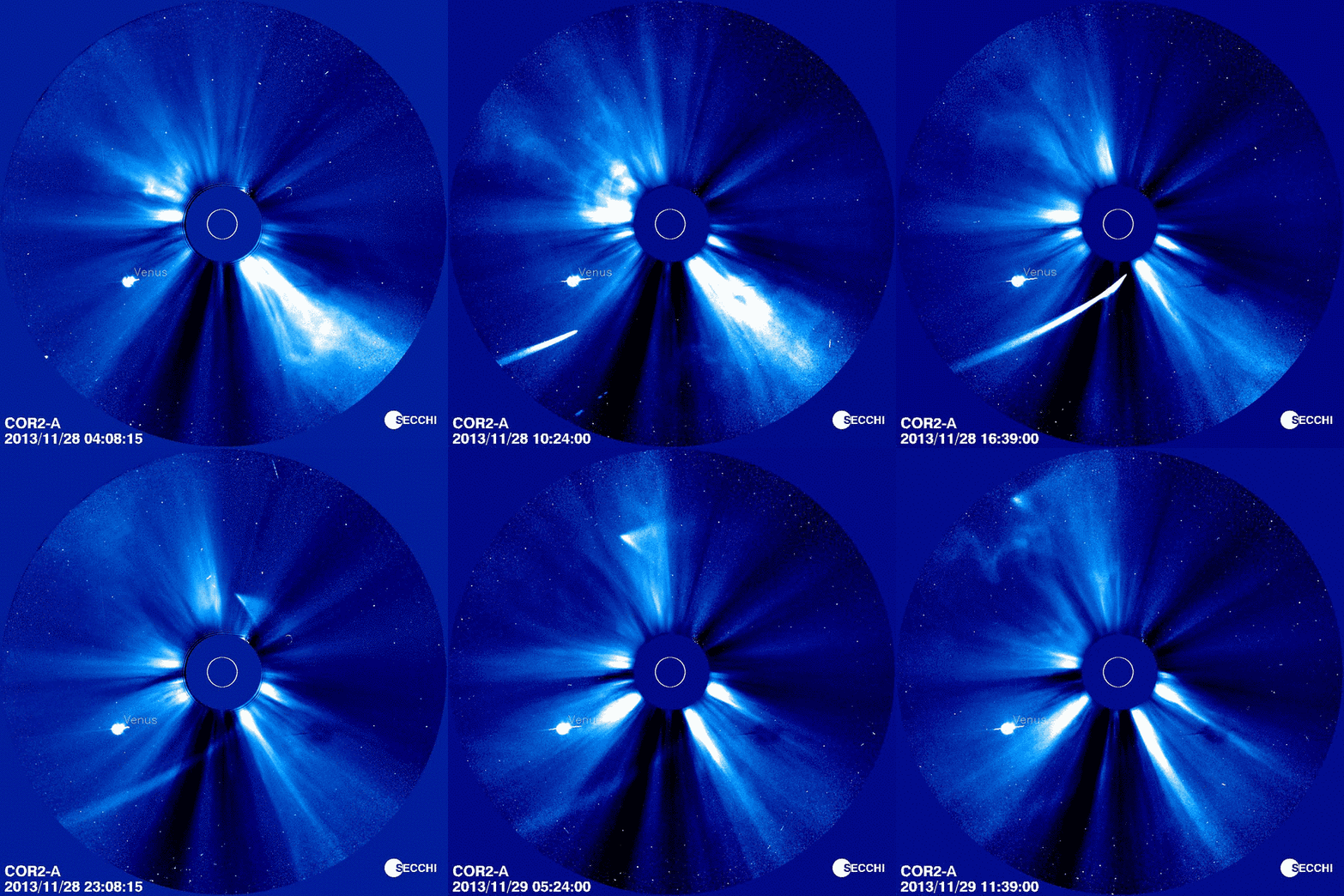
- Pre-perihelion breakup — Comet C/2026 A1's nucleus crumbles, destroyed by intense solar heating and gravitational tides. Comet ISON experienced a similar fate during its 2013 apparition. In this scenario, only a faint remnant of C/2026 A1 remains. Rating: A fizzler.
- "Headless" comet (post-perihelion breakup) — The comet's nucleus survives perihelion but breaks apart shortly after, producing a ghostly head with a bright tail perhaps as long as 15°. Rating: Great object for amateur astronomers, much less so for the public.
- Medium-sized Kreutz comet — Comet survives perihelion intact to become a bright object somewhere between Comet Lovejoy (C/2011 W3), which reached peak brightness between magnitude –3 and –4, and Comet Ikeya-Seki (C/1965 S1) at magnitude –10. Rating: Primarily an object for amateur observers but gathering some public attention.
- Ikeya-Seki-sized Kreutz comet — C/2026 A1 would emerge from the solar glare on April 7th at magnitude –10 with a 10° tail that would grow to 30° by mid-month. Rating: Knock your socks off.
Of course, always take comet forecasts with a grain of sodium chloride. Lefaudeux's simulations are based on reasonable expectations tied to current observational trends.
Nicolas Lefaudeux
"Nothing will be certain until a few days after perihelion, as it is the dust released between ~6 hours and 3–4 days after perihelion that mostly determines the tail’s length and brightness," said Lefaudeux. Assuming that C/2026 A1 survives, we would expect to see a narrow but bright tail because Earth will be in line with the comet's orbital plane. We'll see MAPS "edge-on," similar to viewing Saturn's rings at the planet's equinoxes.
NASA, ESA, CSA, JWST MIRI; Qicheng Zhang et al. (Image processing: Melina Thévenot) CC BY-SA 4.0
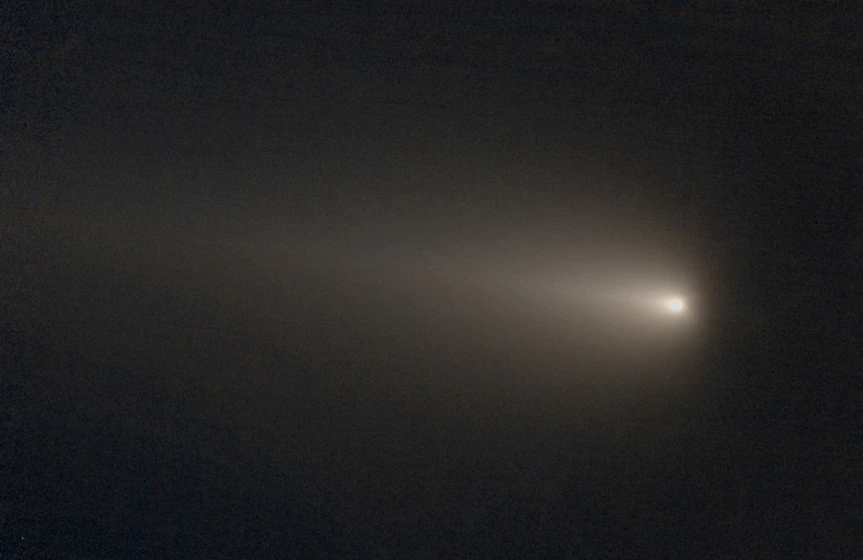
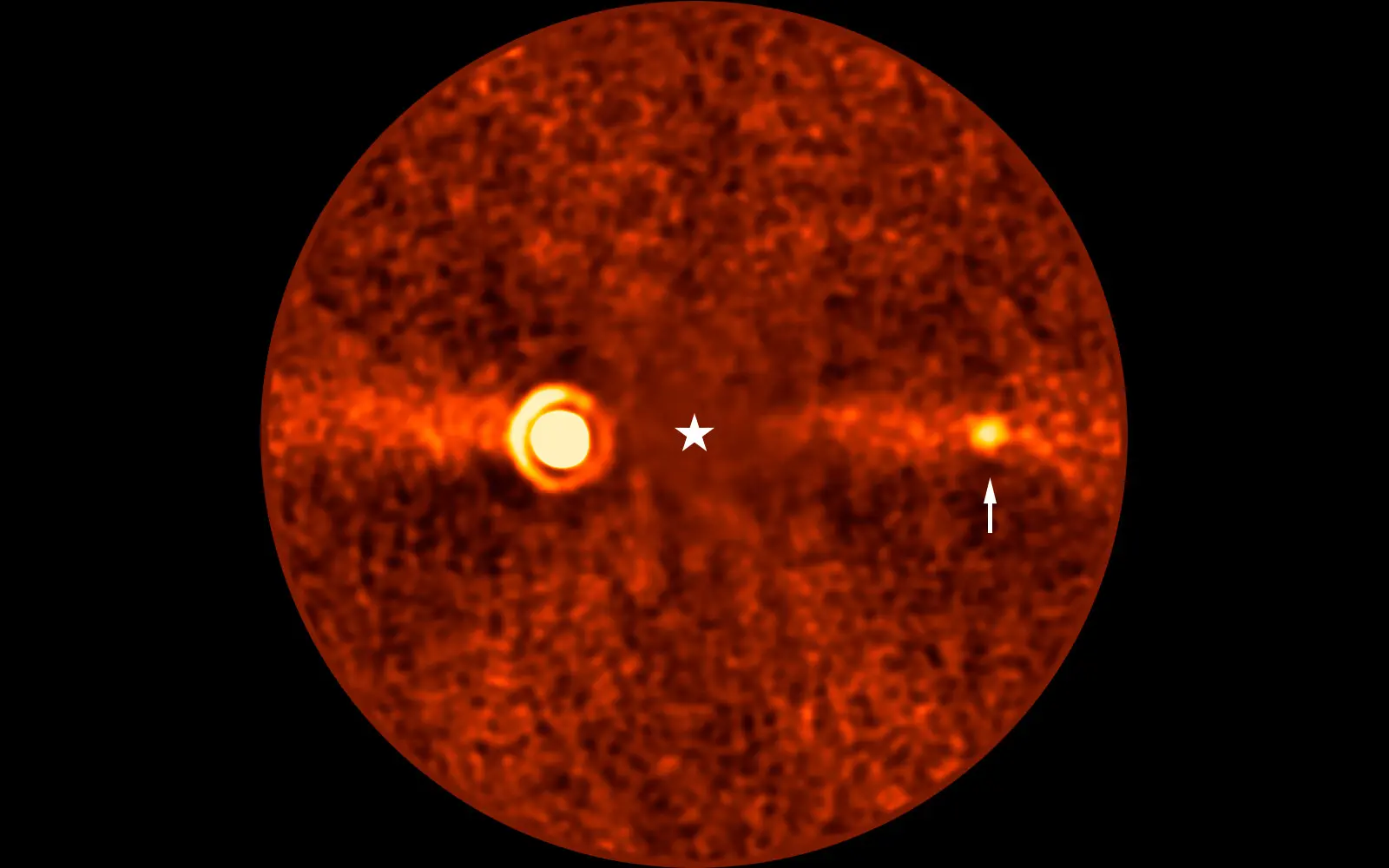
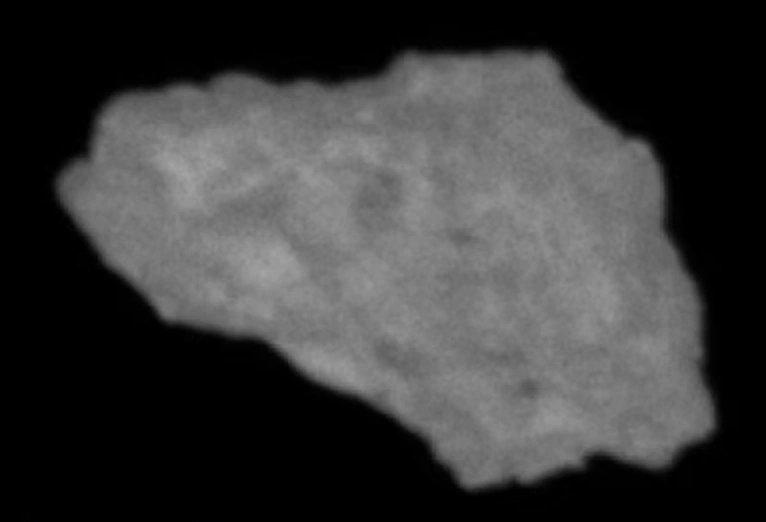
In the just-published paper, Preliminary Nucleus Size Estimate for Kreutz Sungrazer C/2026 A1 (MAPS), Qicheng Zhang and his team used the James Webb Space Telescope to nail down the size of the nucleus to approximately 0.4 kilometer, or ¼ mile — similar to Comet Lovejoy's.
NASA/STEREO/NRL/K. Battams
"That suggests C/2026 A1 could still survive perihelion," writes Zhang. Lovejoy pulled through and briefly became a bright, fetching object with a long tail. But given MAPS's high level of outgassing (ice vaporization due to solar heating), Zhang offers a second possibility. Thruster-like torques from comet jets — geyser-like streams of gas and dust erupting from its nucleus — could spin up the rotation rate of the nucleus, causing it to break to pieces "before it even enters the fields of coronagraphs." Then it would become another ISON.
Fortunately, we'll be able to watch C/2026 A1 make a hairpin turn around the Sun in SOHO's wide-field LASCO C3 and narrow-field LASCO C2 coronagraphs. It will enter the former's field of view from the lower left early on April 2nd and pass through perihelion some 160,000 km (100,000 miles) above the Sun's farside surface on April 4th at 9:13 a.m. EDT. The comet swiftly swings around to the solar nearside and departs the C2 field around 1 a.m. EDT April 6th.
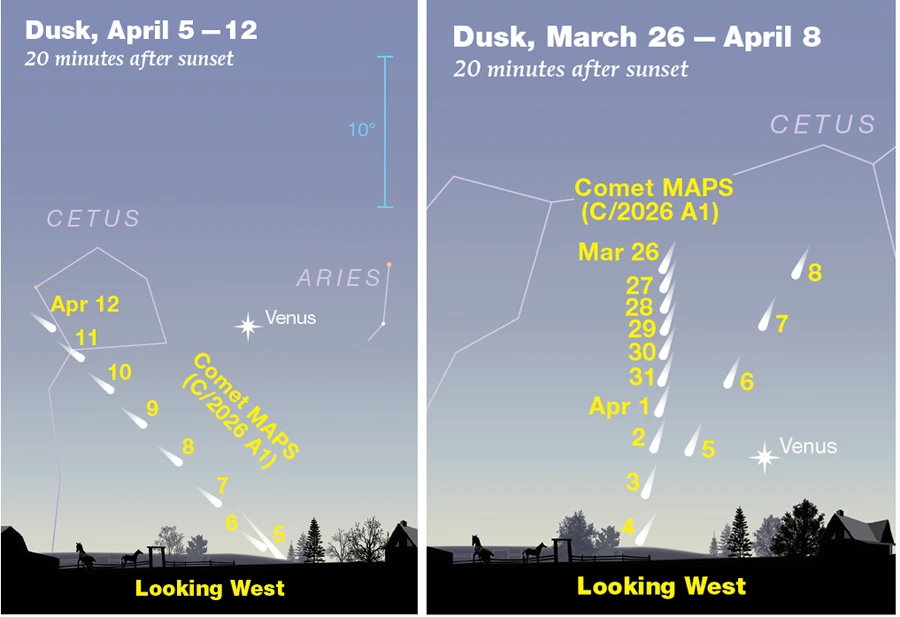
Warning, don't take the position of Venus here too literally; Venus also moves day by day. Its position is correct only for April 5th on the Northern Hemisphere chart (left), and at a later date on the Southern Hemisphere chart (right).
Sky & Telescope graphics
Amateur astronomer and comet discoverer Michael Jäger, whose superb images have graced the pages of Sky & Telescope for decades, is curious why MAPS is producing so little dust. Dust adds pizzazz to comets because it's a good reflector of sunlight.
"Is the nucleus so dust-free from its last passage near the Sun that it has developed a hard crust?" he asks. "Or is it a small, gas-rich comet that’s on its last legs?" He hopes his first assumption is correct, in which case "we'll have a show" once the Sun's intense heat has eroded the crust and exposed fresh material. There's only one way to know for sure. You guessed it — keep your eyes on the comet!
About Bob King
I love the sky (day and night) and have been a skywatcher and amateur astronomer since childhood. I'm also a long-time member of the American Association of Variable Star Observers (AAVSO) and Astronomical League. I pen the Astro Bob blog and have written four books: Night Sky with the Naked Eye (2016); Wonders of the Night Sky You Must See Before You Die (2018) and Urban Legends from Space (2019) and Magnificent Aurora, published in 2024. The universe invites us on an adventure every single night. To accept the invitation, we only need look up.



Comments
Chris-Schur
March 23, 2026 at 9:26 pm
Great article Bob~! From my experience with other comets, if it reaches magnitude -2 near perihelion, then I should be able to capture it with my 10 inch next to the Sun. If its going to disintegrate at perihelion, then the best time will be in the days just before.
You must be logged in to post a comment.
Bob KingPost Author
March 24, 2026 at 1:08 pm
Thanks, Chris! I remember the excellent baffle setup you have and feel confident you'll capture it even at that modest magnitude. I'll be watching the comet list in hopes of seeing your photos. Good luck!
You must be logged in to post a comment.
Raymond
April 1, 2026 at 2:11 pm
Hi Bob,
Great article as always, but I'm confused by your chart. From Northern Hemisphere, closest approach to Venus will be April 9th, but from Southern Hemisphere a much closer approach will be April 5th?
You must be logged in to post a comment.
You must be logged in to post a comment.