 SUNSET:

 0
0Marsquakes reveal a lumpy, viscous mantle and a large, solid inner core, with profound implications for Mars past, present, and future.
A planet’s crust, like the skin of an apple, hides the bulk that lies below. But now, two new analyses of marsquakes are helping scientists burrow a metaphorical hole into the Red Planet’s core. But the results raise as many questions as they answer.
NASA’s Insight mission operated its seismometer on the Martian surface for four years, capturing ripples in the crust at the lander’s location in Elysium Planitia. (You’ve seen similar data if you’ve ever jumped near a seismometer in a science museum and watched the needle wiggle.) Some of the marsquakes Insight detected came from actual shifts in the planet, mostly at the quake-prone Cerberus Fossae region more than 1,600 km (1,000 miles) away. Others came from meteoroids hitting the planet’s surface. Those quakes, as the mission name promised, have already revealed a lot about the Martian interior. Even years after the lander's retirement, though, the data still have the potential to reveal the unexpected.
Surprise! A Large, Solid Inner Core
Whatever the wiggles’ source, scientists saw right away that they were surprisingly long-lived, lasting for hours rather than the seconds-long shakes we typically see on Earth. Taking advantage of their length, Huixing Bi, Daoyuan Sun (both at University of Science and Technology of China) and colleagues, reporting in Nature, zeroed in on wiggles that occurred long after the quake had started. They identify two types of shakes: one of which came from waves traversing the core — and another type that instead reflected off the boundary of a solid, inner core. That inner core is surprisingly big; at 600 km in radius, it takes up the same amount of room in Mars, percentage-wise, as the inner core does in our own planet.
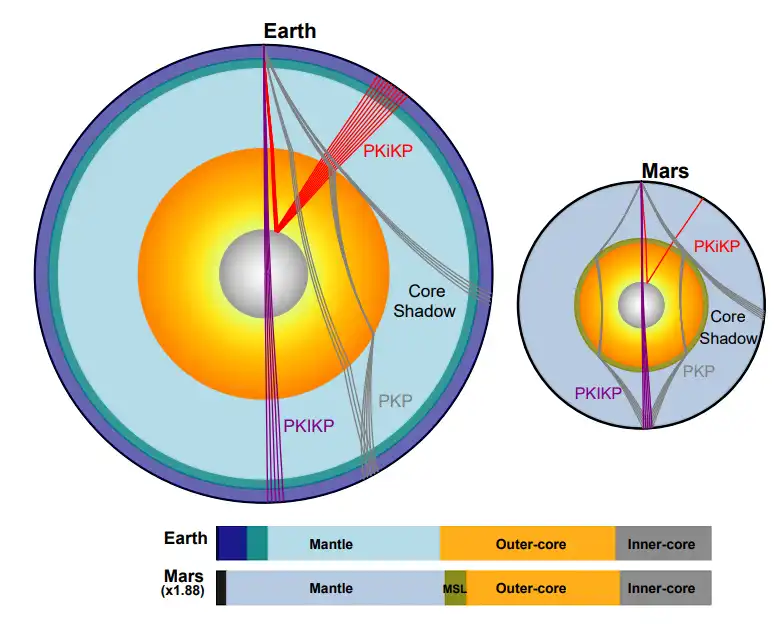
Bi et al. / Nature 2025
Yet the cores of Mars and Earth are anything but alike — and the planets, as a result, have vastly different magnetic fields and atmospheres. Earth’s solid inner core is made almost entirely of an iron-nickel alloy, while its liquid outer core includes lighter elements. Those lighter elements don’t easily solidify, so the outer core has remained liquid in the 4.5 billion years since the solar system’s formation. Yet the outer core is shrinking, slowly building up the solid inner core. In fact, the crystallization process is what produces Earth’s magnetic field. That field plays a crucial role in protecting us from solar radiation and particles that would otherwise strip our atmosphere.
Mars, on the other hand, has no global magnetic field and a barely-there atmosphere. The Red Planet last had global magnetism 4.4 billion years ago — when the planet was still young and hot enough that its insides boiled, producing a thermal magnetic dynamo that lasted only until the planet’s core began to cool.
Scientists didn’t expect Mars to have a solid inner core. First, if it were solidifying fast enough, it would produce a global magnetic field, and Mars doesn’t have one. In addition, multiple methods of measuring the Martian interior have shown it to be much, much lighter than Earth’s. Based on initial marsquake analysis in 2021, the Insight team likewise found the Martian core to be large, light, and therefore liquid.
“Nobody on the Insight team took the search for a solid inner core seriously,” says Amir Khan (ETH Zurich, Switzerland), who led one of the 2021 studies but is not involved in the current work. The light interior they measured should have meant that, if there were a solid inner core, it would have to be tiny, he adds: no more than 300 km at most. So the 600 km radius that Sun’s team measured has come as quite a surprise.
Vedran Lekić (University of Maryland, College Park), who like Khan wasn’t involved in the study, says that a large core is the simplest way to explain the quake observations. “The implications for the current state of Mars’s interior are profound,” he adds.
Khan says the implications for the future of Mars are just as far-reaching. In ancient times, the planet might have had two dynamo mechanisms creating its global magnetic field: the cooling of a hot, young core and the slow crystallization of that core. When the cooling fell below a certain threshold, there wasn’t enough crystallization to support the dynamo anymore.
But that raises an intriguing possibility for a future magnetic resuscitation. As the core continues to cool, Khan speculates, “you get into the same regime we have on Earth. . . . It’s all about these thresholds you need to drive the dynamo, but potentially it could restart.”
Yet, as profound as the implications might be, the large solid core itself is challenging to understand. Simply sticking light elements into the core to lower its density doesn’t work, because lighter elements have a lower melting point and are thus less likely to solidify.
To explain how the inner core could be both light and solid, Bi, Sun, and colleagues explore the possibility that it’s made not of iron-nickel, as in Earth, but rather of iron oxide (FeO). That would also help explain why the density jump going from the outer core to the inner core is so small — if the solid part is relatively light, there won’t be a big difference coming from the outer core.
Still, that composition is challenging in the face of other measurements. Two years ago seismic scientists, including Khan and Henri Samuel (Paris Cité University, CNRS, France), detected a layer of molten rock around the core. “The molten silicate layer heats up the core, because it is enriched in radioactive, heat-producing elements,” Samuel says, “and it also acts as a thermal blanket that prevents the core from cooling.”
“I anticipate that many groups around the world will want to take a closer look . . . and confirm the study’s findings,” says Lekić, “and attempt to reconcile its implications with previously published work.”
Khan, while calling himself a “healthy skeptic,” acknowledges that Sun’s team is working with a rather noisy data set measured a world away. “You’ve only got this one data set, right, and therefore it’s a unique resource,” he says. “You have to mine it as much as you can.”
A Viscous Mantle Holds Remnants of the Past
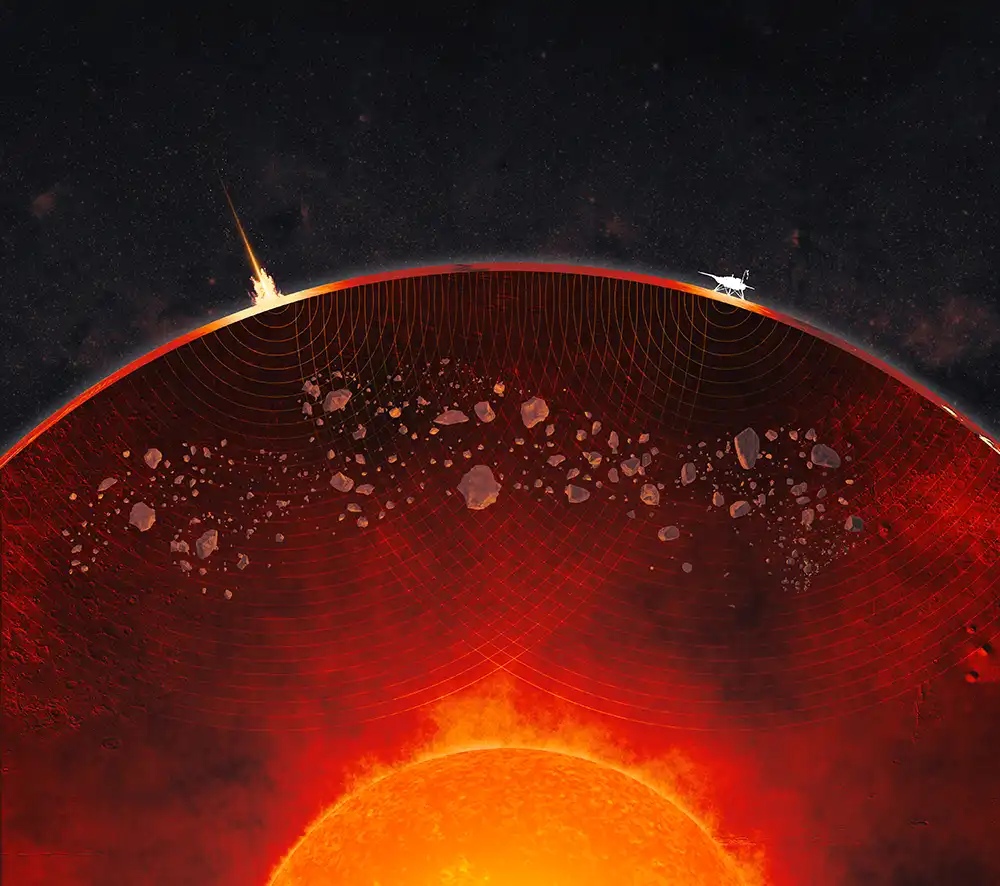
Another study of Insight data, this one in Science and led by Constantinos Charalambous (Imperial College London) and with Samuel as coauthor, peers more shallowly into the Martian interior, investigating the mantle between the core and crust.
NASA / JPL-Caltech
The team selected eight far-away marsquakes that traversed the mantle on their way to the Insight lander. They showed that the mantle distorted the waveforms as the waves passed through the planet, delaying higher-frequency ripples while letting lower-frequency waves pass through unimpeded. The team explains that delay with kilometer-scale lumps in the interior. Lekić, who wasn’t involved in this study either, calls the find “a fascinating and unimpeachable observation.”
The team makes the case that the lumps are made of different stuff than their surroundings, and likely represent the remnants of ancient asteroids that hit the young planet Mars. Those lumps didn’t mix into the mantle because the mantle oozes, rather than flows as in Earth. (Incidentally, the viscous mantle explains why marsquakes last so long — Earth’s mantle damps the oscillations, but in the sluggish Martian mantle, shakes just keep going.)
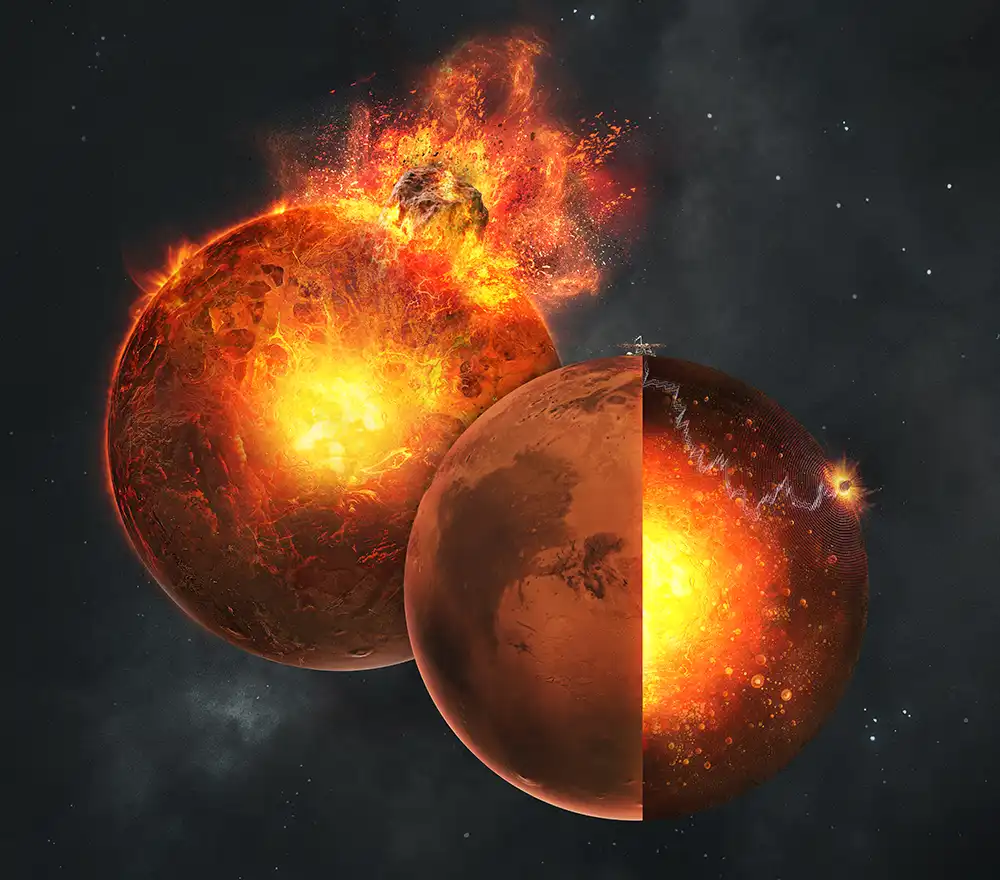
Illustration by @vadimsadovski
“I’d see the two studies as complementary pieces of the same thermal story,” Charalambous says. “Their work reads the present state of the core; ours constrains the mantle conditions that make that state plausible.
“If a solid inner core is confirmed, it fits naturally into this picture, he adds. “Slow cooling would allow only gradual inner-core growth.”
Another seismometer on Mars, or — even better — multiple instruments distributed across the Red Planet would offer a clearer view of the sometimes-confusing interior. But as Khan points out, another such instrument is likely a generation or two away. For now, Charambalous suggests the lumpy interior could be linked to the diverse array of Martian meteorites that have landed on Earth. Simulations, too, can shed new light on what’s happening in both the core and mantle.
About Monica Young
Monica Young, a professional astronomer by training, is News Editor of Sky & Telescope.




Comments
You must be logged in to post a comment.