 SUNSET:

 0
0Just discovered, it’s been orbiting the Sun alongside Earth for decades, and will continue to do so for decades more
Our home planet just got a new companion — or at least, a newfound one.
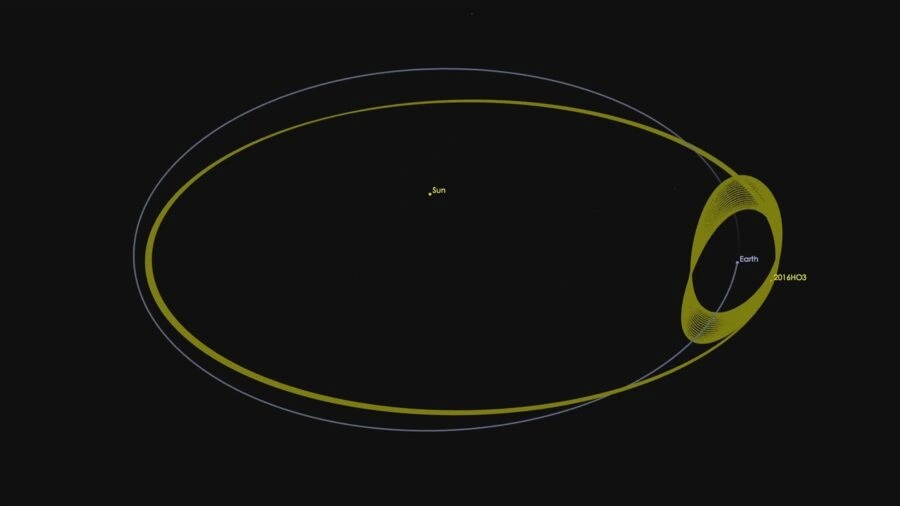
We know the Earth only has one true Moon. But we’ve also known for a while that our planet is currently accompanied by seven other small asteroids that seem to circle around us, even though they don’t really orbit Earth as a true moon would. These objects, known as quasi-moons, tend only to inhabit Earth-accompanying orbits for short periods — years or decades, sometimes centuries.
NASA / JPL-Caltech
Now, it turns out, there’s a new quasi-moon in town. Just discovered on August 29th by the Pan-STARRS observatory on Haleakala, Hawai‘i, asteroid 2025 PN7 was quickly confirmed by other observatories. Earlier images of the object extend back to 2014. It now appears to have been on a quasi-moon orbit for about 60 years, and it will remain so for about 60 more. Eventually, though, it will revert to a horseshoe orbit, one that brings it periodically close to Earth only to back away again, never completing a full circle around our planet.
Alan Harris (Space Science Institute), in a posting on the Minor Planets Mailing List (MPML), writes that its velocity relative to Earth of 3.4 km/s (7,600 mph) is higher than would be expected from lunar ejecta. He adds that it’s “likely just an asteroid that has trickled into a near-Earth orbit from the inner main belt.”
At some point in the future, gravitational interactions may eject it from Earth’s vicinity altogether. “Some future close encounter with Earth could put it on an orbit that intersects either (or both) Mars or Venus,” Harris writes.
Indeed, simulations carried out by French journalist and amateur astronomer Adrien Coffinet — who was the first to post on the MPML group that this object is a quasi-moon of Earth — show that, indeed, this object is likely to cross Mars’s orbit at some point, although that event is likely thousands of years in the future.
Harris tells Sky & Telescope that most of the objects of this type now being discovered are almost in commensurate orbits — that is, they’re close to being in resonance with Earth’s orbits. In this case, 2025 PN7 is close to a one-to-one resonance, Harris says.
While such objects may be opposite Earth, such that they hide from our view behind the Sun, Harris adds that near-resonant orbits mean those objects aren’t a threat: “Any such object does not come unexpectedly, out of the blue, to impact Earth.”
If any object on a commensurate orbit were to impact Earth, “it [would first make] repeated near-identical passes ever closer to Earth before arriving on an impact trajectory,” Harris says. “So there are multiple annual chances to discover the object on one of those repeat passages before any final impact could occur.”

For now, the newly discovered asteroid bears the unassuming assigned name of 2025 PN7. Of the seven previously known quasi-moons of Earth, only two so far have been given official names other than their numerical designations. Kamo’oalewa was named in 2019 after a Hawaiian deity. Cardea, named for a Roman goddess of transitions, received its name from an international competition organized by RadioLab, a public radio program, and the International Astronomical Union. The competition received more than 3,000 entries from 90 countries, and the public voted from a list of seven finalists selected by a panel of scientists and communicators.
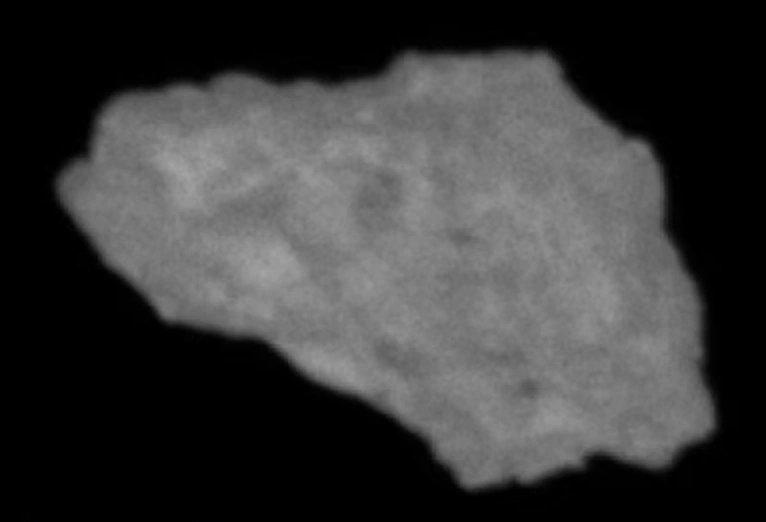
Amateur astronomer Sam Deen, who regularly tracks asteroids and comets, says this object “seems to be an angular, quite elongated solid rock, is about 13–33 meters across and is completing a sort of lopsided pseudo-orbit around Earth, getting as far as 0.4 astronomical unit (au) or as close as 0.03 au from our planet.” The size information comes from the body’s intrinsic brightness, while its shape is deduced from how that brightness changes over time, “by as much as a factor of 3 every several minutes,” Deen says.
Deen adds that “quasi-satellites are especially interesting because their cycling around Earth allows even very small asteroids like this one to be studied for years, and often decades, as they repeatedly come back to visit us every single year.” In addition, he tells Sky & Telescope, “objects in this unusually stable orbit are often unusually easy to visit with spacecraft, already coming quite close to Earth at a lower speed than most. So lower-budget future missions should have a relatively easy time getting to these for exploration, sample return, or even outright asteroid mining.” Indeed, China’s Tianwen 2 is en route to Kamo'oalewa in 2027.



Comments
You must be logged in to post a comment.