 SUNSET:

 0
0A new analysis of Hubble and Gaia data suggests that our galaxy might survive an upcoming encounter with the Andromeda Galaxy unscathed.

The Milky Way and Andromeda are the behemoths of the Local Group, the mini cluster in which we reside. They’re joined by roughly 100 smaller galaxies, including two large sidekicks: M33 (Andromeda’s buddy, the Triangulum Galaxy) and the Large Magellanic Cloud, one of the Milky Way’s close companions.
Astronomers have known since 1912 that Andromeda and the Milky Way are heading toward each other. To determine whether the galaxies will someday collide, however, they needed to know two things: Andromeda’s sideways motion across the sky, called its proper motion, and the galaxies’ masses. To be really sure, they also needed to determine those same properties for the galactic sidekicks.
But measuring these parameters is hard. Andromeda’s shift in sky position over the course of a year, for example, is measured in tens of microarcseconds — where a microarcsecond is a millionth of an arcsecond, or about 50 billionths the width of the full Moon. (In other words, it’s itty bitty.) A century passed before astronomers had the ability to precisely observe such motions.
In 2012, astronomers used the Hubble Space Telescope and the Very Long Baseline Array to conclude that Andromeda would indeed hit the Milky Way, potentially head-on. A subsequent 2019 study added Gaia data and found the encounter was more likely to be a glancing blow. The collision would come in 4.5 billion years and, eventually, result in the galaxies merging.
But the new study, by Till Sawala (University of Helsinki, Finland) and a multi-national team, calls that fate into question. The astronomers combined Gaia and Hubble data for the motions of the four largest Local Group members, as well as updated mass estimates. In all, they considered 22 different variables and ran 100,000 simulations, following the Local Group’s evolution 10 billion years into the future.
Reporting June 2nd in Nature Astronomy, the team found that in about half the simulations, Andromeda and the Milky Way fly past each other in the first round, then later swing back and collide, perhaps 7 to 8 billion years from now. But in the other half, the two galaxies escape entirely — at least, for the next 10 billion years.

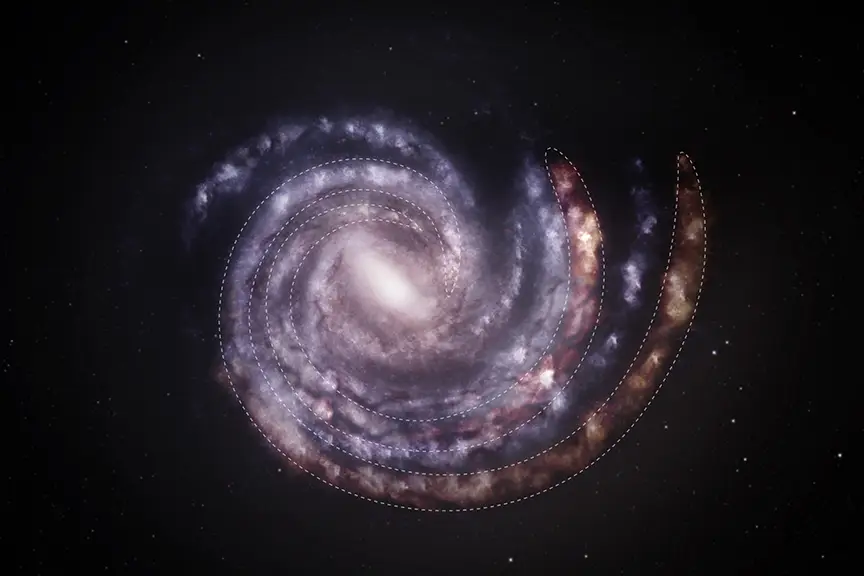
Credit: NASA / ESA / STScI / Till Sawala (University of Helsinki) / DSS / J. DePasquale (STScI)
Like any good sidekick, the Large Magellanic Cloud comes to the Milky Way’s aid. Although M33 helps draw us toward Andromeda, the LMC tugs us up and away. “It doesn’t mean that the LMC will save us from that merger, but it makes it a bit less likely,” Sawala said in a press release.
“As it stands, proclamations of the impending demise of our Galaxy seem greatly exaggerated,” the team concludes in the paper.
Sangmo Tony Sohn (Space Telescope Science Institute), who worked on the previous studies but wasn’t involved in the new one, agrees with the authors’ methods but is skeptical of the conclusion. “I think it all boils down to differences in two key parameters,” he says. Those are Andromeda’s sideways velocity and the combined masses of Andromeda and the Milky Way. Sawala’s team favored lower masses than Sohn and his colleagues did in the 2012 study that concluded merger is inevitable, and lower masses shrink the probability of collision.
Sawala’s team emphasizes there is considerable uncertainty in every galaxy parameter, save for the galaxies’ current positions in the sky. That uncertainty obscures the Milky Way’s fate, Sawala noted.
Better proper motion measurements, extending over longer spans of time — which is now possible as the years pass — will help answer the question. Sohn and his colleagues are currently using Hubble to do that. They expect to achieve more than double the precision of previous proper motion measurements, which should dispel some of the fog in astronomers’ crystal ball.
References:
Till Sawala et al. “No Certainty of a Milky Way–Andromeda Collision.” Nature Astronomy. June 2, 2025.
Roeland P. van der Marel et al. “First Gaia Dynamics of the Andromeda System: DR2 Proper Motions, Orbits, and Rotation of M31 and M33.” Astrophysical Journal. Feb. 7, 2019.
Roeland P. van der Marel et al. “The M31 Velocity Vector. III. Future Milky Way M31–M33 Orbital Evolution, Merging, and Fate of the Sun.” Astrophysical Journal. June 8, 2012.
About Camille M. Carlisle
Science Editor Camille M. Carlisle handles science features for Sky & Telescope. She specializes in black holes, Mars, and whatever she happens to be writing about at the time. Frolic with her through the delights of black holes in her blog, The Black Hole Files.



Comments
You must be logged in to post a comment.