 SUNSET:

 5
5Watch the crescent Moon dance with the planets when it returns next week.
Bob King
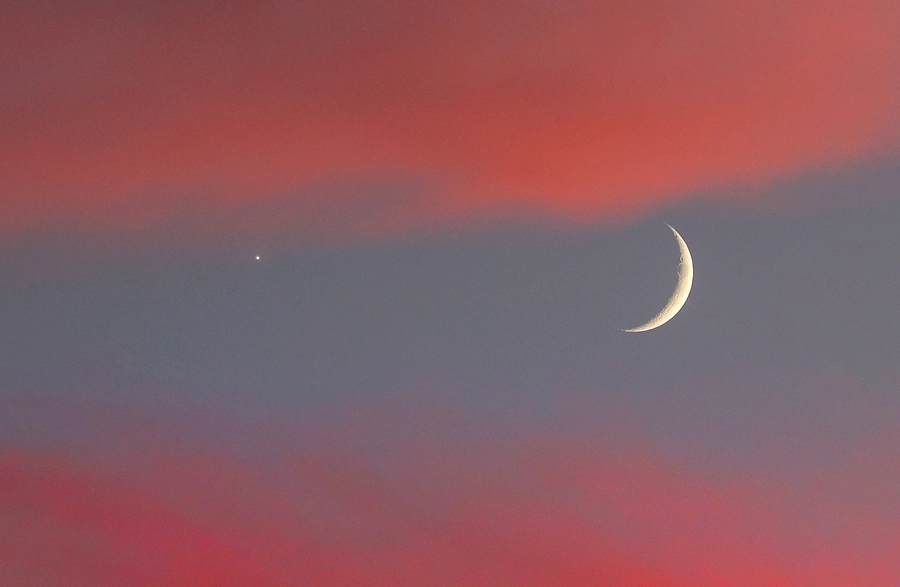
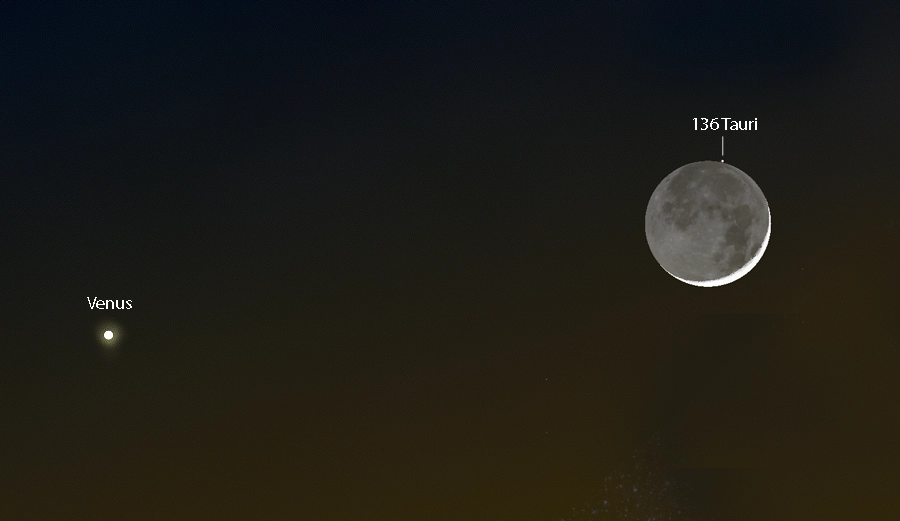
On Monday, May 18th, as evening twilight gets underway, look west and you'll see another of nature's effortless works of art — a willowy, crescent Moon and radiant Venus in close embrace. Only 2° will separate the celestial couple. Two gleaming heavenly bodies juxtaposed can't help but catch the eye and evoke a "wow!" The sight stirs a primitive nerve inside us that responds to striking patterns and arrangements in the sky. We find such things both beautiful and meaningful.
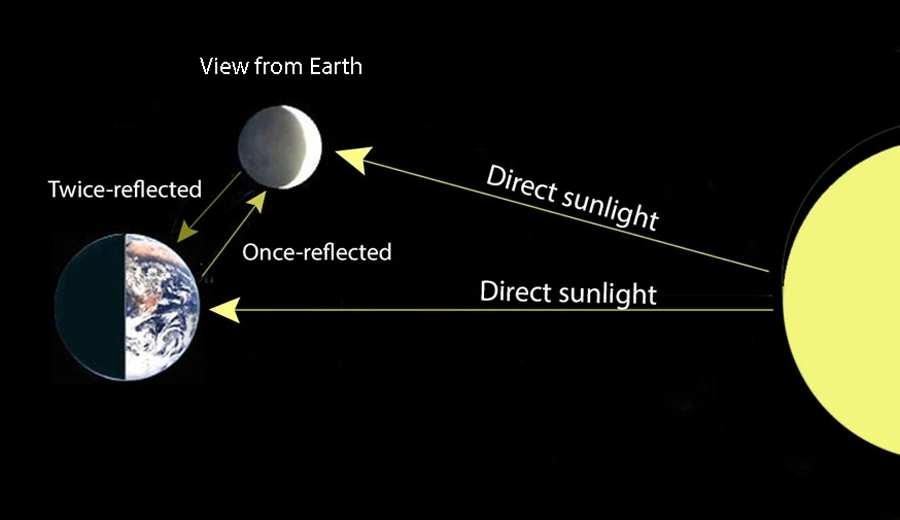
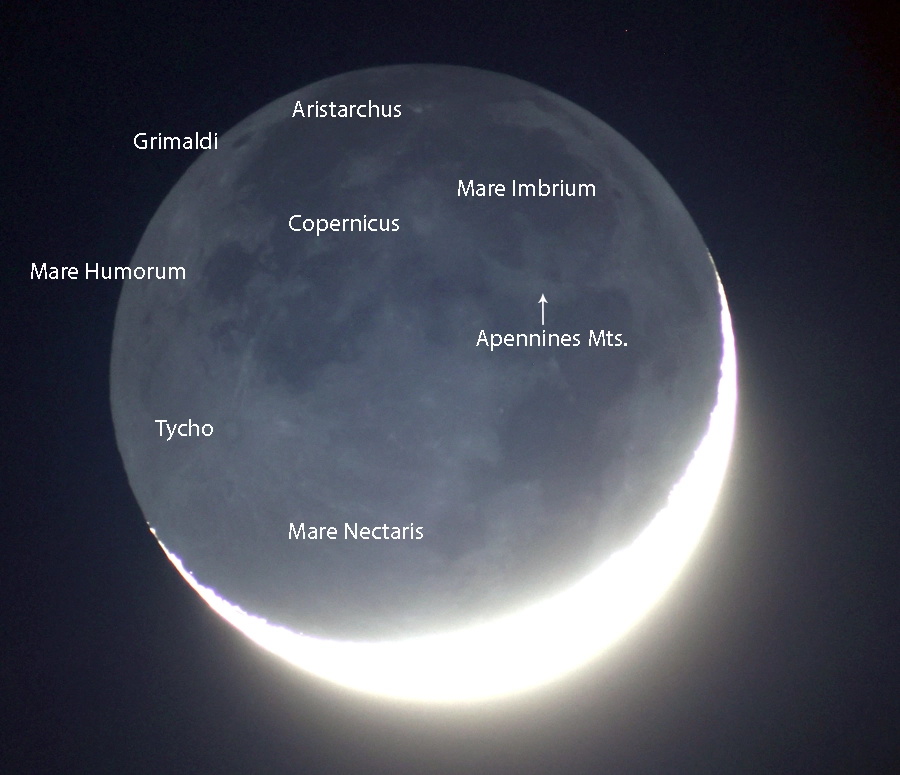
As darkness deepens, the Moon's full outline comes into view. The Sun directly illuminates the crescent. Sunlight reflected from Earth to the Moon and back to our eyes illuminates the remainder of the lunar disk, where it's still nighttime. Although this Earthshine looks dim and dusky from our perspective, if you could stand on the Moon, you'd see the brilliant, nearly full Earth against the black satin sky.
Bob King
Not only is our planet almost four times larger than the Moon, it's also much brighter, reflecting about 31% of the light it receives from the Sun versus our satellite's 11%. Together, these factors make the full Earth at least 43 times brighter than a full Moon — plenty enough to navigate the lunar surface. Just to be sure, let's hear from someone who's actually been there. On July 20, 1969, Apollo 11 astronaut Michael Collins had this to say as he and his crewmates orbited the Moon:
APOLLO: "Houston. Apollo 11. The earthshine coming through the window is so bright you can read a book by it."
HOUSTON: "Oh, very good."
Bob King
To fully appreciate how bright, train your binoculars on the Moon's night portion and see for yourself how many rayed craters and muddled maria are visible. You're essentially observing the full Moon but without the overwhelming glare!
Sky & Telescope diagram
Conjunctions happen all the time but vary in the public interest they generate. The Sun, planets, and to a degree, the Moon, orbit within the relatively flat plane of the solar system. Projected onto the sky, the plane traces out an imaginary circle through the zodiac constellations called the ecliptic. Like travelers constrained to use a single road all their lives, solar system inhabitants invariably run into each other. The planets take years to complete their circuits, but the Moon circles the entire ecliptic in about four weeks. A heavenly busybody, it drops in on each planet every month.
No two conjunctions are the same. In some, the celestial players get really close; others are loose and less compelling. Sometimes the pairing happens below the horizon for your location, or when the Sun is shining. Other conjunctions happen too close to the Sun and get washed out in the glare. The timing for this one on May 18th is perfect, so be sure to grab a seat.
Stellarium
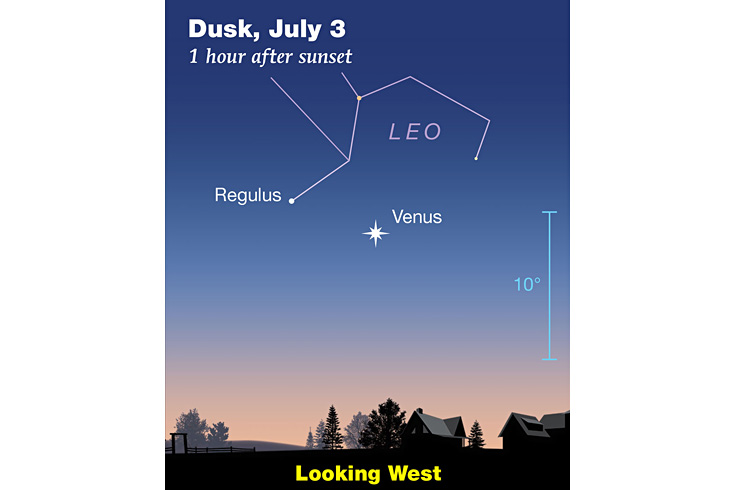
From the East Coast, the Moon and Venus will shine across from one another nearly parallel to the horizon. But the clock keeps on ticking, and the Moon never stops moving. So, by the time it's dark in Seattle 3,000 miles to the west, the crescent will hover almost directly above Venus.
More in store!
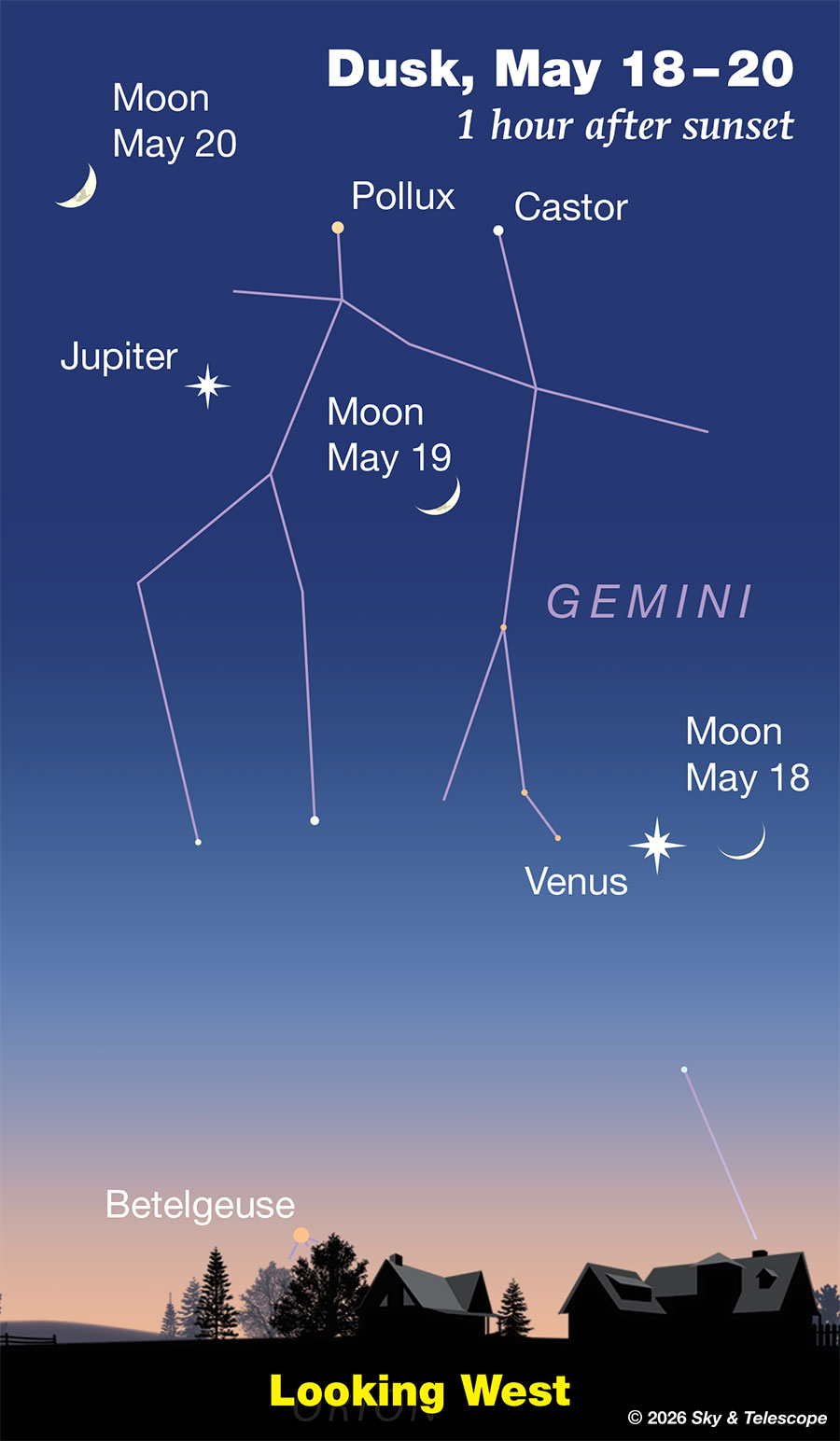
One night later, on May 19th, a slightly thicker crescent will stand between Venus and the evening's other bright planet, Jupiter. The glamorous trio forms a line because we see them across the flat plane of the solar system in roughly the same line of sight. On May 20th, as the Moon prepares to leave the fold, it joins Jupiter and Venus for a final fling. Three nights of celestial firepower!
Stellarium
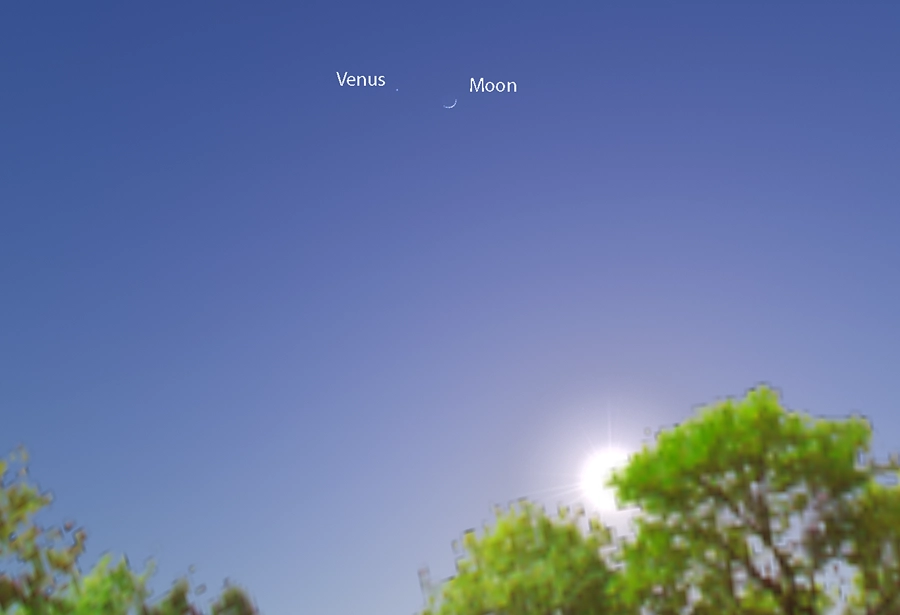
If you've never observed Venus in the daytime, the Moon can help you find it. On May 18th, try looking around 5 p.m. local time, several hours before sunset. The duo will be in high in the western sky some 30° from the Sun and aligned roughly parallel to the horizon. Locate the Moon with your eyes, then fetch it in binoculars. With the Moon crisply in focus, look a short distance to its left (approximately 3½°) for the white spark of Venus. Note the planet's distance and orientation with respect to the crescent, then lower the binoculars and use just your eyes. I'm confident you'll see it!
Orange Moon, blue Moon
Our last full Moon fell on May 1st, early enough in a long month to complete another cycle and turn full again on the night of May 30–31. In modern usage, we call the second full moon in a calendar month a Blue Moon. Likewise, when a season has four instead of three full moons, the third is considered a Blue Moon, too. For the full story on the moniker's origin, check out Sky & Telescope's illuminating examination.
The May 1st Full Flower Moon rose in Libra. Nearly a month later, it will occupy Ophiuchus two constellations to the east. Mid-northern latitude observers will notice something special about this upcoming Blue Moon. Its declination of −28.5° makes it the lowest-altitude full Moon of the year. So low we'll see it glow orange and yellow (not blue!) the entire night, its cooler colors scattered away by the dense air.
I often listen to music when I'm observing from home. I can't think of a better selection to get in a blue-moony mood than Jo Stafford's rendition of Blue Moon.
About Bob King
I love the sky (day and night) and have been a skywatcher and amateur astronomer since childhood. I'm also a long-time member of the American Association of Variable Star Observers (AAVSO) and Astronomical League. I pen the Astro Bob blog and have written four books: Night Sky with the Naked Eye (2016); Wonders of the Night Sky You Must See Before You Die (2018) and Urban Legends from Space (2019) and Magnificent Aurora, published in 2024. The universe invites us on an adventure every single night. To accept the invitation, we only need look up.



Comments
Anthony Barreiro
May 15, 2026 at 11:19 pm
Thank you, Bob! Following the Moon, planets, and bright stars helps me feel connected to rhythms much bigger than anything on our little Earth. Lately I've been enjoying watching Venus move past El Nath, changing position noticeably from one evening to the next. Venus has been scooting mostly to the left above the horizon, gaining very little altitude. That helps me see how the ecliptic slopes gently above the western horizon during this season from my mid-northern latitude. Similarly before and during dawn the Moon has been moving on a leftward descending diagonal past Saturn and Mars. When the sky is clear and I'm up before dawn this is my favorite time to watch the sky. It's quiet and none of the neighbors have their lights on. Yesterday morning the earthlit decrescent Moon was especially beautiful.
You must be logged in to post a comment.
Bob KingPost Author
May 18, 2026 at 11:54 pm
Hi Anthony,
Thanks for sharing the things that connect you to the cosmic clock. There are many small movements, cycles and seasons in the sky that allow us to find connection. Grand events like total eclipses are wonderful, but one can live a full and rich observing life on small morsels. I also enjoy dawn, or just before. There's a sacredness to it. Part of that is because human "noise" is at a minimum. The other morning I was up observing the Milky Way through the night right up to dawn. The light came on quickly and before long the first robin sang. Man, I loved it.
You must be logged in to post a comment.
Anthony Barreiro
May 20, 2026 at 7:30 pm
It's been a long time since I pulled an all-nighter, but the transition from night to dawn to sunrise is a profound experience. Sacred is a good word. You see the world differently.
The waxing crescent Moon has been lovely since barely one day old Saturday, dancing with Venus and Jupiter.
You must be logged in to post a comment.
John Schnupp
May 17, 2026 at 2:20 pm
Probably one of my best music experiences involving the Moon was at a Willie Nelson concert at the Shelburne Museum, Shelburne VT. It was August 8, 2006 and as the nearly full (99.6% waxing gibbous) Moon rose in the south east, Willie Nelson sang Moonlight in Vermont. His set list for that night was perfectly curated for the events of that night.
You must be logged in to post a comment.
Bob KingPost Author
May 18, 2026 at 11:38 pm
Hi John,
Sounds like Willie was right on. I just listened to it on YouTube. Great stuff! I also recommend the Sinatra and Ella Fitzgerald versions. Vocals like water flowing in a stream.
You must be logged in to post a comment.
You must be logged in to post a comment.