 SUNSET:

 0
0The Moon returns to the evening sky this week to show off its elegant crescent and invite us to tour its nightside.
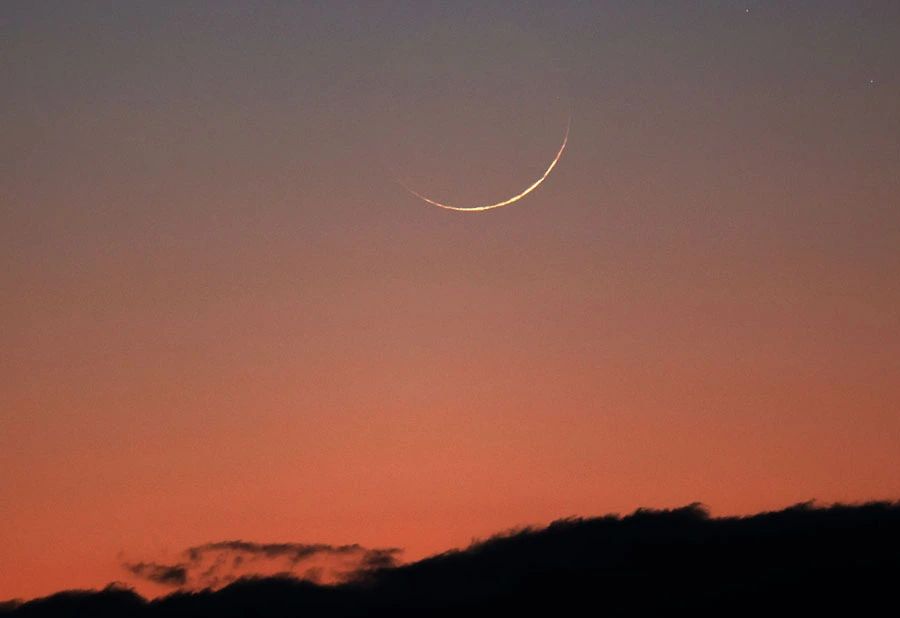
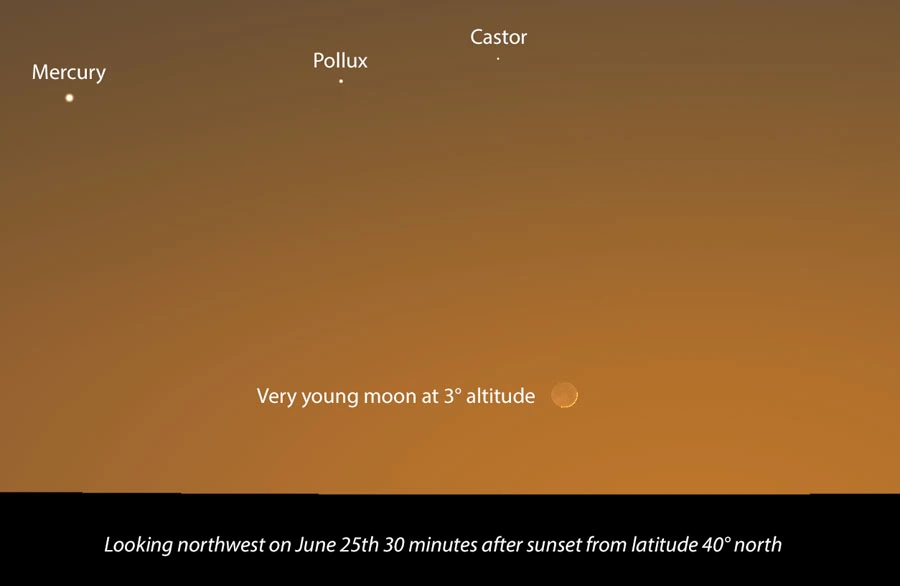
North American observers have a shot at seeing a sub-24-hour-old Moon on Wednesday evening, June 25th. Circumstances for viewing exceptionally young moons are best during northern spring, when the Moon's path tilts nearly perpendicular to the western horizon. In June, the Moon's more slanted path makes finding a young crescent more challenging. Fortunately, we get a little help in the declination department. That evening, the Moon will stand at +26.5° north, boosting it 3° above the ecliptic's northernmost point. The extra "bump" will help to increase its visibility.
Bob King
Sky & Telescope Contributing Editor Stephen James O’Meara has the record for the youngest crescent moon sighting at 15 hours, 32 minutes past new in May 1990. Mohsen G. Mirsaeed of Tehran, Iran, captured the record for the youngest Moon ever seen with optical aid on September 7, 2002, at 11 hours, 40 minutes.
New Moon occurs on June 25th at 6:31 a.m. Eastern Time. About a half-hour after sunset, when the sky is just dark enough to potentially spot the young crescent, the Moon will be approximately 15 hours old for skywatchers in the Eastern Time Zone, 16 hours old for the Central Time Zone, 17 hours for the Mountain Time Zone and 18 hours for the Pacific Time Zone. Use this calculator to find the time of your local sunset.
Two things are crucial for seeing this cosmic delicacy — an unobstructed view to the northwest and a sky clean of smoke, haze and clouds. Even if conditions are perfect, bring binoculars or a small, wide-field telescope. You'll be battling bright twilight and need optical assistance. Before beginning the hunt, make sure your instrument is pre-focused at infinity. You can either focus on a star field from a previous night (and leave the setting unchanged) or focus on a stray cloud that evening if one is available. Finally, allow time to get situated before undertaking your observations, so you're relaxed and ready when the time comes.
Stellarium
You can start searching for the Moon about 15 to 20 minutes after sunset. A star app will help you determine its approximate location. Once you know where to look, point the binoculars at the area and then slowly sweep two full fields of view to either side. If nothing is seen, examine similarly wide strips of sky above and below where you think the Moon should be. Repeat the sequence, making sure to keep track of the Moon's shifting position over time. The Stellarium Mobile app works well for this, but there are many other good choices.
An alternate approach is to take successive photos of the Moon's general location with a 50-mm or 35-mm lens. Then press the camera's playback button, magnify the image 5× or 10×, and hunt for the crescent on the LCD back screen. Modern DSLR and mirrorless cameras are quite good at teasing out dim celestial objects in bright twilight.
Full Moon in the Old Moon's arms
Bob King
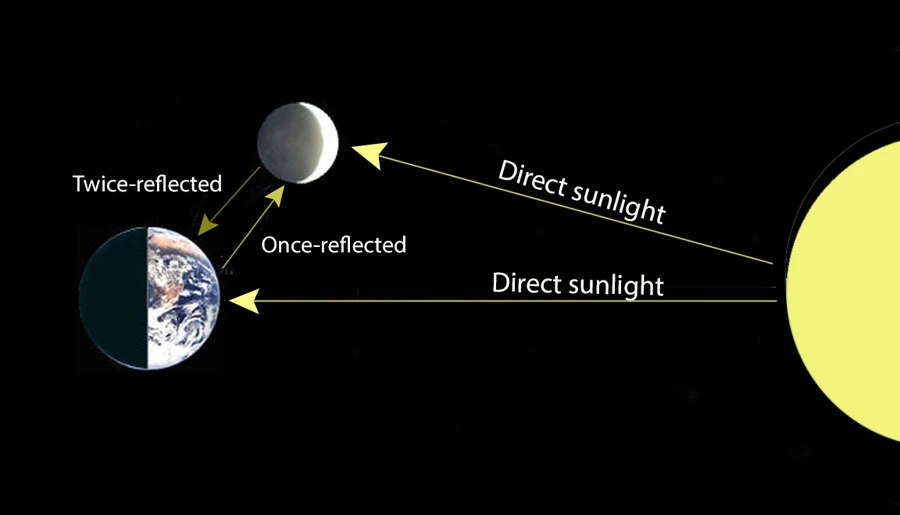
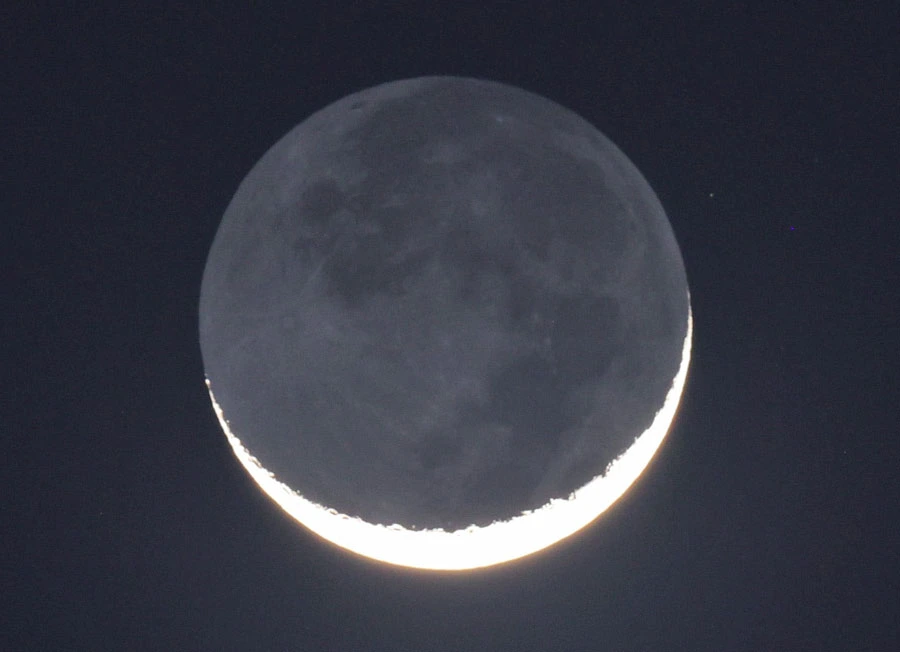
Whether or not you see the super-youthful Moon, you'll have no problem finding the waxing crescent on the following nights — June 26th to the 28th — when it climbs higher in the western sky and shows a bellyful of earthshine. Traditionally, this lunar phase is called the "old Moon in the new Moon's arms." But it looks more like the "full Moon in the new Moon's arms," especially when viewed through binoculars or a telescope. From the lunar perspective, the nearly "full Earth" dimly illuminates much of the lunar disk with the same face-on, shadowless lighting that the Sun does at full Moon.
Tom Polakis
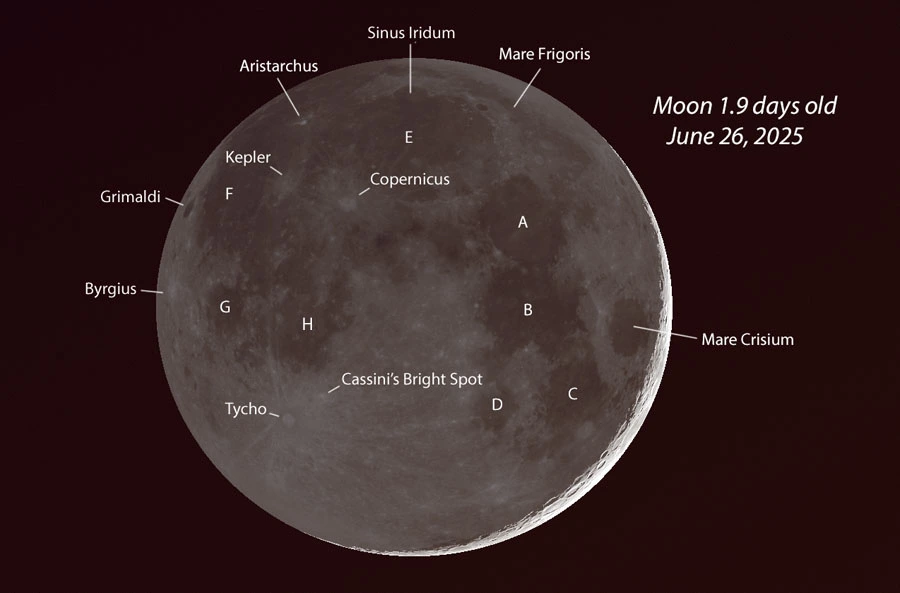
I've tried without success to discern lunar maria (seas) in earthlight without optical aid. At best, I can sense a vague, mottled texture with averted vision. On the other hand, my 8×42 and 10×50 binoculars make easy work of most of the maria, except for those that bound the bright crescent. I've also seen Cassini's Bright Spot and the most prominent rayed craters — Tycho, Copernicus (the easiest), Kepler, and Aristarchus. The last is currently near its maximum libration, displaced toward the western limb, so it may take a bit more effort to see than usual. More challenging binocular objects include the dark-floored crater Grimaldi, Sinus Iridum (Bay of Rainbows), the smaller-rayed crater Byrgius, Mare Crisium, and Mare Frigoris.
Stellarium
Through a small telescope, you can explore the Moon's nightside exactly as if it were full but without the solar glare. On June 26th, observers will have about an hour of good viewing before the Moon drops too close to the horizon. The following night, the observing window widens to more than 90 minutes. Thereafter, the advancing crescent not only gobbles up more of the landscape, but its increasing brilliance makes seeing earthlit details more challenging. Earth's phase is also dwindling, which diminishes the amount of reflected light available. That said, I've tracked earthlight visually through an 8-inch telescope as late as the 10-day-old waxing gibbous. I bet you can push it even farther. Clean optics and keeping the bright Moon out of the field of view will help ensure success.
Heather McNamara and Danielle Moser / NASA MSFC
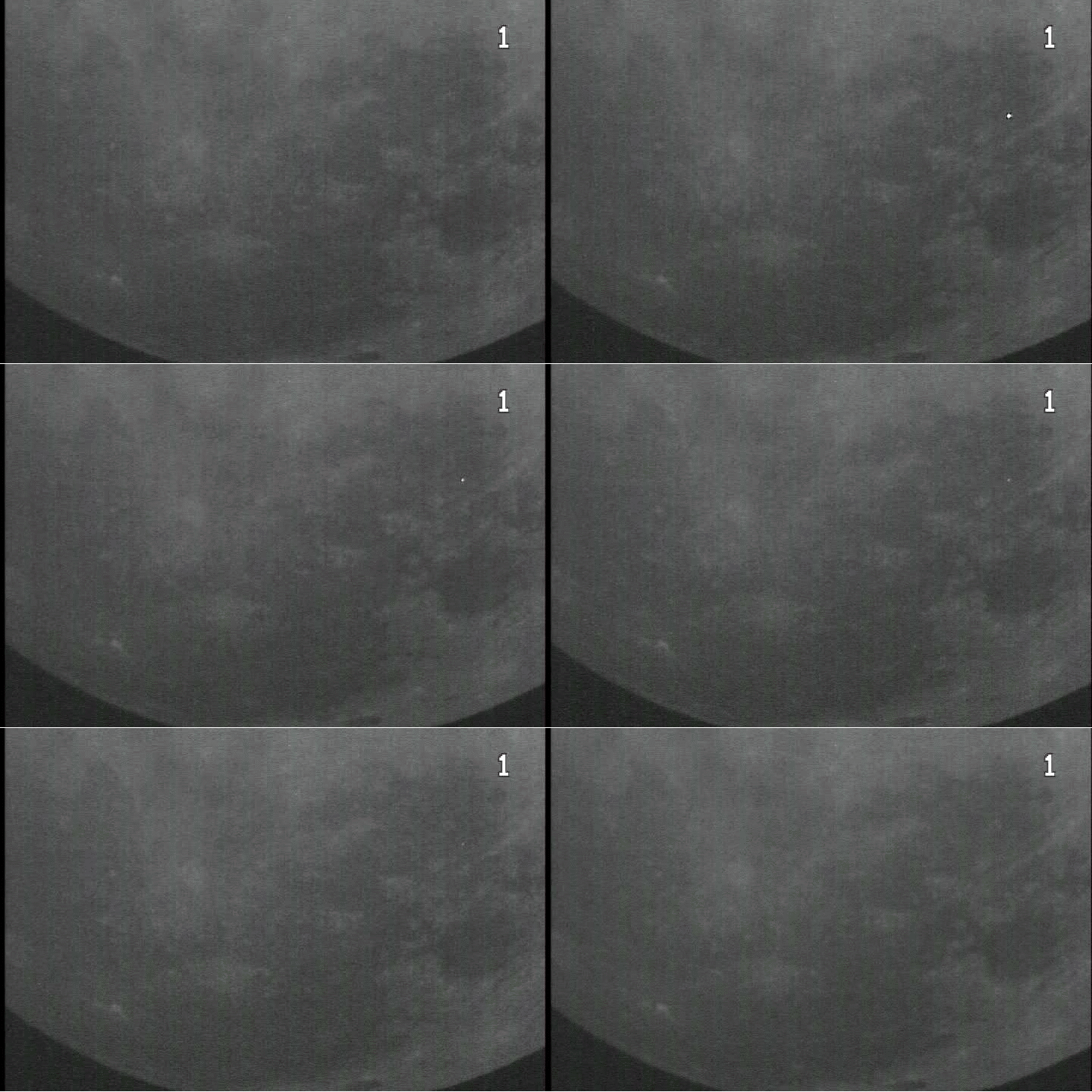
During your explorations be alert for rare lunar impacts. Meteoroids strike the airless Moon's surface at high velocity and create brief, visible flashes of light. The semi-dark Moon makes an ideal background against which to see them. As you poke around the blue-gray lunar gloom with binoculars or a telescope, imagine the radiant globe of Earth at your back — a planetary night light to help you find your way before the Sun's return.
About Bob King
I love the sky (day and night) and have been a skywatcher and amateur astronomer since childhood. I'm also a long-time member of the American Association of Variable Star Observers (AAVSO) and Astronomical League. I pen the Astro Bob blog and have written four books: Night Sky with the Naked Eye (2016); Wonders of the Night Sky You Must See Before You Die (2018) and Urban Legends from Space (2019) and Magnificent Aurora, published in 2024. The universe invites us on an adventure every single night. To accept the invitation, we only need look up.



Comments
You must be logged in to post a comment.