 SUNSET:

 2
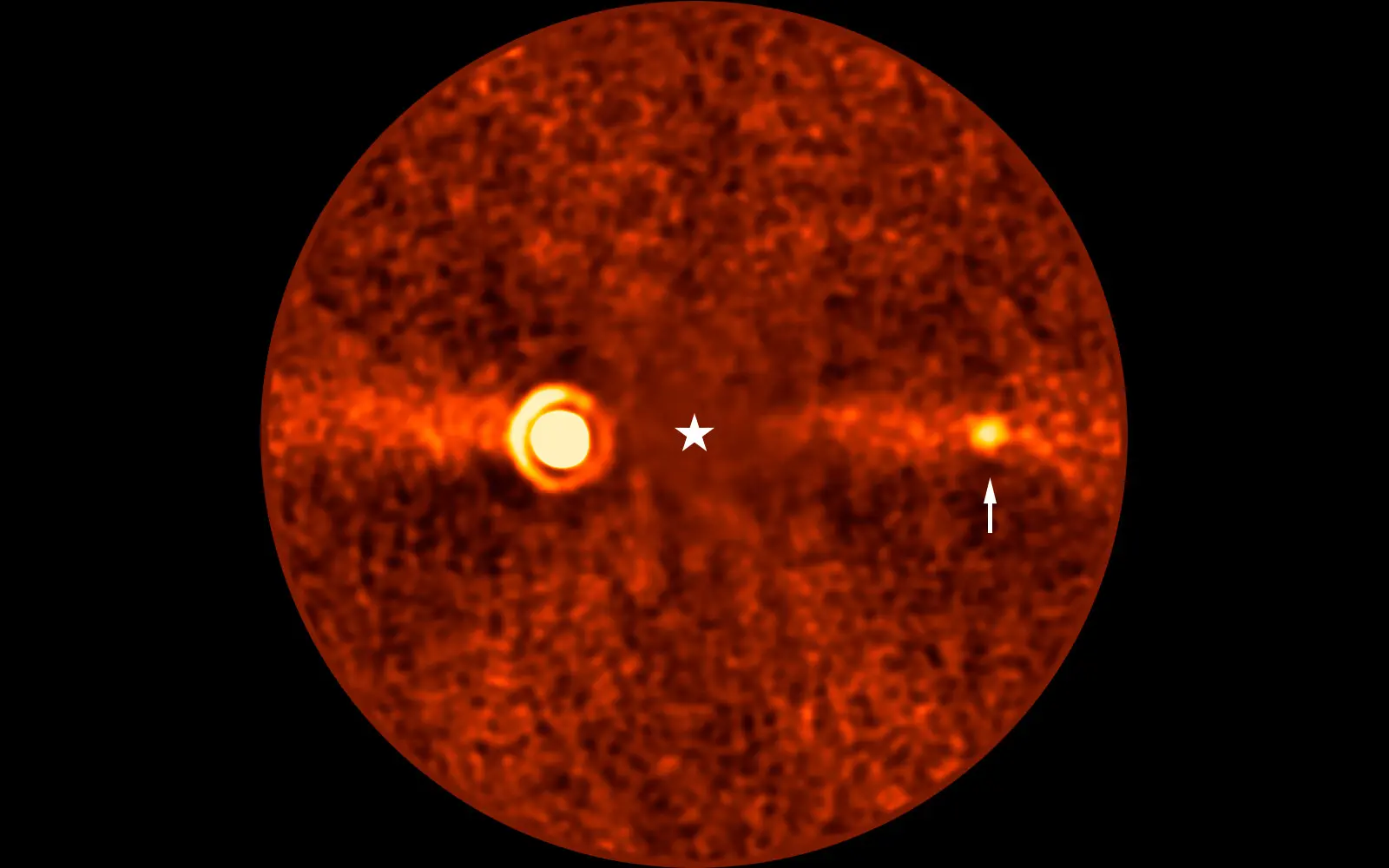
2Astronomers have found X-rays coming from a strange object that releases regular bursts of radio waves, shedding new light on what that object might be.

X-ray: NASA / CXC / ICRAR, Curtin Univ. / Z. Wang et al.; Infrared: NASA / JPL / CalTech / IPAC; Radio: SARAO / MeerKAT; Image processing: NASA / CXC / SAO / N. Wolk
Every 44 minutes and 12 seconds, there’s a flash of radio waves coming from deep in the plane of the Milky Way. The radio source is some 15,000 light-years away in the southern constellation Scutum — about two-thirds of the way between us and our galaxy’s central supermassive black hole. But we still don’t know what it is.
An international team of astronomers now report X-rays detected from this mystery object, publishing the results May 28th in Nature. That high-energy radiation tells us that whatever this object is, it’s more powerful than previously thought. But the observations still leave the source of that power up for debate.
From the first observations of this radio source, named ASKAP J12832–0911 for the Australia SKA Pathfinder Telescope that discovered it, astronomers knew it wasn’t a regular pulsar. Normally, regular lighthouse-like beams of emission account for such regular radio pulses. But in rare cases known as long-period transients, the pulses are so far apart, and slowing down so slowly, that spin can’t be driving the emission.
Instead, the way most of the radio waves aligned with each other (known to astronomers as a high fraction of circular polarization) indicate that potent magnetic fields are involved. And the radio observations also showed that the source of the emission was small — much smaller than a star like the Sun. The object must instead be the remnant of a star — either a white dwarf, neutron star, or black hole. (While a black hole itself can’t carry a magnetic field, inflowing gas might.)
More than a year after the object’s discovery, and several follow-up observations later, astronomers hadn’t made much headway. So Ziteng Wang (Curtin University, Australia) and colleagues went looking for clues at other wavelengths. Some scenarios explaining long-period transients call for X-ray emission, so the team combed through archival images the Chandra X-ray Observatory — even though no X-rays had ever been found for other such mystery objects.
Unexpectedly, they found exactly what they were looking for.
On February 14, 2024, Chandra turned its eye on a supernova remnant within our galaxy for more than five hours. In the same field, there was an uncatalogued dot of X-rays. The observation was long enough that Wang’s team could look for pulsations, and sure enough, it pulsed. But when the team tried for new observations just a few months later, the X-ray source was gone.
Still, the very fact that the X-rays came from this object for even a short time suggest it’s more powerful than previous estimates had indicated. The X-rays also rule out several scenarios — the team excludes pulsars and isolated white dwarfs.

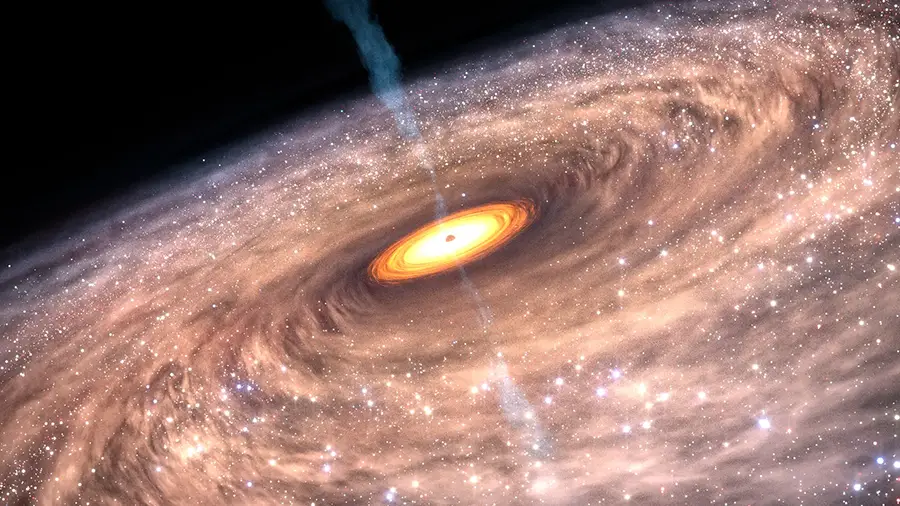
NASA / JPL-Caltech
Two possibilities remain, though as the team points out, both scenarios have their challenges. One option is that the object might actually be a pair: a highly magnetic white dwarf circling tightly around a small star. No other white dwarf, whether alone or with a companion, has been found with such a strong magnetic field.
Alternatively, the object could be a magnetar, a highly magnetic neutron star. There are only a few dozen known in the Milky Way, but we know of these objects explains the radio and X-ray pulses. The catch is that the object isn’t emitting much in the way of X-rays anymore — and that’s something that magnetar models can’t easily explain.
So what is this mystery object in the Milky Way? Time may yet tell, if astronomers can quickly capture X-ray observations of such objects after their discovery in radio surveys. With a budget proposal that cuts NASA’s funding of a host of X-ray observatories, including Chandra as well as NuSTAR, XRISM, and ESA’s XMM-Newton, it’s unclear what the future holds.
About Monica Young
Monica Young, a professional astronomer by training, is News Editor of Sky & Telescope.







Comments
Frank-ReedNavigation.com
June 14, 2025 at 2:38 pm
First, a typo you can fix: "ASKAP J12832–0911". You mentioned that the object is in Scutum, which implies RA about 18h and Dec about -10°. But the code after the J in this object ID is just a low-precision RA and Dec. The first part should start with 18: the object's RA is 18h32m and its Dec is -09°11' yielding J1832-0911.
Speaking of Scutum, you called it a "southern constellation". That really stood out to me as an odd description. It's an equatorial constellation, right? South of the celestial equator, but barely... Given this near-equatorial location on the celestial sphere, this "mystery object" --if it were visible-- could be seen from anywhere on the globe except the highest Arctic locations, north of about 81°N.
You must be logged in to post a comment.
Lou
June 15, 2025 at 6:05 am
Hi Monica, sorry to post here, but the article on 'Never berfore views of the Sun' keeps crashing my browser.
You must be logged in to post a comment.
You must be logged in to post a comment.