 SUNSET:

 0
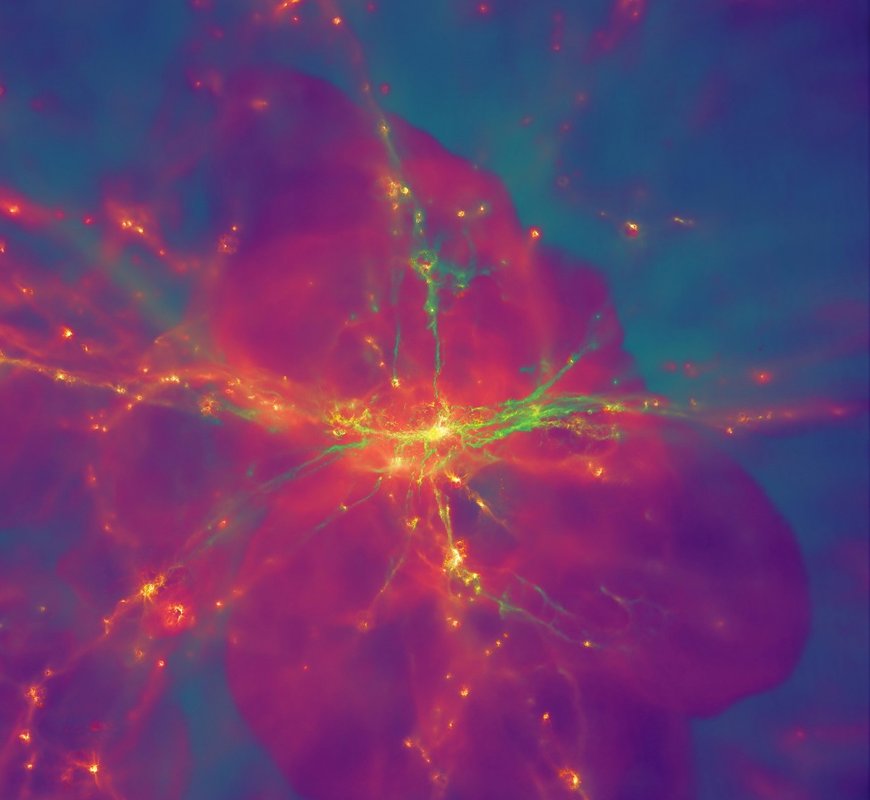
0New supercomputer simulations reveal the journey gas takes to enter a galaxy and surround and enter its black hole.

Caltech / Phil Hopkins group
Thick, fluffy disks of material surround rapidly growing supermassive black holes, new supercomputer simulations reveal. Governed by magnetic fields, the disks can feed a black hole with tens of solar masses’ worth of gas every year — a rate high enough to sustain turbulence and prevent the formation of stars in the infalling gas.
Almost every galaxy has a supermassive black hole at its core. If the black hole is accreting large amounts of matter, the galaxy’s nucleus shines brightly and is cataloged as a quasar. No one doubts that quasars are powered by accreting supermassive black holes, but details of their feeding behavior remain sketchy.
Computer simulations come to the rescue, but they probe very different scales. Large-scale cosmological simulations, mainly governed by gravity, shed light on galaxies’ formation, their interactions, and the way they amass intergalactic gas. Other simulations on a much smaller scale trace the formation of individual stars, taking into account complex physics such as the role of magnetic fields.
Now, a team led by theoretical astrophysicist Philip Hopkins (Caltech) has combined the large and the small in one super-simulation spanning 12 orders of magnitude in size scales. The simulation enables the researchers to follow the motion of primordial gas from the newborn universe all the way into the gaseous disk feeding a growing supermassive black hole weighing in at 10 million solar masses.
“There was this big gap between the two [types of simulation],” Hopkins says in a Caltech press release. “Now, for the first time, we have bridged that gap.”
“I’ve never before seen a simulation with such a huge dynamic range,” comments Joop Schaye (Leiden Observatory, The Netherlands), the principal investigator of a state-of-the-art cosmological simulation named EAGLE. “It’s as if they simulate the whole solar system down to the scale of water draining into a single plughole.”
Admittedly, he adds, the small-scale part of the new simulation only zooms in on a single accreting supermassive black hole and tracks its evolution for a “mere” 10,000 years or so, while the cosmological part spans billions of years. “But it’s really neat.”
As they write in a comprehensive paper in The Open Journal of Astrophysics, Hopkins and his colleagues found that magnetic fields play a much more important role in the formation and shaping of an accretion disk than previously thought. Astronomers expected dense disks to cool down efficiently, becoming thin and flat — just like the rings of Saturn. However, the new simulations show that the magnetic pressure in the dense gas can be thousands of times stronger than the gas pressure.
High magnetic pressure prevents the disk from thinning down, keeping it thick and fluffy. It also suppresses the formation of new stars, which would lower the black hole’s accretion rate. As a result, the black hole can easily continue to consume more than 10 solar masses of gas per year for at least thousands of years. This may explain the rapid growth of massive black holes in the early universe.
“This paper shows that high-density accretion disks can be stable, and supermassive black holes can be efficiently fed even with very high accretion rates,” says Jordy Davelaar (Flatiron Institute). Davelaar’s own computer simulations (and virtual-reality movies) of the black holes in our galactic center and in the elliptical galaxy M87 — both of which have been imaged by the Event Horizon Telescope — indicate that they, too, are surrounded by fluffy disks of gas.
However, Davelaar notes that those nearby black holes are comparatively “quiet,” with much lower accretion rates between one-hundredth and one-hundred-millionth of a solar mass per year. “Their accretion disks have a much lower density and a higher temperature,” he says. “Their thickness is due to gas pressure, not to magnetic pressure.”
Caltech / Phil Hopkins group
Cosmologist Rien van de Weijgaert (University of Groningen, The Netherlands) says the new simulation by Hopkins and his colleagues is “a computational piece of art.” However, he cautions, “it’s also a patchwork of different pieces of physics tied together, making it hard to evaluate how compelling it is.” Moreover, the authors still had to put in a number of things “by hand,” such as the origin of the first black holes and the initial magnetic fields, which become stronger as gas is compressed.
“You can never calculate everything from first principles,” says van de Weijgaert. “The only computer capable of doing that is the universe itself.”
In their paper (the first in a series of three), the authors also recognize the shortcomings of their work. For instance, their simulation does not yet incorporate the way the central parts of the accretion disk could push matter and energy back into their surroundings, whether through powerful jets of plasma or intense radiation.
“Perhaps the biggest caveat here,” they write, “is that (owing to the computational expense of these simulations) we have studied just one case, so it is not obvious how much of our conclusions can be generalized to very different conditions with e.g. much lower accretion rates, let alone extremely low-accretion rate systems like M87 or Sgr A*,” referring to the Milky Way’s central black hole.
Schaye agrees that there’s still a lot to do. “But you have to start somewhere,” he says, “and this is a very impressive piece of work.”
About Govert Schilling
Sky & Telescope Contributing Editor Govert Schilling lives in The Netherlands but loves to explore his home planet. In May 2022, Harvard University Press published The Elephant in the Universe: Our Hundred-Year Search for Dark Matter. His latest book is Target Earth - Meteorites, Asteroids, Comets, and Other Cosmic Intruders That Threaten Our Planet.



Comments
You must be logged in to post a comment.