 SUNSET:

 1
1Astronomers have discovered a second asteroid in the inner solar system, circling the Sun almost entirely within the orbit of Venus.
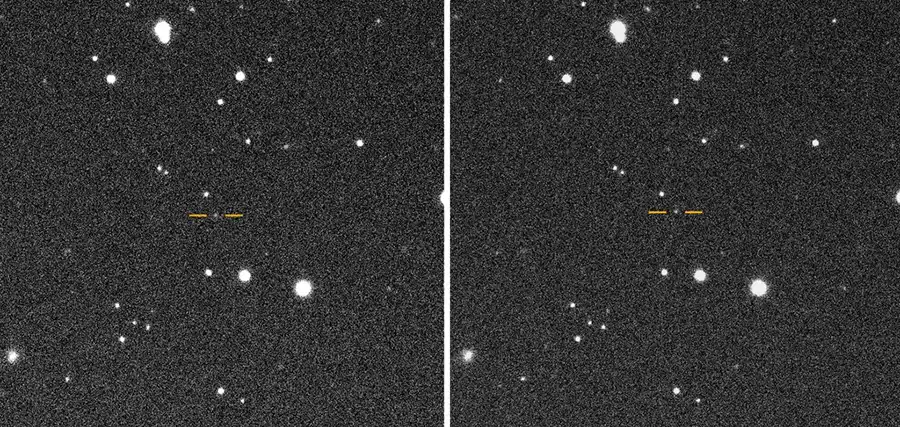
Photographs courtesy of Scott S. Sheppard
Found on September 27th by Scott Sheppard (Carnegie Institution for Science), an asteroid now designated as 2025 SC79 turns out to orbit almost entirely inside the orbit of Venus — only the second asteroid ever found so close to the Sun, after one called 594913 'Ayló'chaxnim.
“It was very exciting to discover 2025 SC79,” Sheppard tells Sky & Telescope. He first observed it using the Cerro Tololo Dark Energy Camera the night before leaving on a hiking trip. Because the object was moving fast, he knew it must be very close to the Sun, so he’d need to image it again and soon to confirm its orbit before it became lost in the Sun’s glare.
“I had to schedule new observations to re-observe the object while deep in the forest of Pennsylvania,” he says. “It is just amazing that even camp sites today have good Wi-Fi access — that allowed me to download the new second observations of this asteroid and determine its unique orbit that is interior to Venus.”
Sheppard adds that asteroids close to the Sun are difficult to observe. “Asteroids that lurk near the Sun can only be observed during twilight, when the Sun is just about to rise or set,” he says. “If these ‘twilight’ asteroids approach Earth, they could pose serious impact hazards.”
While the orbit of 2025 SC79 does not cross Earth’s, gravitational nudges from close approaches to Venus could send it careening into another orbit, where it would be hard to find. “There appears to be many twilight asteroids yet to be found, as we are only scratching the surface,” he says. “We have to keep covering as much sky as possible in twilight, waiting for these near-Sun asteroids to poke their heads out.”
In the Inner Solar system
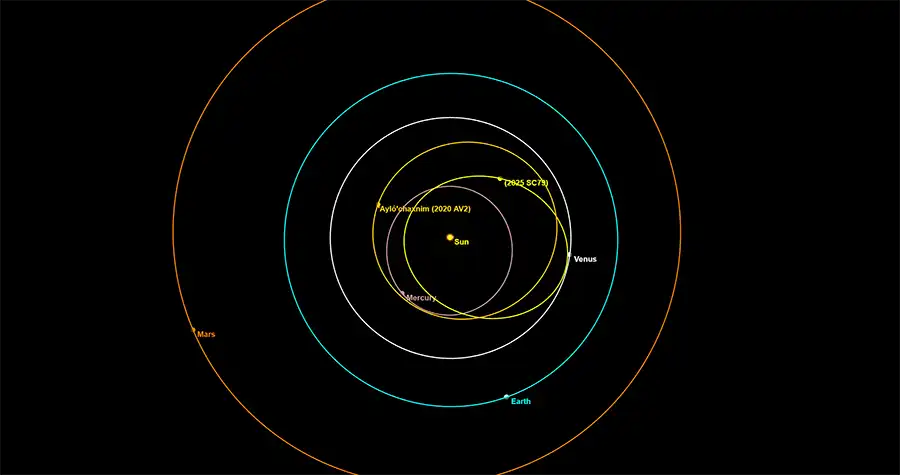
Tony Dunn / Orbit Simulator
“It’s exciting to see another unusual asteroid discovered, especially in difficult-to-reach areas like near the Sun,” says astronomy student K Ly (UCLA), pointing to the object’s exceptional orbit. It has the fourth-fastest orbit of any asteroid taking only 128 days to circle the Sun.
“The number of asteroids inside Venus’ orbit has been somewhat of a mystery, as theoretical predictions suggested that they should be rare and mostly small,” Ly says, “yet the large size of ꞌAylóꞌchaxnim suggests otherwise.”
'Ayló'chaxnim spans 1.7 km, but Sheppard estimates the new object to be only 700 meters across. Finding this new example of an 'Ayló'chaxnim -class object, Ly suggests, “could hopefully give us a better idea of how many asteroids lie close to the Sun, and in turn use that to estimate how many of those will [eventually] become near-Earth asteroids.”
Because of its smaller size, Ly wonders how long the object can last even if not kicked out of its present orbit. So near the Sun, it is more strongly buffeted by the Yarkovsky–O'Keefe–Radzievskii–Paddack (YORP) effect, which combines the effect of the sunlight scattering off the surface with the object's own thermal emission. The YORP effect might tear the rock apart in less than 1 million years, reducing it to dust.
Two other asteroids, known as 2021 PH27 and 2025 GN1, have similar orbital periods that are even shorter than that of 2025 SC79, at 113 days. They are on highly elliptical orbits that take them in much closer to the Sun than Mercury, and out well beyond Venus. Astronomers think they are the remains of an object that split apart about 10,000 years ago. The origins of 2025 SC79 are still unclear.
While the orbit of the newfound asteroid also reaches just inside Mercury’s orbit, its farthest point from the Sun (aphelion) sometimes slightly exceeds Venus’s closest approach to the Sun (perihelion). So it’s not entirely within Venus’s orbit and may one day cross paths with our sister planet.
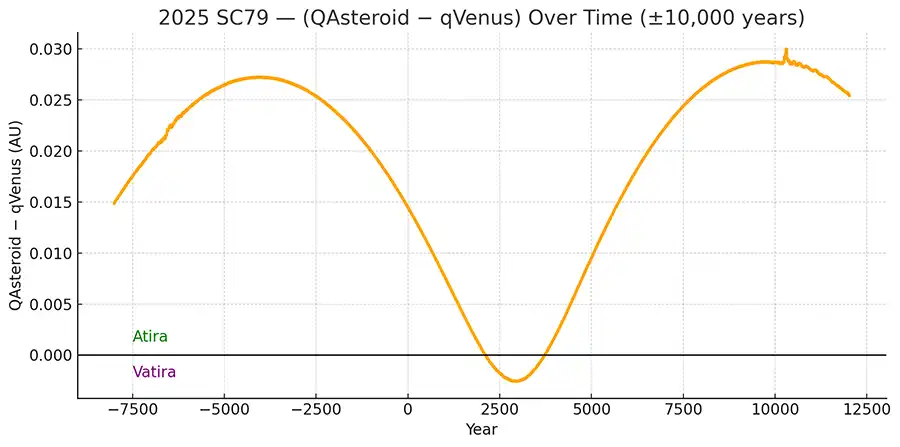
Tony Dunn / Orbit Simulator
Uncertainty remains about the exact orbit of 2025 SC79, but amateur astronomer Tony Dunn says it’s possible that its orbit could go completely interior to that of Venus within a century. Dunn has carried out simulations of the object’s trajectory that take into account gravitational effects, but he cautions that they don’t take sunlight-driven factors, like the YORP effect, into account — and those effects are significant so near the Sun.
Future observations of this object using large telescopes will help astronomers learn where this object came from, what it’s made of, and how it’s surviving in the inner solar system.


Comments
Jose Luis-Alvarellos
October 24, 2025 at 6:36 pm
"...many twilight asteroids..." -> Observationally (from Earth) that's exactly what they are: Twilight Zone asteroids.
You must be logged in to post a comment.
You must be logged in to post a comment.