 SUNSET:

 3
3
Bob King
For the past two weeks, I've been aboard the Hurtigruten ship MS Nordcapp, doing aurora and astronomy presentations for a group of 25 people in the Road Scholar Astronomy Above the Arctic Circle cruise. The boat ferries local people between towns and cities along the Norwegian coast and serves as a floating platform for aurora tourism and other adventures. Passengers sail into the polar regions up where the aurora holds court every night of the year, weather permitting. If you've ever wanted to see the northern lights, a cruise is one way to achieve that dream.
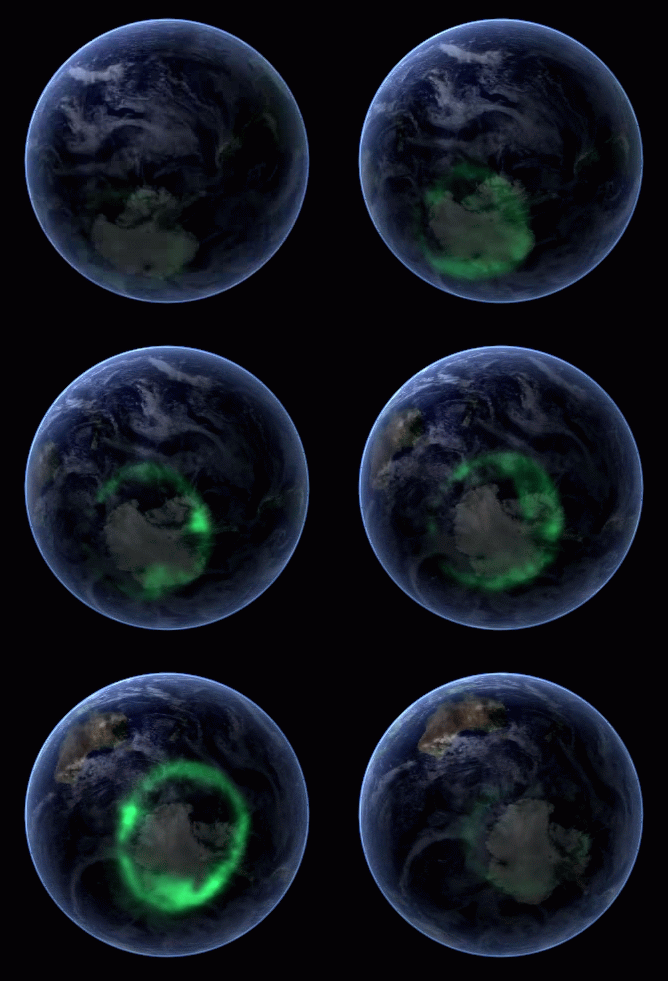
NASA
Northern Norway sits directly under a donut of aurora called the northern auroral oval, a huge ring of glowing aurora centered over Earth's north geomagnetic pole located on Ellesmere Island in Nunavut, Canada. Its counterpart, the southern oval, hovers over the Antarctic. The ovals' lower borders are typically around 100 kilometers (60 miles) high and can reach more than 500 kilometers. These ghostly green wreaths are permanent features of Earth's polar regions.
NOAA
The ovals are always present, even during quiet times when no solar storms ruffle Earth's protective magnetic envelope (called the magnetosphere). Particles trapped within the magnetosphere from previous injections, as well as ions supplied by Earth's ionosphere, continuously supply the material needed to keep the ovals aglow. Both contract into roughly circular rings about 10° of latitude thick that extend from about latitudes 65° to 75° north and south. From a polar-orbiting satellite's point of view, this approximately circular crown of glowing atmospheric gases festoons the northern regions of Siberia, Scandinavia, Greenland, Canada, and Alaska. You can check the current status of either oval at NOAA's 30-Minute Forecast site or in a smartphone app like SpaceWeatherLive.
Bob King
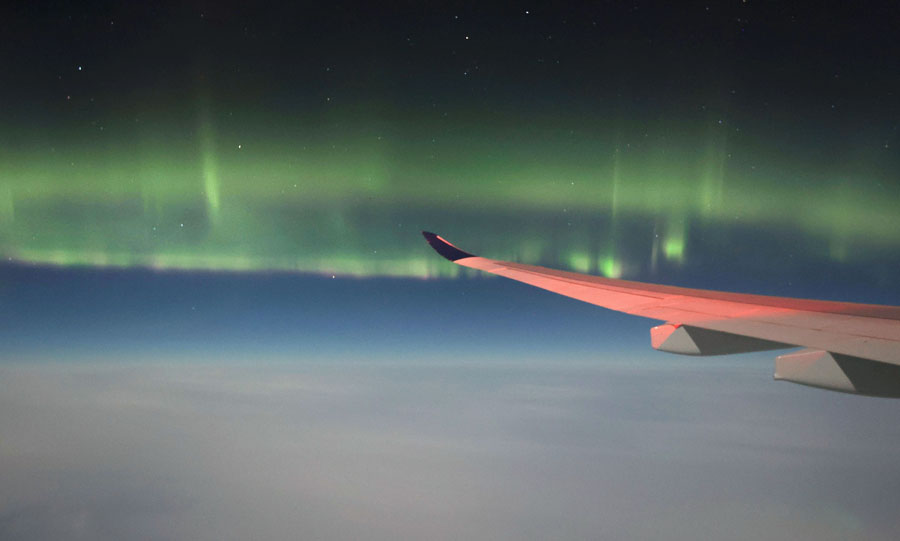
Before the cruise even began, I watched the northern lights dance over the North Atlantic Ocean near Greenland from the window of the airplane. A swirl, an arc, and finally a flurry of bright rays flickered just above the wing as we traveled east and north over the moonlit wilds of Canada's Labrador province en route to Amsterdam. If you're taking a night flight from the U.S. to Europe or Asia, book a window seat on the left side of the plane — chances are good you'll see the lights. Not only are you far above the clouds, but the plane also flies a polar route to take advantage of the curvature of the Earth.
Bob King
Bob King
Our journey began in Bergen, located in the southern part of the country at latitude 60° north, and reached its northernmost point in Honningsvåg at 71° north, some 4.5° above the Arctic Circle. During a tour of the town we learned that the 71.0° line cuts straight through the tomato section of a local supermarket.
In the northern part of the coastal country, the mountains and fjords are blanketed in snow and look as imposing and forbidding as the mountains of Antarctica. But there are no glaciers here and temperatures are almost always mild, at least from a Minnesotan's perspective. Daily highs hover around 1° C (34° F) with lows in the mid-to-upper 20s. Gentle snows were frequent, along with occasional winds. The comparatively mild climate is courtesy of the Gulf Stream, which keeps the coast much warmer than it would be at these high northern latitudes.

Bob King
Despite having seen hundreds of auroras from the Duluth, Minnesota, area over the past 45 years, I had never witnessed a full-blown polar aurora, a display visible specifically from Arctic or Antarctic regions that are positioned directly under the oval. During solar storms and other Sun-related events, the ovals thicken, brightening and expanding equatorward. Observers in the northern half of the U.S. (and sometimes farther south) then have an opportunity to view the aurora. Rarely does the oval sit directly over U.S. locations, so we most often see it from the side — the reason many of our displays spread horizontally across the northern sky. Arcs and rays are common in the mid-latitudes.
Bob King
Bob King
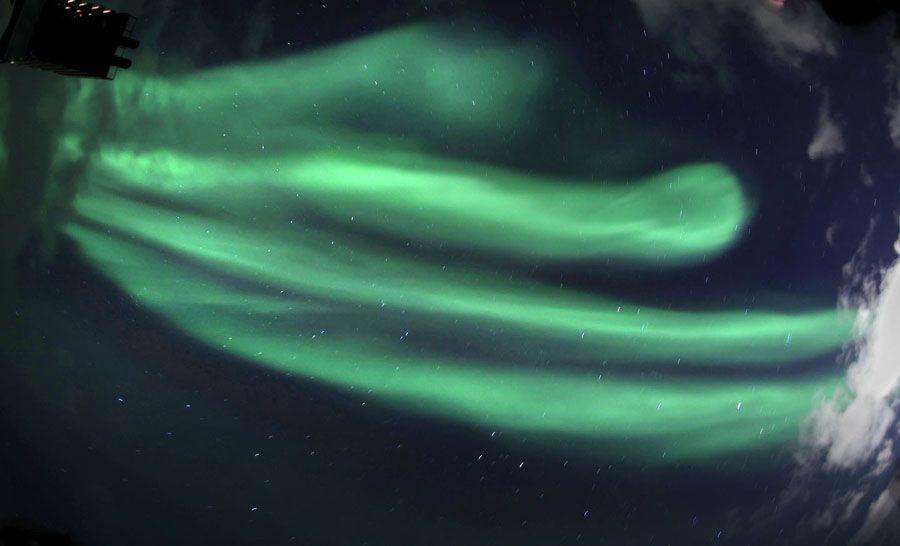
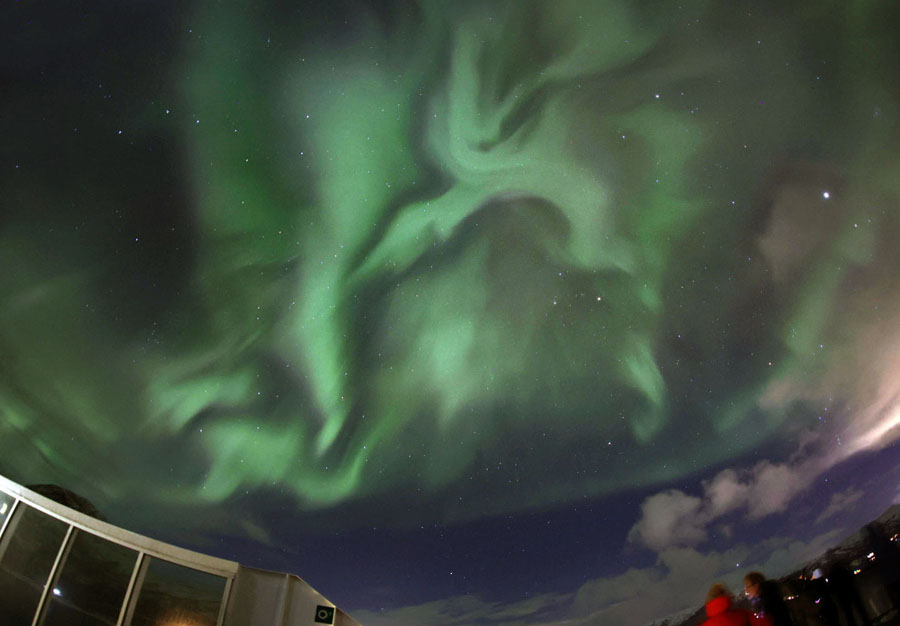
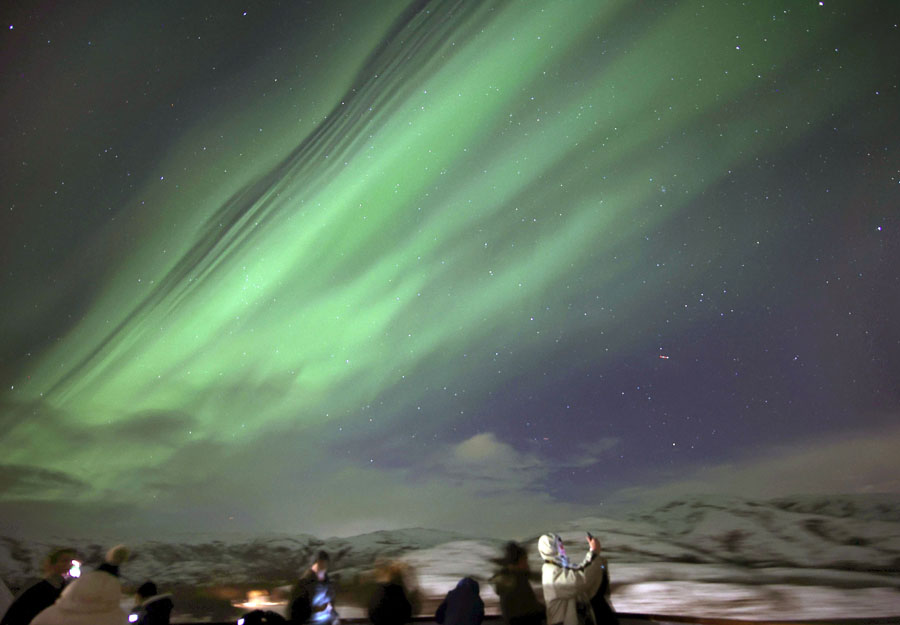
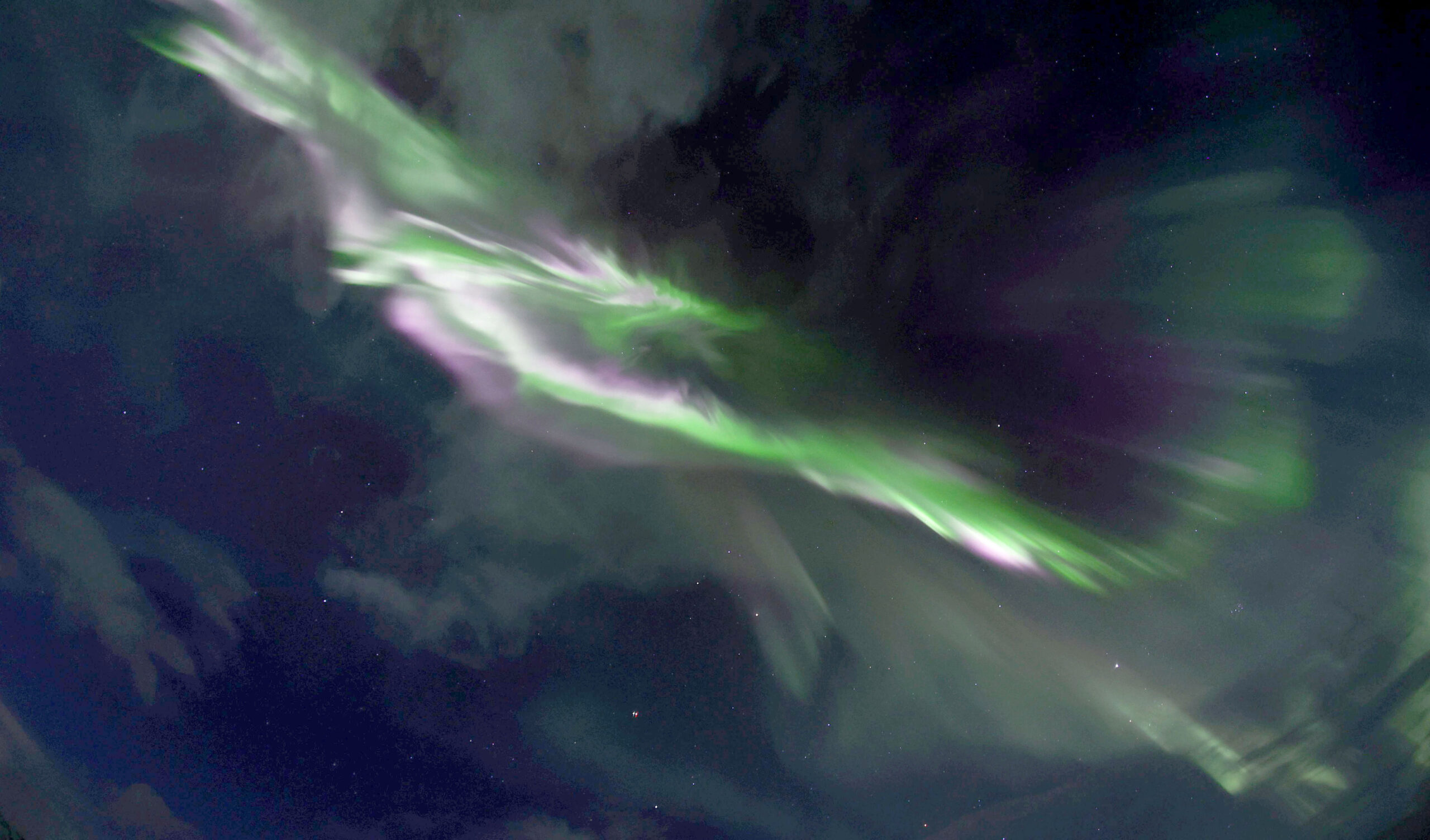
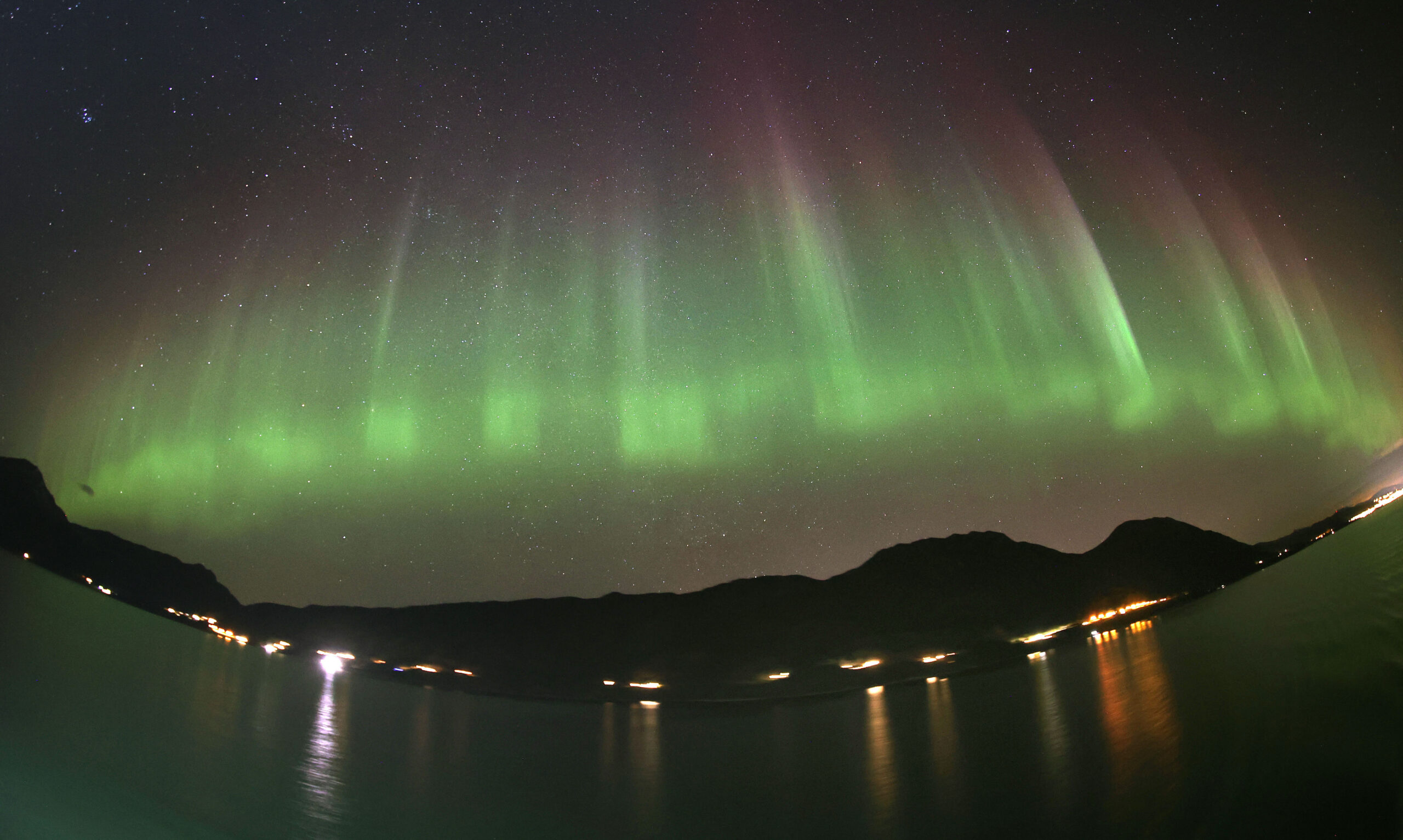
From under the oval, one looks straight up into the aurora. Viewed from the bottom up, it looks like big, green whirlpools or gigantic fingers of light extending from one end of the sky to the other. The sky-topping, amoeba-like whorls, multiple curtains, stripes, and swirls change rapidly. At times, the heavens seethed with aurora, which quickly faded away only to return in full force minutes later. Here's what I learned during the nine auroral displays we were fortunate enough to witness during our time at sea: Never turn your back on the aurora! It always has more tricks up its sleeve. Getting to bed was one of the trip's greatest challenges.

Bob King
Bob King
The grandest display occurred on the night of February 17th. We experienced a minor geomagnetic storm that would have produced a modest aurora for the northern fringe of the U.S. Near the pole, the sky raged. At one point, a gigantic, boomerang-shape arc shimmered from bottom to top with brilliant green and pink rays. Everyone on deck screamed uncontrollably with joy and amazement. Toward the end of the cosmic conflagration, a brilliant bubble of light bulged from the arc. For the next five seconds, this patch broke up into a frothy foam of tiny auroral substructures that seethed furiously like a pot of boiling water. I've never seen anything like it in my life.
The majesty of nature manifests itself in countless big and small ways. In our daily hurry, it's sometimes easy to miss the small ones. Not the aurora. It knocks you right in the head, making it impossible to walk away untouched.
Bob King is the author of Magnificent Aurora: Your Complete Guide to Nature's Greatest Light Show. Find it on ShopatSky.com.
About Bob King
I love the sky (day and night) and have been a skywatcher and amateur astronomer since childhood. I'm also a long-time member of the American Association of Variable Star Observers (AAVSO) and Astronomical League. I pen the Astro Bob blog and have written four books: Night Sky with the Naked Eye (2016); Wonders of the Night Sky You Must See Before You Die (2018) and Urban Legends from Space (2019) and Magnificent Aurora, published in 2024. The universe invites us on an adventure every single night. To accept the invitation, we only need look up.



Comments
Alexander Vasenin
March 2, 2025 at 12:34 am
What a great story! I hope to go to this kind of adventure one day.
You must be logged in to post a comment.
Bob KingPost Author
March 2, 2025 at 11:44 pm
Thanks, Alexander! I hope you have the opportunity. It's worth it in so many ways — cultural experience, aurora, making friends and excellent local foods.
You must be logged in to post a comment.
cperalta1960
March 12, 2025 at 2:33 pm
I was a passenger on the Hurtigruten's MS Nordkapp ship. My friends and I boarded in Tromso and ended in Bergen. I just want to say "thank you" to astronomer, Bob. Although, we were not part of his group. We got the benefit of hearing his explanations on the stern of the ship and share the beauty of watching these beautiful Northern Lights. Thank you again from your California friends.
You must be logged in to post a comment.
You must be logged in to post a comment.