 SUNSET:

 12
12A newly-discovered nova in Lupus is on the rise and approaching naked-eye visibility. Here’s how to see it.

Piqui Diaz
(Story updated with the latest AAVSO chart and a new link for brightness updates — June 21, 2025)
Exciting news! On June 12th (June 12.9 UT), the All-Sky Automated Survey for Supernovae (ASAS-SN) discovered a new 8.7-magnitude stellar object in Lupus. Not long after, Yusuke Tampo, with the South African Astronomical Observatory (University of Cape Town), obtained a spectrum of the "new star" and identified it as a classical nova based on its spectral features and dramatic increase in brightness.
The nova went through a slew of temporary names — AT 2025nlr, ASASSN-25cm, and N Lup 2025 — until receiving its official designation V462 Lupi on June 16th. Since discovery, the nova has brightened rapidly. As of 2 p.m. Eastern Time June 21st, it's at magnitude 5.6, and visible without optical aid from a dark-sky location. Its rise has been phenomenal when you consider that prior to the explosion, the progenitor star was approximately magnitude 22.3 (in the blue band) according to American Association for Variable Stars (AAVSO) observer Sebastián Otero, who dug up an older image from a photographic plate.

The new nova in Lupus is near a trio of naked-eye stars — Delta (δ) Beta (β) Lupi and Kappa (κ) Centauri. I've circled them here and on the more detailed AAVSO chart below.
Stellarium with additions by Bob King
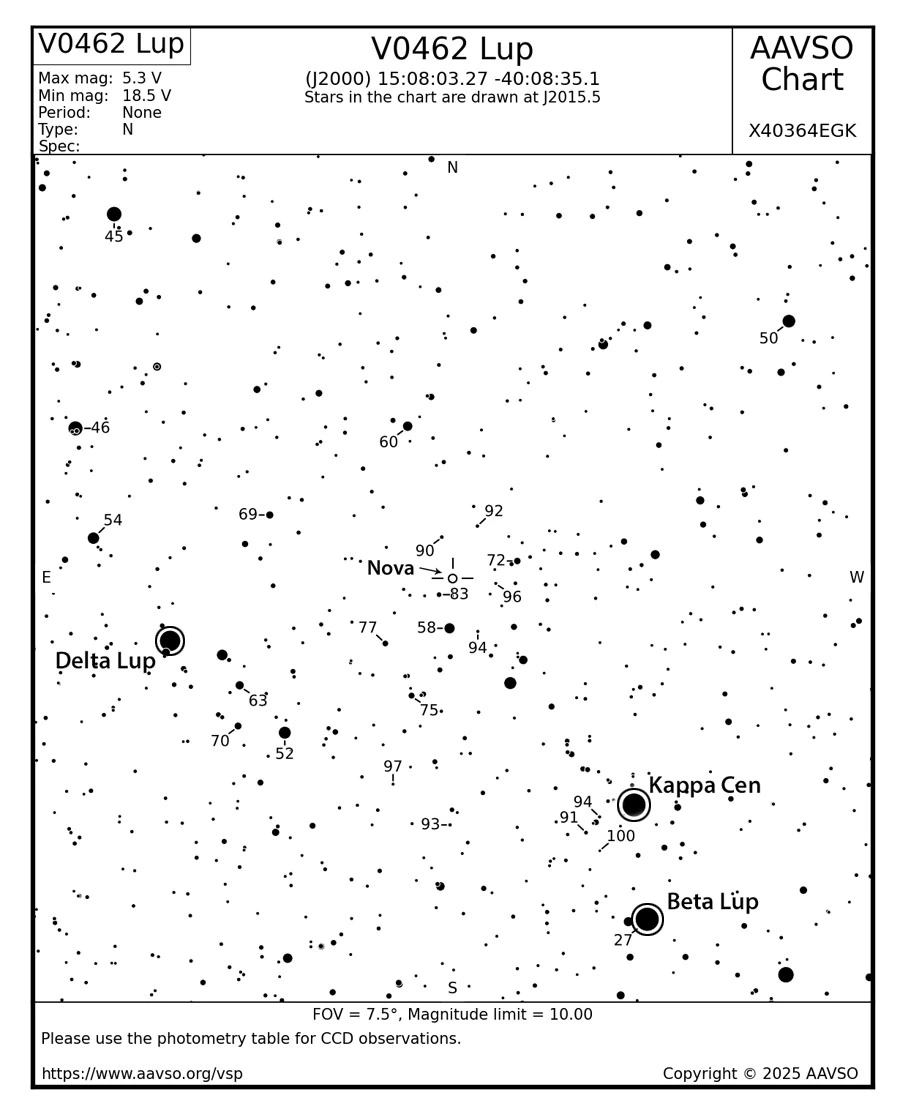
Courtesy of the AAVSO with additions by Bob King
Despite a southerly declination of –40°, the nova is bright enough to observe even in the northern United States. For instance, at my latitude 0f 47°N, the nova stands 3° above the horizon at meridian crossing. While that may sound hopeless, V462 Lupi will still shine around magnitude 9 after factoring in 2.5-magnitudes for extinction due to thick air in the horizon direction. Give me an unobstructed horizon, and I'll be ready to spring into action.

ESO / M. Kornmesser

Stellarium
If you're observing from a latitude around 40°N, the newcomer climbs to a comfortable 10° at meridian crossing, which occurs around 10:30 p.m. local time. From Tucson it reaches 18° altitude. You've got this! Nova explosions reaching 6th magnitude or brighter are uncommon, so treat yourself to a look the next clear night. The basic Stellarium map provided here should get you there. Then you can use the American Association of Variable Star Observers (AAVSO) map to pinpoint the nova's position and estimate its changing brightness in the nights ahead.
To keep up on its changing brightness, use the AAVSO Search engine. Type the name V462 Lup into the Target box, hit enter and scroll up for the latest brightness estimates. You can also make additional charts as well as create a light curve for the nova at the site at the AAVSO landing page. Scroll up to the Pick a Star box, type in V462 Lup and select Create a finder chart.
Happy hunting!
About Bob King
I love the sky (day and night) and have been a skywatcher and amateur astronomer since childhood. I'm also a long-time member of the American Association of Variable Star Observers (AAVSO) and Astronomical League. I pen the Astro Bob blog and have written four books: Night Sky with the Naked Eye (2016); Wonders of the Night Sky You Must See Before You Die (2018) and Urban Legends from Space (2019) and Magnificent Aurora, published in 2024. The universe invites us on an adventure every single night. To accept the invitation, we only need look up.


Comments
Anthony Barreiro
June 17, 2025 at 3:45 am
Thank you Bob. I'm glad I happened to see this article right after you posted it. I went up Bernal Hill this evening to show passersby the conjunction of Mars and Regulus in my little spotting scope. Clear weather. I was able to see the nova through 10x42 binoculars. The little triangle of fifth and sixth magnitude stars just below the nova was an easy landmark. The nova was brighter than the 6.4 magnitude star and fainter than the 5.8 magnitude star.
You must be logged in to post a comment.
Bob KingPost Author
June 17, 2025 at 5:09 pm
Hi Anthony,
That IS a good landmark. Glad you were able to see the nova. Here the smoke is just thin enough I should be able to spot it over Lake Superior, where I have a pretty good southern horizon. I'm looking forward to this evening.
You must be logged in to post a comment.
John
June 18, 2025 at 2:28 am
Wow. So there's a huge difference between the 15-degree field of the AAVSO chart and the 1-degree field of my scope and camera! Below is a link to tonight's image. I had to push the nova way up to the top of the frame so that I could barely squeeze in your triangle.
https://blogger.googleusercontent.com/img/b/R29vZ2xl/AVvXsEgEFQDSpVGDj2NQ5DjdIsDjnrzpMoP5cwRtRjR86bcBOT2ctjDdPivZHUX7L8wjfJS4hHMGxB9PUanDzmvpzWckbH9PAr76GyA0faXOom4NczGz0F5pt4xNrNXUCu_f7-x3zGSOgtf2EcMSuvd3ZEVTA95M05JDZhlawymTbNF7ZzQaSsEHLc9S_hvmP2Gx/s2749/Nova_Lupi_2025_with_HR_Lup_2025Jun17_Atik_14x15sec.jpg
You must be logged in to post a comment.
Bob KingPost Author
June 18, 2025 at 11:38 am
Hi John,
Indeed there is! I had to go with the wider AAVSO chart in order to include sufficiently bright comparison stars for observers to estimate the nova's brightness.
I included the binocular map to show the sky at a more familiar scale. Great photo by the way!
You must be logged in to post a comment.
John
June 18, 2025 at 2:31 am
Here's a zoomed in comparison with the same starfield in Aladin.
https://blogger.googleusercontent.com/img/b/R29vZ2xl/AVvXsEiu6kbD1KkaSvRbilPQ05iY8LBVJcg8pFQupPk8tqfTp-D4wSKDyFpy9knivkB2ua81eanxpEIgF0Mzttk8Sv3FfwpJGe1Vf1d6Fen-ZNPCXwPe1UknB275N_O3EEC8biWMS4GL_URdKrSZjDqOnGrZMi46IMSTsYqxUDfF1J1_Wv-zJp0EJ7zKldTvRe2X/s1006/Nova_Lupi_2025_2025Jun17.jpg
You must be logged in to post a comment.
Anthony Barreiro
June 18, 2025 at 6:01 pm
Around 10:30 pm PDT last night, June 17, the nova looked about as bright as magnitude 5.8 HR Lupi. Seeing it brighten so obviously from one night to the next was exciting.
Is there an estimate of the nova's distance?
You must be logged in to post a comment.
Bob KingPost Author
June 18, 2025 at 9:18 pm
Anthony,
Good question. I've not heard of one yet but will share it when I heard. It's likely to come up in an AAVSO discussion group.
You must be logged in to post a comment.
OwlEye
June 19, 2025 at 12:32 am
Hi Bob,
Thank you for posting this article in such a timely fashion! This evening, after a day of rain and thunderstorms, our sky here in northeastern Kansas began to clear at sunset, and by deep blue twilight I was able to spot the nova with a 7 X 50 binocular as lightning from the storms to our east flashed the field of view. Using both this binocular and a 6-inch reflector, I estimated the magnitude as 5.5, using the mag 5.3 star HD 133340 Lupi as a comparison star. The sky was surprisingly transparent so low in my southern sky, enabling me to see the nova and all the surrounding stars quite clearly!
What a beautifully surreal evening, especially in light of the fact that I thought I had little or no chance of seeing this "guest" star at all!!
Regards,
Doug Z
You must be logged in to post a comment.
Markhl
June 22, 2025 at 1:49 am
I saw the nova from Irvine, CA at about 34 degrees N. Near 10 pm when it had just crossed the meridian and was about 17 degrees high.
In a heavily light-polluted sky! Limiting magnitude about 2 or 3. Could not see it or the field stars with the naked eye. In 7x35 binoculars I could only see down to about mag 4.
The nova was clearly visible on a photo taken with the native Camera app on an iPhone 15 Pro Max at 2X zoom! The phone was handheld and not on a tripod. I used the Night mode of the Camera app to take a 10-second exposure. Nova was about mag 5.8. Go out there and give it a try
You must be logged in to post a comment.
hamishbarker
June 22, 2025 at 7:11 am
I just observed it (11:00UTC) from Nelson NZ, 41 deg south. It's almost at the zenith. In terms of brightness, it seemed midway between HR Lup (the mag 5.8 variable at the head of the narrow triangle) and HR5607 (one of the two at the base of the narrow triangle).
Tried to take a spectrum last night but as soon as I was set up, clouds and brief rain shower moved over my location.
You must be logged in to post a comment.
hamishbarker
June 22, 2025 at 7:12 am
forgot to say, that was observing with 12x36 IS canon stabilized binos, from a lawn lounger (essential due to the zenith position).
You must be logged in to post a comment.
Bob KingPost Author
June 22, 2025 at 1:11 pm
Hamish,
I'm so jealous! Viewing V462 Lup at the zenith on a lawn lounger? It doesn't get better. Thanks for sharing your observation.
You must be logged in to post a comment.
You must be logged in to post a comment.