 SUNSET:

 6
6
FRIDAY, APRIL 25
■ This is the time of year when, as the last of twilight fades away, the dim Little Dipper extends to the right from Polaris and slightly up. High above the Little Dipper's bowl, you'll find the Big Dipper's bowl.
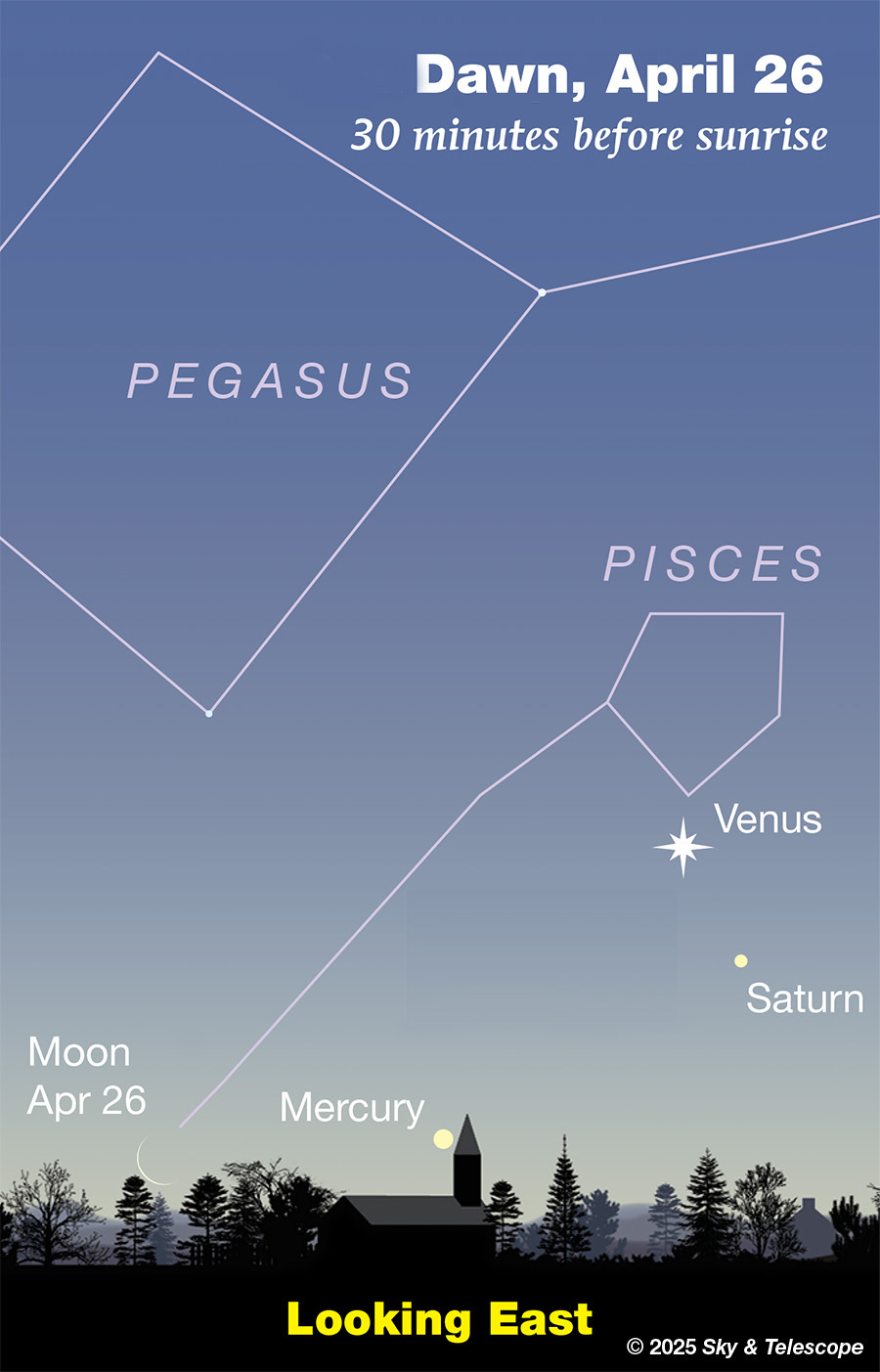
■ Venus shines low in the brightening dawn this week, guiding the way toward much fainter Saturn and Mercury. See the illustrations under "This Week's Planets Roundup" below.
SATURDAY, APRIL 26
■ As night descends, look high in the west for Pollux and Castor, the heads of the Gemini twins, lined up almost horizontally (depending on your latitude). Mars glows off to their left or upper left.
Pollux and Castor form the top of the enormous Arch of Spring. To their lower left spot Procyon, the left end of the Arch. Farther to their lower right is the other end, formed by Menkalinan (Beta Aurigae) and then brilliant Capella. The whole thing sinks in the west through the evening.
SUNDAY, APRIL 27
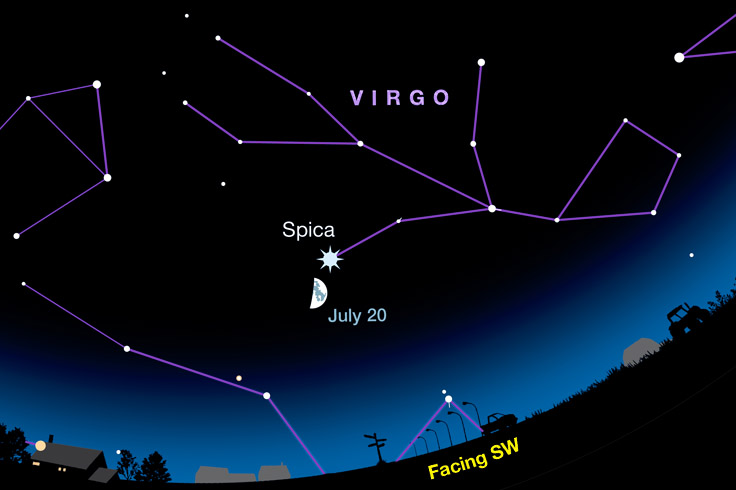
■ Arcturus is the brightest star high in the east these evenings. Spica shines lower right of it by about three fists at arm's length. To the right of Spica by half that distance is the distinctive four-star constellation Corvus, the springtime Crow.
■ Vega, the Summer Star, the zero-magnitude equal of Arcturus, now twinkles low in the northeast at nightfall. . . depending on your latitude. The farther north you are the higher Vega will be. If you're in the latitudes of the southern US, you may have to wait a bit later for it to appear.
■ New Moon (exact at 3:31 p.m. EDT).
MONDAY, APRIL 28
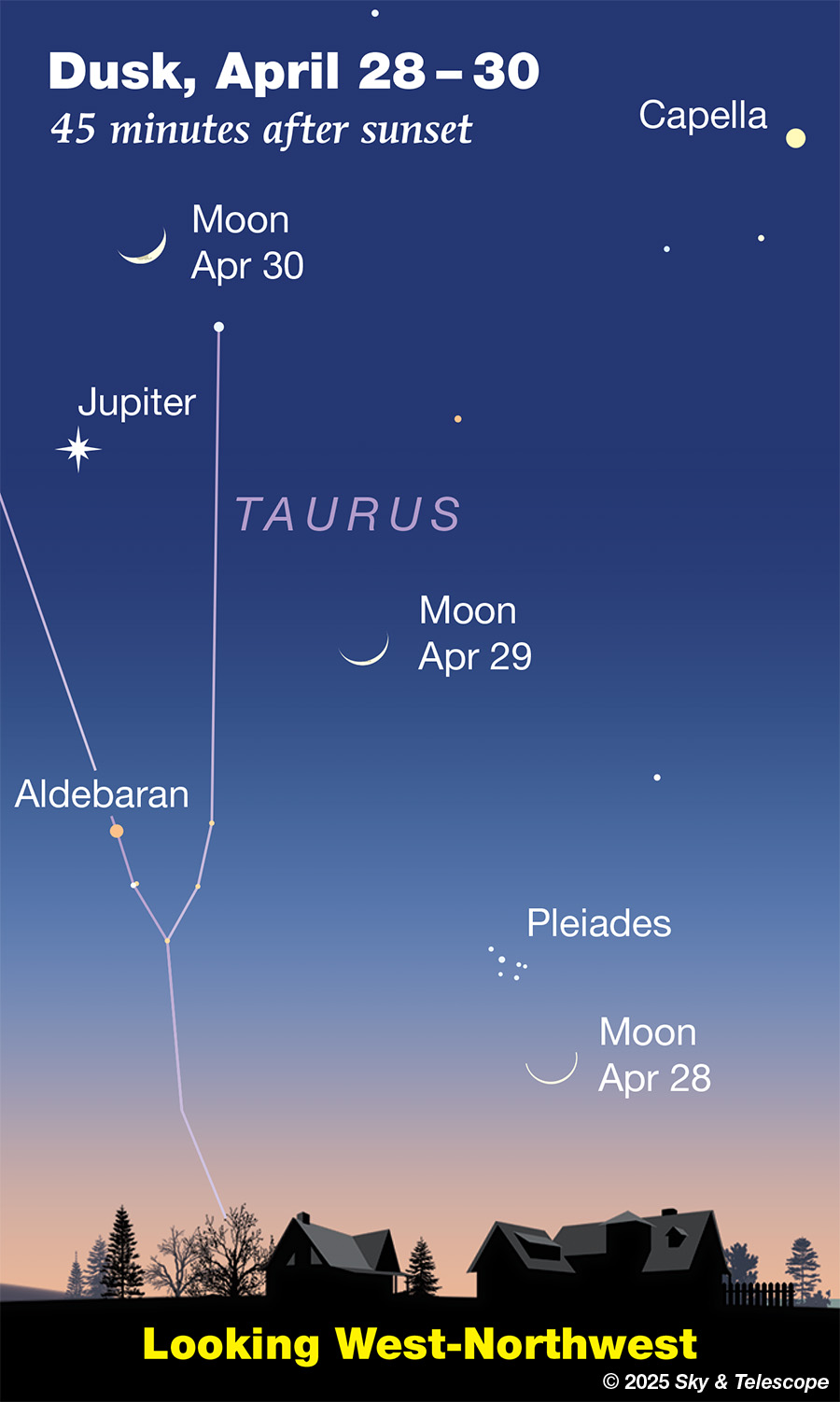
■ In early twilight, watch for the very thin crescent Moon, a mere 1¼ days old, to become visible a little above the west-northwest horizon as shown below. Binoculars help! And can even binoculars show the faint Pleiades above it though the twilight glow?
TUESDAY, APRIL 29
■ Now the Moon in the western dusk forms a not-quite-equilateral triangle with Jupiter and Aldebaran, as shown above.
■ Bright Arcturus climbs high in the east these evenings. Equally bright Capella is descending high in the northwest. Late twilight is when they stand at exactly the same height above your horizon.
WEDNESDAY, APRIL 30
■ The Moon shines over Jupiter, as shown above. These are the two brightest things in the evening sky; Jupiter, even as far away from us as it is now, is nearly twice as bright as Sirius. Jupiter sets around 11 p.m., and the Moon sets about 50 minutes after it (for North America).
■ These spring evenings, the long, dim sea serpent Hydra snakes almost level far across the southern sky. Find his head, a rather dim asterism about the size of your thumbprint at arm's length, in the southwest. It's almost halfway from Procyon to Regulus. Left or lower left of Hydra's head, by about a fist and a half, is 2nd-magnitude orange Alphard, Hydra's lonely heart.
Hydra's dim, irregular body and tail stretch from there all the way to Libra rising in the southeast. He carries Crater and Corvus on his back.
Hydra's star pattern, from forehead to tail-tip, is 95° long. That's more than a quarter of the way around the celestial sphere. No other constellation does that. Even the star pattern of the river Eridanus is only 66° from end to end.
THURSDAY, MAY 1
■ The thickening crescent Moon of May Day shines under Castor and Pollux, as shown below.

■ High above the Big Dipper, nearly crossing the zenith, are three pairs of dim naked-eye stars, all 3rd or 4th magnitude, marking the Great Bear's feet. They're also known as the Three Springs (or Leaps) of the Gazelle, from early Arab lore. They form an east-west line that lies roughly midway between the Bowl of the Big Dipper and the Sickle of Leo. The line is 30° (three fists) long. See the evening constellation chart in the center of the April or May Sky & Telescope.
According to the ancient Arabian story, the gazelle was drinking at a pond — the big, dim Coma Berenices star cluster — and bounded away when startled by a flick of Leo's nearby tail, Denebola. Leo, however, seems quite unaware; he's facing the other way.
Another version of the story sees Coma Berenices as Leo's fluffy tailtip, and the pond as formed by stars in Ursa Major.
FRIDAY, MAY 2
■ Look for the Moon forming a gently curving line with Pollux and Castor this evening, as shown above. Mars looks on from their upper left.
■ Although it's May now, wintry Sirius still twinkles very low in the west-southwest at the end of twilight. It sets soon after. How much longer into the spring can you keep Sirius in view? In other words, what will be its date of "heliacal setting" as seen by you?
■ Meanwhile summer is seven weeks away, but the Summer Triangle is beginning to make its appearance in the east, one star after another. The first in view is Vega. It stands out brightly low in the northeast after nightfall.
Next up is Deneb, lower left of Vega by two or three fists at arm's length. Deneb takes about an hour to appear after Vega does, depending on your latitude.
The third is Altair, which shows up far to Vega's lower right by about 11 p.m.
SATURDAY, MAY 3
■ Now the waxing Moon shines next to Mars. They're only couple degrees apart. Meanwhile, Mars is less than 1° to the right of the Beehive star cluster, as binoculars or a telescope at low power will reveal.
SUNDAY, MAY 4
■ First-quarter Moon (exact at 9:52 a.m. Eastern Daylight Time). By evening for North America the Moon's terminator will be showing a slight bit of convexity.
After dark the Moon will be under the Sickle of Leo, with Regulus to its left or upper left and Mars (similar to Regulus in brightness but different in color) farther to the Moon's lower right.
■ And Mars skims across the northern edge of the Beehive cluster this evening and tomorrow evening.
This Week's Planet Roundup
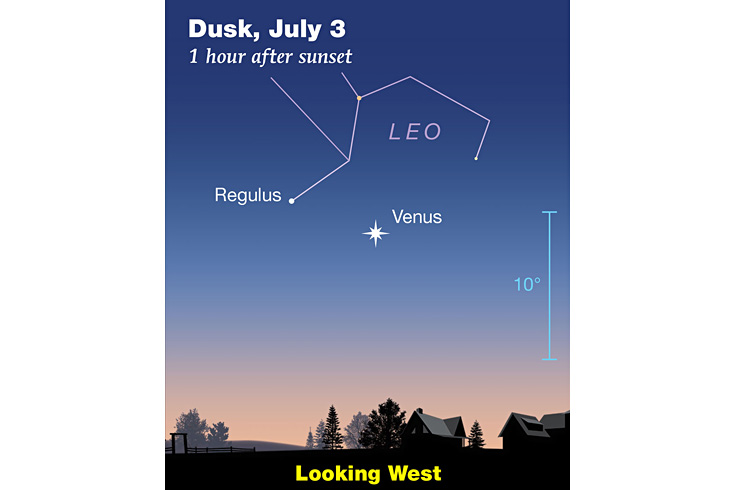
Mercury and Saturn are barely detectable very deep in the glow of sunrise. But a bright marker, Venus, shows the way. On the morning of April 26th find Saturn and Mercury positioned under Venus as shown below. Saturn on that date is 5½° from Venus and magnitude +1.2, while Mercury is 9° from Venus and mag +0.3. Bring binoculars. Good luck. And know that a fourth planet, Neptune, lurks invisibly faint behind them.
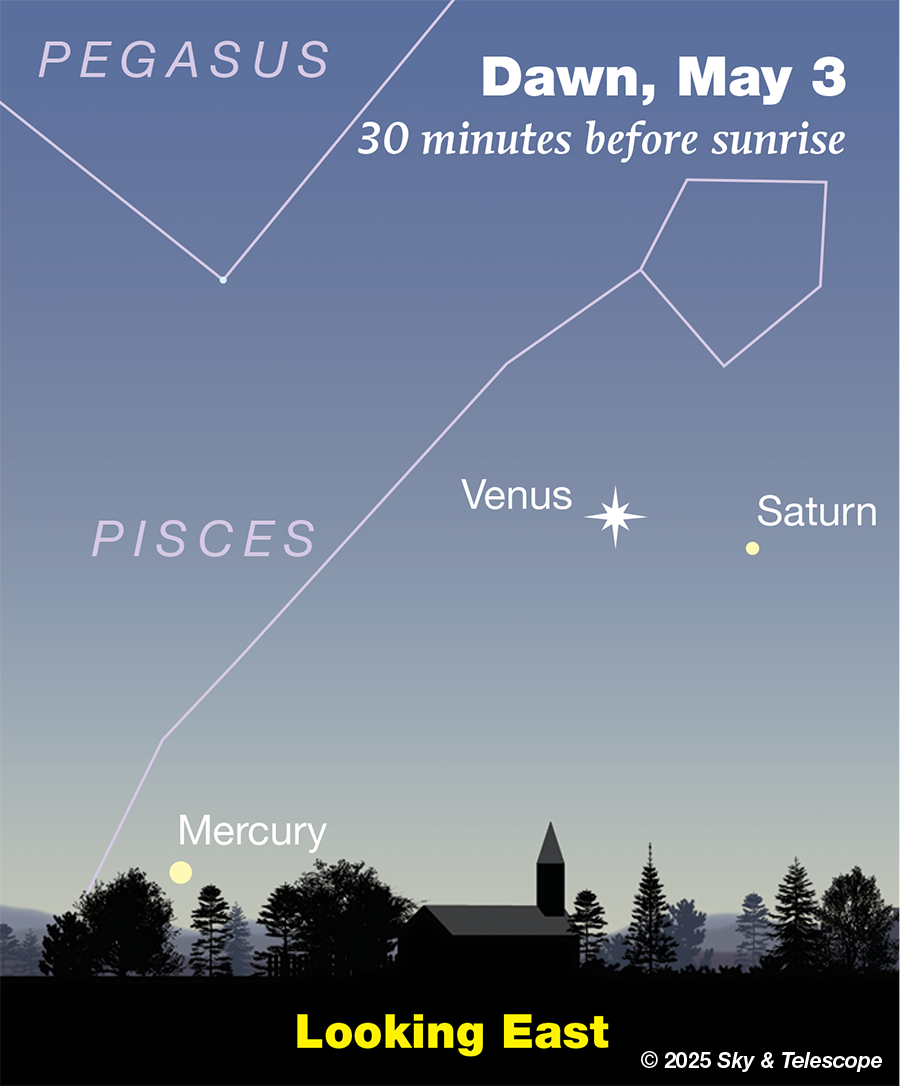
On subsequent mornings Venus stays at nearly the same height and brightness, Saturn creeps toward the upper right, and Mercury moves left while brightening a bit to reach magnitude 0.0 on the morning of May 3rd, shown below.
Venus itself, magnitude –4.7, rises at the very beginning of dawn. For skywatchers at mid-northern latitudes, Venus will continue to rise right at the start of dawn through the end of May.
In a telescope Venus is a shrinking, thickening crescent, currently about 28% sunlit. It will fill out to become half lit around the end of May. How far into broad daylight can you follow Venus with your scope?
Mars (magnitude +0.9, in Cancer) glows high in the southwest in the evening, left or upper left of Pollux and Castor (magnitudes +1.1 and +1.6, respectively). Mars continues to pull a farther away from them.
For telescope users Mars has shrunk to only 6½ arcseconds in diameter, hardly more than a fuzzy blob. At least you can see that Mars is gibbous, 90% sunlit.

Jupiter (magnitude –2.0, in Taurus) shines bright white in the west in early evening, 44° lower right of Mars along the ecliptic. Jupiter continues to form a shrinking triangle with Taurus's two horntip stars, Beta and fainter Zeta Tauri. The triangle will turn into a straight line on May 15th.
Jupiter sets in the west-northwest around 11 p.m. daylight-saving time.
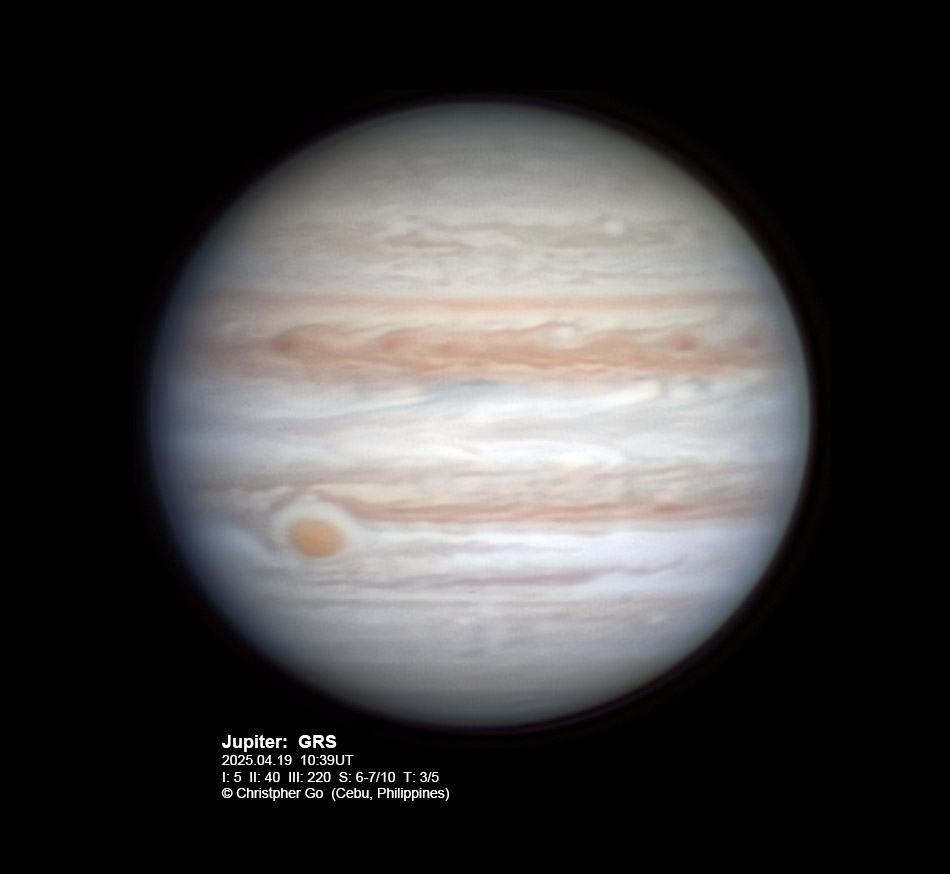
In a telescope Jupiter has shrunk to only 34 arcseconds wide, about as small as it gets. For the daily doings of its Galilean moons see the April or May Sky & Telescope, page 51.
Uranus is lost in the sunset.
Neptune, 8th magnitude, is hidden in the glare of dawn in the background of Venus and Saturn.
All descriptions that relate to your horizon — including the words up, down, right, and left — are written for the world's mid-northern latitudes. Descriptions and graphics that also depend on longitude (mainly Moon positions) are for North America.
Eastern Daylight Time (EDT) is Universal Time minus 4 hours. UT is also known as UTC, GMT, or Z time.
Want to become a better astronomer? Learn your way around the constellations. They're the key to locating everything fainter and deeper to hunt with binoculars or a telescope.
This is an outdoor nature hobby. For a more detailed constellation guide covering the whole evening sky, use the big monthly map in the center of each issue of Sky & Telescope, the essential magazine of astronomy.
For the attitude every new amateur astronomer needs, read Jennifer Willis's Modest Expectations Give Rise to Delight.
Once you get a telescope, to put it to good use you'll need a much more detailed, large-scale sky atlas (set of charts). The basic standard is the Pocket Sky Atlas, in either the original or Jumbo Edition. Both show all 30,000 stars to magnitude 7.6, and 1,500 deep-sky targets — star clusters, nebulae, and galaxies — to search out among them.
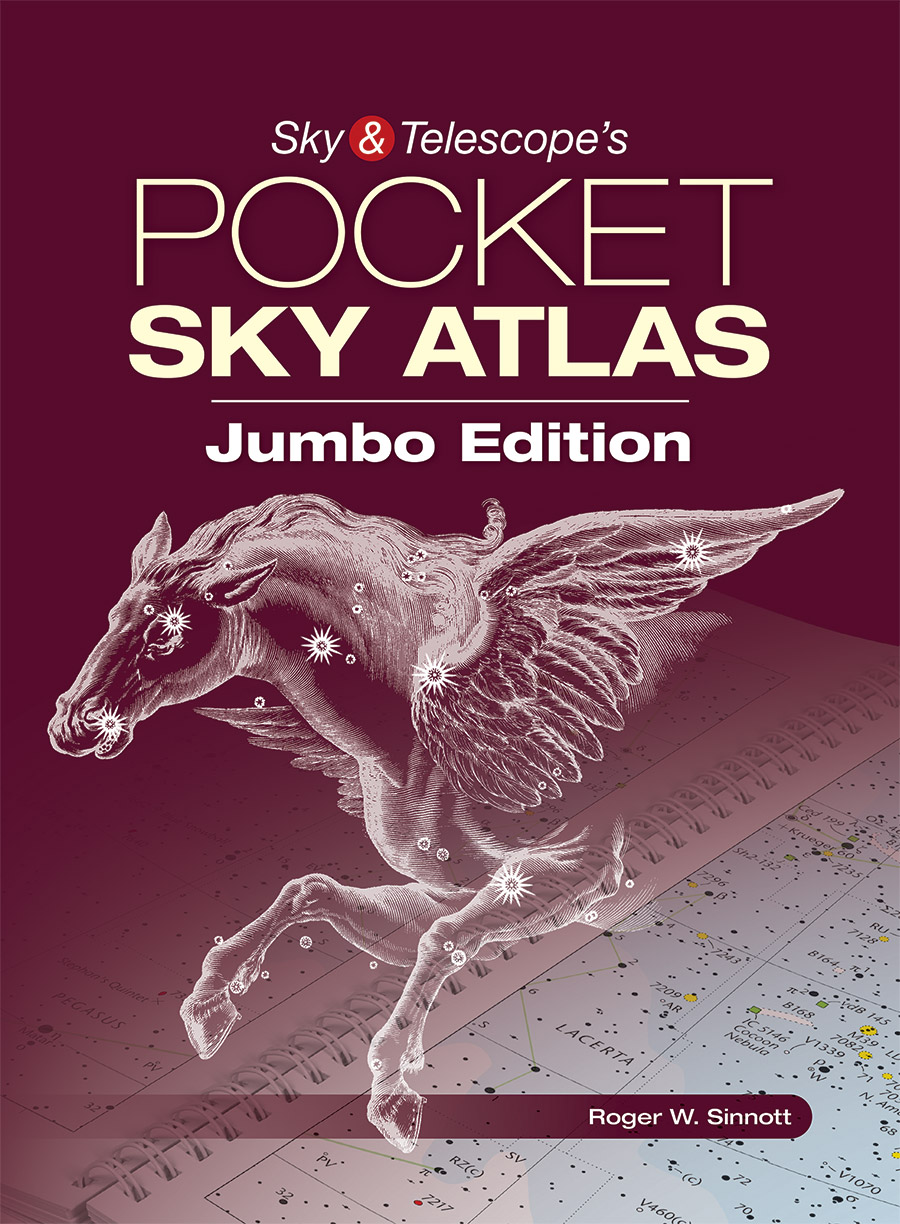
Next up is the larger and deeper Sky Atlas 2000.0, plotting stars to magnitude 8.5; nearly three times as many, as well as many more deep-sky objects. It's currently out of print, but maybe you can find one used.
The next up, once you know your way around well, are the even larger Interstellarum atlas (with 201,000+ stars to magnitude 9.5, and 14,000 deep-sky objects selected to be detectable by eye in large amateur telescopes), and Uranometria 2000.0 (332,000 stars to mag 9.75, and 10,300 deep-sky objects). And read How to Use a Star Chart with a Telescope. It applies just as much to charts on your phone or tablet as to charts on paper.
You'll also want a good deep-sky guidebook. A beloved old classic is the three-volume Burnham's Celestial Handbook. An impressive more modern one is the big Night Sky Observer's Guide set (2+ volumes) by Kepple and Sanner. The pinnacle for total astro-geeks is the new Annals of the Deep Sky series, currently at 11 volumes as it works its way forward through the constellations alphabetically. So far it's up to H.
Can computerized telescopes replace charts? Not for beginners I don't think, and not for scopes on mounts and tripods that are less than top-quality mechanically. Unless, that is, you prefer spending your time getting finicky technology to work rather than learning how to explore the sky. As Terence Dickinson and Alan Dyer say in their Backyard Astronomer's Guide, "A full appreciation of the universe cannot come without developing the skills to find things in the sky and understanding how the sky works. This knowledge comes only by spending time under the stars with star maps in hand and a curious mind." Without these, "the sky never becomes a friendly place."
If you do get a computerized scope, make sure that its drives can be disengaged so you can swing it around and point it readily by hand when you want to, rather than only slowly by the electric motors (which eat batteries).
However, finding faint telescopic objects the old-fashioned way with charts isn't simple either. Do learn the essential tricks at How to Use a Star Chart with a Telescope.
 Audio sky tour. Out under the evening sky with your
earbuds in place, listen to Kelly Beatty's monthly
podcast tour of the naked-eye heavens above. It's free.
"The dangers of not thinking clearly are much greater now than ever before. It's not that there's something new in our way of thinking, it's that credulous and confused thinking can be much more lethal in ways it was never before."
— Carl Sagan, 1996
"Facts are stubborn things; and whatever may be our wishes, our inclinations, or the dictates of our passion, they cannot alter the state of facts and evidence."
— John Adams, 1770
About Alan MacRobert
Alan M. MacRobert became an avid Sky & Telescope subscriber in 1966 at age 14, joined the editorial staff in 1982, and is now a senior contributing editor, semi-retired. He played a role in practically every part of the magazine and the company's other products for more than a generation, both on the amateur-observing side and the science-reporting side. In 1994 a book collection of his observing how-tos and telescopic sky tours was published as Star Hopping for Backyard Astronomers. He has produced This Week's Sky at a Glance online every week since 1989.


Comments
misha17
April 30, 2025 at 7:48 pm
May 1st, or "May Day" was formerly "Beltaine", one the "quarter days" of pagan Europe. It marks the approximate half-way point between the Vernal Equinox and the Summer Solstice.*
As with the other "quarter days", the Catholic Church appropriated it as a holy day to purge it of its pagan roots. It became the Feast of St Walp⁷urga; according to Wikipedia, "Saint Walpurga was hailed by the Christians of Germany for battling 'pest, rabies, and whooping cough, as well as against witchcraft'".
"Walpurga's Eve" or "Walpurgis Night", the night before her feast day, was celebrated with bonfires to ward off evil spirits, just Samhein - six months away on October 31st - was converted to "All Hallows (Holy) Eve", or "Halloween", when November 1st was converted to a holy day, the Feast of All Saints.
* Depending on how it's measured, the actual midpoint between the Vernal Equinox occurs a few days later in the first week of May.
You must be logged in to post a comment.
misha17
April 30, 2025 at 7:58 pm
Correction: the pagan mid-season dates are "cross-quarter days".
You must be logged in to post a comment.
mary beth
May 1, 2025 at 11:36 am
The etymology of the word Beltane may mean “bright fire”. I read that all the fires would be doused in a town and re-lit from friction fire (neidfyre) from which everyone would get a kindling.
I asked Grok to give me the exact date of the midpoint between the two seasons for 2025 and it said 04:32 UTC May 6, would be 11:32 CDT May 5 in Texas.
Be a fun time to toast in the start of “solar summer” with a nice glass of Mosel Riesling wine, beautifully described here:
Sonnenfeuer, Sternengold, Kühlen Mondlichtschein' - The fire of the Sun, the gold of the stars, and cool moonlight.
You must be logged in to post a comment.
misha17
May 1, 2025 at 9:43 pm
In past years I've commented on the midpoint between the June Solstice and the September Equinox. There are at least 4 ways to measure the midpoint:
1. The instant halfway between the times of the Equinox and Solstice, which is what you mentioned (let's call this the "chronological midpoint").
2. However, the Earth's motion around the Sun is uneven, causing the Sun's apparent motion across the sky to also "wobble" a little.
(It’s one of the reasons why the dates of earliest sunrise/sunset and latest sunset/sunrise do not coincide with the Solstice dates).
The Earth passed perigee in January, when the Sun's apparent daily motion was fastest, and its daily motion will continue to slow until it reaches apogee in July. It moved further along its apparent path in the sky (called the "Ecliptic") before the chronological midpoint than after, so its midpoint in location along the the Ecliptic (between the March Equinox point, when the Sun "crossed" the Celestial Equator, and the June Solstice point, when the Sun stands highest above the CE) occurs a day or so before the chronological midpoint.
The coordinates of Sun's location on the Ecliptic are called its Celestial Latitude and Celestial Longitude.
3. Another way to describe the Sun's location is by its Right Ascension, measured along the Celestial Equator in "hours" and "minutess". 0 hrs RA is the point of the March Equinox, 6hrs RA is the point of the June Solstice.
As with the motion along the Ecliptic, the Sun's motion in Right Ascension was faster before the chronological midpoint than after, so the midpoint in this frame of reference also occurs before the chronological midpoint.
4. The location of the Sun above or below the Celestial Equator is called its Declination. The Sun's change in Declination traces sine wave, not a straight line. Most of the change in Declination occurs within a month of the Equinoces.
At the Solstice the Sun appears to be 23 degrees above the Celestial Equator; it passed the declination halfway point in late April; by the chronological midpoint, it is already at 70% of its Solstice Declination, about 16 degrees above the Celestial Equator.
You must be logged in to post a comment.
mary beth
May 2, 2025 at 10:33 am
Your explanation is very good and I understand it pretty well. I have a (dumb)) question.
For example, today, our solar noon altitude is 76° but of course the sun is much higher than that. It is about to the zenith so do I need to add the 23.5 to that to get the declination or the true altitude and also is that 23.5 variable depending on wobble etc?
Thank you! Your posts are so informative?
You must be logged in to post a comment.
mary beth
May 2, 2025 at 10:33 am
! Not ? (Sorry)
You must be logged in to post a comment.
You must be logged in to post a comment.