 SUNSET:

 10
10Titan shadow transits are rare, occurring only about every 15 years. Don’t miss the chance to see one this observing season.
I'm embarrassed to admit that I've yet to see a Titan shadow transit despite having observed the planet at four ring-plane crossings starting in 1966 at age 12. That's why I'm so looking forward to the current season, when there will be 10 opportunities to make it happen. In the past, either the timing was wrong, the seeing lousy, clouds nixed the view, or I wasn't aware of when to look. Maybe you've experienced similar hurdles. Failure isn't necessarily a bad thing in astronomy. It often sharpens the blade of desire.
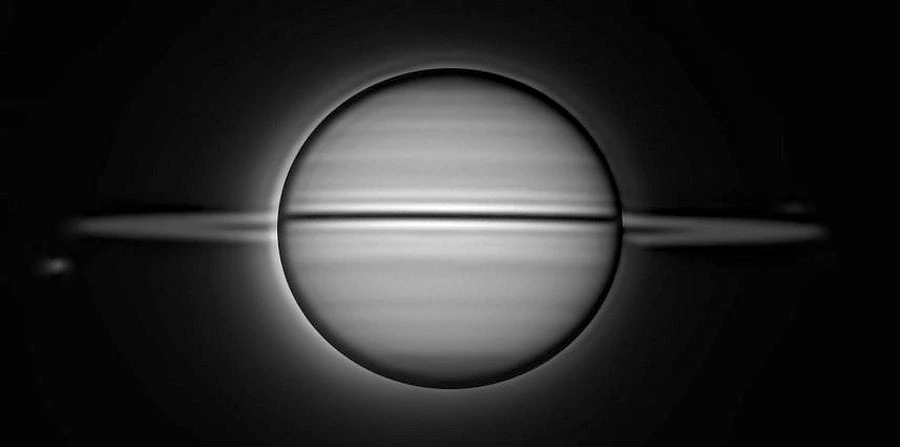
The ring plane and its shadow stripe Saturn's Equatorial Zone in this infrared image made on May 11th. The rings are tipped 2.5° with their south face visible. Dione is seen below the ring at left. North is up.
Christopher Go
Titan transits occur only during the relatively brief time Earth and Saturn both lie nearly on the same plane, which coincides with when the rings appear approximately edge-on. Currently, we see the rings' south side, with the ring plane tilted between 2.7° (May 14th) and 3.2° (May 31st). The rings have been difficult to tease out since the planet's return to the morning sky. Not only have they been backlit by the Sun until recently, but Saturn also continues to lay low in the eastern sky at dawn, especially from mid-northern latitudes. Poor seeing coupled with bright twilight have made it difficult to discern much more than a pale-yellow ball. I finally succeeded on May 14th, when the rings flickered in and out of sight in my 10-inch Dob at 168×. They were nothing short of wispy — on the verge of invisibility.
Shadow transits are common at Jupiter, and they occur when one (or more) of the four Galilean satellites casts its shadow on the gas giant's cloud tops. The size of the dark spot is closely related to the size of the moon. Ganymede is the largest, with an apparent diameter of about 1.7″, and Europa the smallest at about 1.0″. Through the telescope, Ganymede's shadow is a definitive black dot, while Europa looks more like a pinpoint.

Sid Leach, Adam Block, and Francisco Arabia
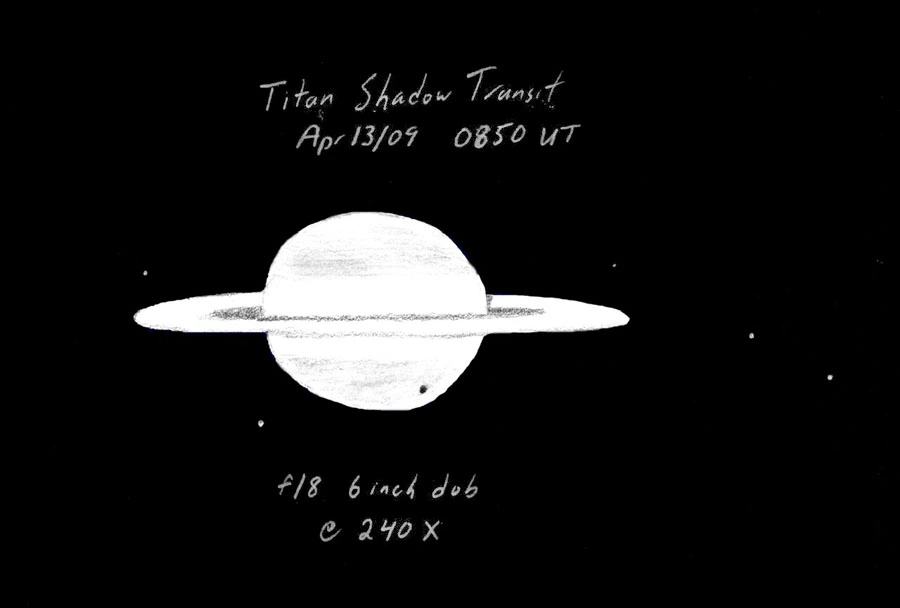
Saturn's moons likewise cast shadows, with Titan's the easiest to see because it's the largest, with an apparent diameter of 0.8″at opposition on September 21st. This means you'll want to use at least a 3-inch telescope and magnification of 200× or more to discern the inky speck. At times, both moon and shadow will occupy the disk simultaneously. Titan itself appears somewhat smaller than its shadow and paler in tone. Even after the shadow portion of the transit series ends on October 6th, you can continue to observe the moon pass in front of Saturn every 16 days, through January 25, 2026.
ESA, NASA, JPL, and University of Arizona
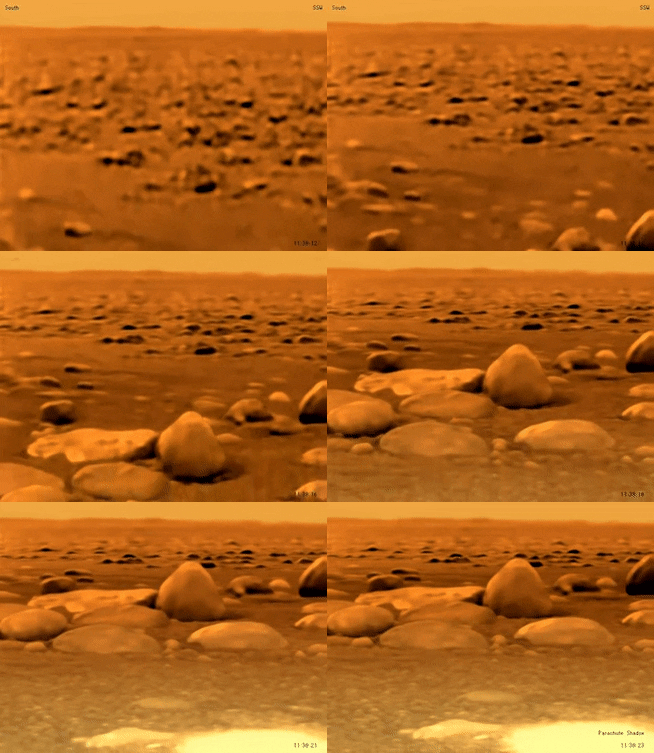
Titan's one of the most fascinating places in the solar system. With a diameter of 5,150 km (3,200 miles), it's larger than Mercury. Nitrogen and methane dominate its atmosphere, which is 1.4 times denser than Earth's. It's also teeming with lakes and rivers filled with ethane and methane, which are liquid at Titan's frigid surface temperature of –179°C (–290°F). If you were sufficiently protected against the cold and jumped into a Titanian lake, you'd be in for a big surprise. Liquid methane is only about half as dense as water, so you'd sink . . . and fast!
Upcoming titan shadow transits (UT)
| Date | Start | Mid-transit | End |
| May 15 | 9:49 | 12:59 | 15:44 |
| May 31 | 9:05 | 12:12 | 14:53 |
| June 16 | 8:21 | 11:24 | 14:00 |
| July 2 | 7:40 | 10:35 | 13:03 |
| July 18 | 7:00 | 9:44 | 12:05 |
| Aug. 3 | 6:25 | 8:52 | 11:04 |
| Aug. 19 | 5:52 | 8:01 | 10:00 |
| Sept. 4 | 5:25 | 7:09 | 8:50 |
| Sept. 20 | 5:09 | 6:20 | 7:34 |
| Oct. 6 | 5:32* |
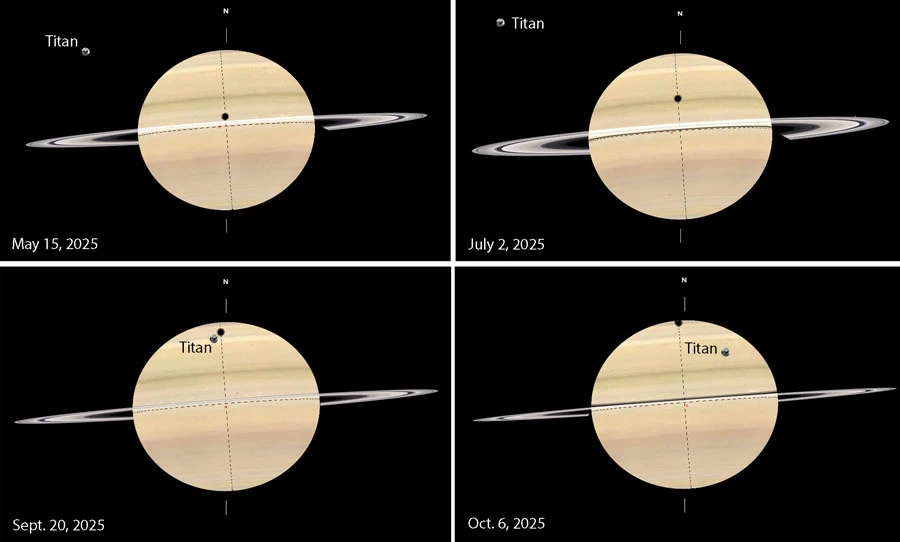
When the current transit series began last November, timing favored Eastern Hemisphere observers. Now through early October, skywatchers in the Americas will get a crack at the shadow. Most of the transits occur after midnight, especially for the eastern half of the U.S. The table above lists the Universal Times (UT) of the start, midpoint, and end of each event. To convert to local times, use this UTC time zone converter. Notice that the transits occur every 16 days, which is Titan's orbital period.
Diagrams created with WinJUPOS
Bill Weir
Titan and its shadow gradually migrate northward across Saturn's oblate disk this spring and summer. The May 15th transit occurs across the planet's Equatorial Zone (EZ) and lasts nearly 6 hours. But on October 6th, when Titan's shadow nibbles the northern limb, the event lasts only about 2 hours.
Rhea's also fair game
Rhea, the planet's second largest satellite, casts a shadow just 0.3″ in diameter. Telescopes in the 8- to 10-inch range should be able to tackle it in excellent seeing. Also, because Rhea orbits much closer to Saturn, transits are more frequent. To find out when they'll happen, use a stargazing app like Stellarium or SkySafari and run through a simulation. I pick the date I plan to observe and then open the clock/calendar and step through time, noting when Rhea's shadow enters and exits Saturn's disk from my location.
There's really just one rule for seeing a Titan shadow transit. Jump at the first opportunity. That's my plan. If I miss it this time around, the next series won't happen for another 15 years!
About Bob King
I love the sky (day and night) and have been a skywatcher and amateur astronomer since childhood. I'm also a long-time member of the American Association of Variable Star Observers (AAVSO) and Astronomical League. I pen the Astro Bob blog and have written four books: Night Sky with the Naked Eye (2016); Wonders of the Night Sky You Must See Before You Die (2018) and Urban Legends from Space (2019) and Magnificent Aurora, published in 2024. The universe invites us on an adventure every single night. To accept the invitation, we only need look up.



Comments
Andrew-Casely
May 20, 2025 at 6:58 am
Nice article Bob... but for Titan transits, it gets even nuttier. Each entire transit series is only visible from one side of Earth.
Yup.
So all of the 2025 series are visible with Saturn at approximately the same place in the sky, the transits getting earlier in the night/day as the season progresses. If you get one of the 2025 transits, you get the lot! The 2025 series is favourable for the Americas (north and south), as is the series in 2038-39, while the 2009 series was good for Australia. The 2054 series may be decent for the Middle East or India. So if you can see them, you are luckier than you know!
[I don't think there's another favourable transit set from here in Australia in my lifetime... so I will need to enjoy other cool planetary action!]
You must be logged in to post a comment.
Bob KingPost Author
May 21, 2025 at 1:25 am
Hi Andrew,
Thank you! And thank you for the future outlook. When it comes to Titan transits it seems we have to align our lives just so to see them!
You must be logged in to post a comment.
terrymoseley
June 27, 2025 at 10:48 pm
Hi Andrew,
I know exactly what you mean, but as each transit can last up to 5 hours or more, given the rotation of the Earth they can be seen at least in part by a bit more than just one side of the Earth.
A bit like Venus transits - I've seen both the latest ones, but not the whole of either of them (weather also played a part!).
I have also seen several Mercury transits, at least 2 in total, as they don't last so long.
And of course many many transits and shadow transits of the Galilean Moons of Jupiter.
But I've never seen one of Titan: living in Ireland, my best hope is for the later ones in this series.
You must be logged in to post a comment.
MarkInSocorro
July 2, 2025 at 7:24 pm
I was able to view the Titan transit this morning, 7/2/2025, from Socorro, NM, USA. I used a Celestron Evolution 6 at 230x. I also made an image with a ZWO ASI585MC and submitted it to the gallery.
You must be logged in to post a comment.
John Asztalos
July 9, 2025 at 9:47 am
Bob, Thanks for posting this. I managed to see Titan (not the shadow) transit a year ago, and 8 days later also saw Titan reappear from occultation (12-1/2" dob on platform). The seeing was very good both times. Here in Colorado the early morning seems to be the best for seeing and transparency, and lack of clouds, during the summer. This year I've already seen two shadow transits, and there are also Titan eclipses to look for. It's amazing that the Americas are blessed with all these events, but it's due to the almost exactly 16 day orbit. I remember 15 years ago, just missing these, as Saturn was getting low in the west all the time, and weather and trees were a problem. Having had success now, I'm going to try for Rhea shadow transits!
You must be logged in to post a comment.
Bob KingPost Author
July 9, 2025 at 11:06 am
Hi John,
Thank you! I'm happy you were able to see two Titan shadow transits thus far this season AND the other events you described. Rhea will be a challenge but given that it's closer to Saturn, events will be more frequent. Good luck and let us know if you succeed. I finally saw my first Titan shadow transit on July 2nd. Seeing was poor at first, but as sunrise approached, the air steadied, and the view was phenomenal at 400x in my 10-inch f/4.7 Dob. With Titan close by, the scene looked totally 3-D.
You must be logged in to post a comment.
Scott E
August 3, 2025 at 11:47 am
Hi Bob, I finally got to see this. Thanks for the article. Saw many Jupiter shadow/transits. Never gave Saturn a thought. Didn't realize they were so rare. It was a treat to catch one. And it was my 60th birthday as well!
Telescope used is a Meade 12" SCT LX90 ACF. 20mm eyepiece was best, yielding 152x. Rarely do I use my 7.4mm for
You must be logged in to post a comment.
Scott E
August 3, 2025 at 11:50 am
Hi Bob, I finally got to see this. Thanks for the article. Saw many Jupiter shadow/transits. Never gave Saturn a thought. Didn't realize they were so rare. It was a treat to catch one. And it was my 60th birthday as well!
Telescope used is a Meade 12" SCT LX90 ACF. 20mm eyepiece was best, yielding 152x. Rarely do I use my 7.4mm for 411x. Nice size, but just too blurry! Here in W Ohio the atmosphere is always moving. But the moments of still air came often as the night was good. Was 50F when I was done. Great to catch this rare chance!
You must be logged in to post a comment.
Scott E
August 3, 2025 at 11:52 am
Sorry, hit send by mistake before I was done. 🙂
You must be logged in to post a comment.
Ludovicus
August 3, 2025 at 10:43 pm
Thanks for the great article Bob!
We have had smoky hazes and cloudy evenings plaguing the Canadian Prairies this spring and early summer, and last night, despite T-storm warnings, we actually had clearings that permitted me to use my ST120 (Skywatcher 120mm f/5) even as low as 133X to watch this event. I opted when seeing got better before mid-transit on Aug 3 morning (around 2:30 MDT local) and then things went glorious! 170X was best balance of best seeing and transparency in the 4.7"... I'd normally have used one of my smaller APOs or my 6" but with the unknowns surrounding sky conditions, I opted for quick setup/take down just in case!
For those curious on my setup given short refractor vs CA:
ST120 f/5, with APM 2" PRISM diagonal, BK7, on 2"-1.25" adapter, Baader Semi-Apo (SA) filter, then various EPs. Best view at 170x was using my TS Optics UWAN 7mm with Baader Zoom 2.25x (1.95x when direct on EP barrel) Barlow. AMAZING view - best I've had in this scope. 🙂
BTW 133x in the 120mm was also pretty capable with decent seeing. My average was 7-8/10 Pickering, at worst, 5, during 133x initial detection, then settled. Awesome...
Will try my 6" on this on August 19th!
May all have success!
DH
You must be logged in to post a comment.
You must be logged in to post a comment.